
Surprise meEntangled Vale
Meaning after the end of time
What good is a clock when everyone is on their own schedule?
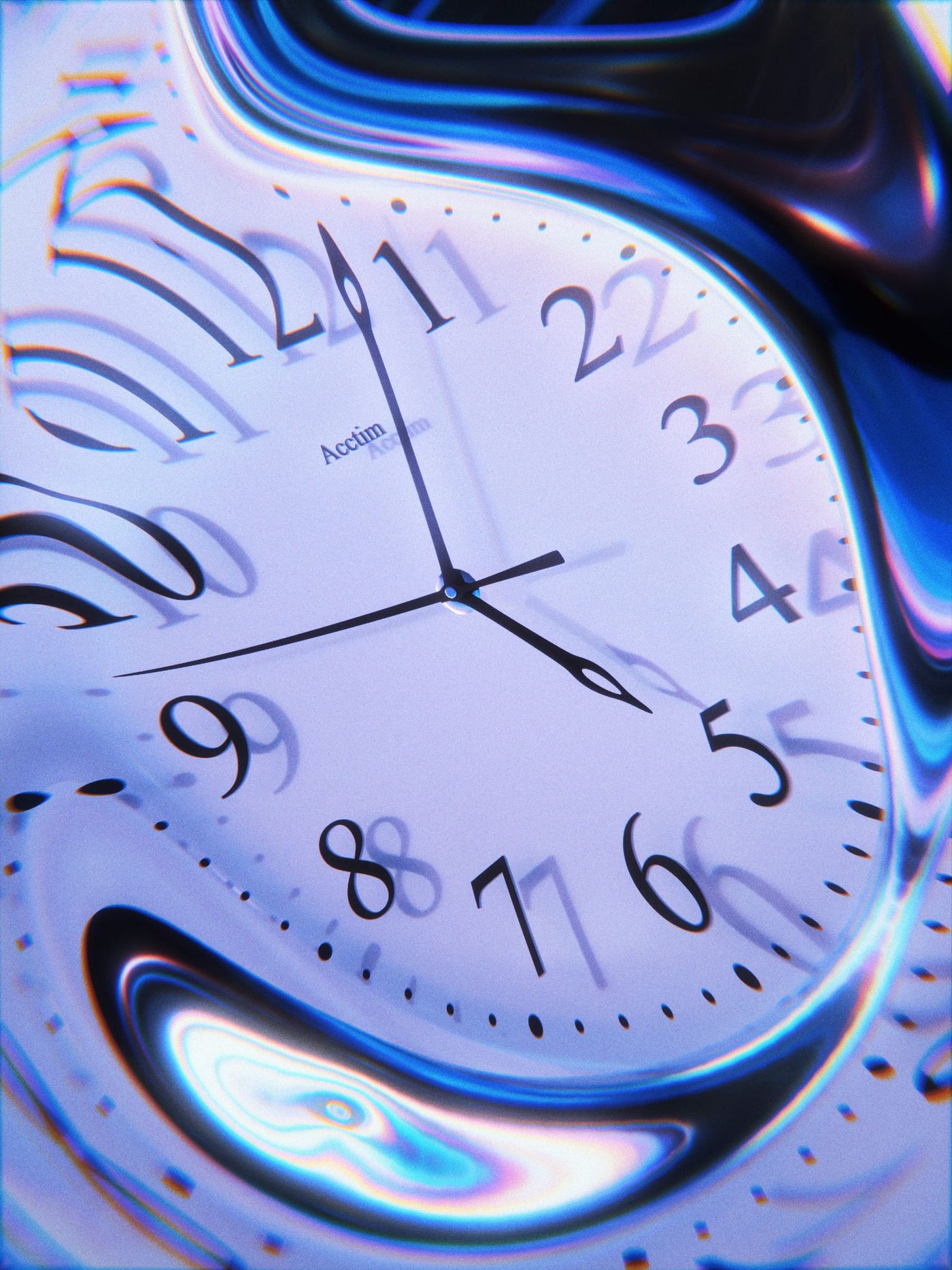
The COVID-19 pandemic broke time.
A week feels like it lasts a million years, a year feels like it fits in a day. It’s absurd that the quarantine started almost seven years ago now, that I was in my 20’s and somehow now am in my 30’s. That I ran an Airbnb out of my house in Philadelphia for five of those years. That somewhere between then and now, I brute-forced my way through the tail end of a PhD, mostly over Zoom calls. That I met people who are in my life for good, and lost people I thought would be around much longer. That OpenAI released its first version of ChatGPT in late 2022. My memories of it all are like a fever dream. Time stretches and folds into itself like taffy.
During quarantine, people who once moved through largely shared schedules adapted to a plurality of individual rhythms organized around remote work, algorithmic feeds, travel, personal routines, and whatever else happens to structure a particular life.
A parent with a remote office job might technically start work at 8 a.m. while still in bed, split conventional working hours between tasks and supervising their child’s online school, then continue with paid work into the night after the child went to sleep, because the commute had stopped marking either edge of the workday. An essential worker might grind through rigid shifts while their spouse or roommate kept to an 8-to-5 Zoom schedule, or slept until afternoon and then worked freelance through the night. A birthday party might be a Zoom window opened from someone’s bedroom.
People might measure periods by pandemic events like “before lockdown,” “during the sourdough period,” “after the first time I got COVID.” This divergence between people’s daily rhythms is a kind of desynchronization.
As whimsical or outlandish as it may sound on its face, I’ve noticed that when I talk with other people about the pandemic and mention my conviction that it broke time, they often intuitively agree before I can explain what I mean. (The exceptions are people whose circumstances let them keep roughly the same schedule the whole way through.) But my claim is supported by more than a feeling, however commonly shared it may be. The pandemic fractured the rhythms that helped us read the world we shared, leaving us in a peculiar (and quite magical) position.
Reading the world
Standardized clock time is a relatively recent historical invention. In the eighteenth and nineteenth centuries, clock time became increasingly bound up with labor discipline and productivity through industrialization. (Historian E. P. Thompson famously traced the shift from task-oriented work to work measured by the clock.) So, by the twentieth century—despite being the product of a historically and politically specific way of organizing human life—standardized time felt objective, and the systems that organized it were working well enough to largely disappear from view.
Standardized time is semiotic. (It operates in the realm of signs, symbols, and meaning. In semiotics, a sign is anything that communicates a meaning beyond the sign itself.) A clock reading does not inherently tell anyone what should be happening. Its social meaning depends on institutions, schedules, conventions, and other people interpreting it in compatible ways.
“Eight o'clock” functions partly as a sign within a collectively maintained system. So pandemic desynchronization was at least partly a semiotic rupture, because it weakened the shared social world that used to give time more compatible meaning across millions of lives.
The way a culture organizes signs also helps determine what can be known within it. A shared semiotic structure, like knowing the time, also helps us make inferences about things we cannot directly see. On a weekday morning in autumn before the pandemic, we might assume that a colleague is at work or that a neighbor’s children are at school. A clock reading supports those expectations because we understand how it connects to a larger pattern of activity. When that pattern stops being dependable, the clock is still technically legible, but the world it once helped us interpret is harder to read.
This raises a broader question about what allows a recognizable sign to count as evidence of something beyond itself. The answer depends on our assumptions about how the world is ordered. Consider a worldview in which nature is understood as a divine creation that contains visible clues to its own hidden properties. Within that framework, a resemblance between two things could suggest that they were connected in ways that someone might discover by interpreting the likeness.
Lungwort, for example, has pale-spotted leaves that somewhat resemble diseased lungs, so medieval healers read the plant as a remedy for lung ailments. The plant’s appearance was understood to reveal something about its otherwise concealed powers. A world everyone believed to contain such clues could be investigated by learning how to read them. (Even within this paradigm, a healer could give someone lungwort and find that their condition did not improve, and that experience might challenge the relationship the healer had inferred from the plant’s appearance. The wider practice would still shape what they noticed and what they recognized as evidence.)
In The Order of Things, French philosopher and historian Michel Foucault describes such a paradigm when he discusses differences between earlier forms of knowledge and those developing through and beyond the seventeenth century. According to Foucault, Western cultural knowledge and meaning before the Renaissance were largely constructed through resemblance. Because resemblance linked all signs to what they signified, all of nature could be interpreted as a single, unified mesh of interlaced meaning. (This relationship was ternary: resemblance supplied a third element linking the visible sign to what it was taken to signify.)
Because resemblance linked all signs to what they signified, all of nature could be interpreted as a single, unified mesh of interlaced meaning.
When the system of signs is closed like this, Foucault argues, knowledge equates to interpretation:
The world is covered with signs that must be deciphered, and those signs, which reveal resemblances and affinities, are themselves no more than forms of similitude. To know must therefore be to interpret: to find a way from the visible mark to that which is being said by it and which, without that mark, would lie like unspoken speech, dormant within things. (Foucault 1994, 36)
Divination, the ability to read all of nature as a single text, was therefore part of how someone got from encountering things to knowing something about them. It carried intellectual authority for the same reason a scholar's reading of an ancient text did. Both rested on the same understanding that signs could disclose connections already woven into the fabric of the world through resemblance, waiting to be recognized.
The authority to interpret
If divination carried authority because of how signs were understood to connect to the world, then changing that connection would change what counts as knowledge (and in my view, would also change the reality built around that knowledge). This is where Foucault’s historical account connects back to my opening claim that time broke. Clock time is one familiar example of how deeply those relationships can structure everyday life.
Before returning to what happened during the pandemic, though, let’s unpack how an established relationship between signs and the world could be transformed. Foucault locates such a transformation in how meaning gets organized. Understanding his account requires a closer look at the place writing held within the world that divination helped people to read.
Writing became privileged in the West over the course of the Renaissance, and Foucault offers a possible reason for this when he suggests that written marks were understood as being closer than the spoken word to the way meaning worked, closer to the signatures nature had inscribed onto things. He also marks a gendered split between written and spoken esoterism in the sixteenth century, writing that the spoken word is “stripped of all its powers” as “merely the female part of language [...] Writing, on the other hand, is the active intellect, the ‘male principle’ of language. It alone harbours the truth.” (Foucault 1994, 42)
The ternary system of the sixteenth century gave way to a binary system in the seventeenth. The ternary system had worked through the written word in complicated, unstable ways. The later binary framework (initially) stabilized written representation, and writing lost its kinship with the signs inscribed in nature.
A binary understanding of meaning also begged the question: what links a sign to what it signifies? If the resemblance between lungwort leaves and diseased lungs lost its authority to establish a healing power, where did that authority go?
In the 20th century, when Foucault was writing, the answer was analysis of meaning and signification. A sign was understood to represent something not through resemblance but through a relationship that could be understood and analyzed, with the goal of deciphering the objective truth. Analysis—and the institutions that gave it authority—helped to organize reality, and the coherence of our shared world became bound up with the stability of those systems. This framework would prove unsustainable over time as institutions like the Church were gradually eroded.
Analysis—and the institutions that gave it authority—helped to organize reality, and the coherence of our shared world became bound up with the stability of those systems.
Meanwhile, standardized time (masculine-coded through associations with industrial labor, history, progress, reason, productivity, control, and the public economic sphere) increasingly demanded primacy over space (feminine-coded through associations with the body and domesticity). Time obscured and minimized the importance of space in the same way that the written word obscured and minimized the importance of the spoken word. Neither feminine-coded counterpart stopped existing, though. They kept simmering under the surface of Western culture, passed down through maternal lines and local ways of being and knowing, surviving in spite of erasure.
Rebuilding continuity
Modern systems have become increasingly unable to hold reality together. As they weaken and desynchronize, interpretation becomes more constitutive; it becomes one of the processes that makes things coherent. Making sense of the world requires more conscious attention to the circumstances in which signs appear, because that context is needed for interpretation.
This growing need to work out relationships between signs and the world is part of why divination is intelligible again. The subject is increasingly required to participate consciously in holding things together. (And if Foucault is right, is it such a stretch to treat divination, in a more experiential sense, as a practice of reading patterns and correspondences as valid signs of possible futures?)
Manifestation likewise involves interpretation, as an anticipated future gives present circumstances a particular significance. How I interpret what is happening shapes what I do about it, and what I do shapes what happens next.
The old singular text of nature is gone. There is no longer one stable symbolic order that everyone agrees how to read. The modern replacement, a world stabilized through supposedly neutral categories, standardized institutions, shared schedules, authoritative media, and binary systems of signification, is coming apart too. So, the post-pandemic epoch has thrown us into a bizarre third condition where meaning is interpretive again, but without being unified.
Fredric Jameson connects the breakdown of signification to the breakdown of temporal subjectivity, of how we live in time. Drawing on psychoanalyst Jacques Lacan, he argues that having a sense of self depends partly on being able to pull past and future together with the present. When the signifying chain breaks down, that temporal synthesis breaks down with it, leaving a succession of disconnected presents and ultimately a dissolution of the self. The self, and the time it uses to maintain continuity, come apart together.
Desynchronization marks a shift from general postmodern fragmentation into a distinctly post-pandemic condition. Postmodernity fragmented meaning while huge portions of collective life—workplaces, schools, churches, media—were still synchronized, but the pandemic tipped the entire board. Meanwhile, algorithmic feed content increasingly individualized both informational reality and temporal reality. Postmodernism fractured the common world of meaning, but the pandemic fractured the common temporal world through which subjects inhabited that fragmentation. This fits comfortably in framing language of collective ego death, or even a collective version of what New Age might call a dark night of the soul.
Postmodernism fractured the common world of meaning, but the pandemic fractured the common temporal world through which subjects inhabited that fragmentation.
So what replaces the broken self? What happens after ego death?
You reconstruct a relationship between self and world. Through this process, you reconstruct yourself and you reconstruct the world.
Divination and manifestation are two sides of that renewed relationship between sign, subject, and world. Divination is an interpretive practice, manifestation is a generative practice. Divination is concerned with receiving signs from reality, manifestation with putting signs into reality. The relationship is reciprocal.
This is also why it's too simple to say you solipsistically create your own reality. Locating the power of manifestation completely within any one person would mean ignoring a world that can answer, resist, hurt, surprise, and change us. But once the frameworks that seemed to tell the subject what reality was become visibly contingent, the subject becomes more conscious of their own participation in constituting reality, and is enabled to live, interpret, act upon, anticipate, and therefore partly bring about that reality, because of the reciprocal relationship between world and interpreter.
Divination and manifestation can also help people create relations across time again. Divination allows a sign in the present to become meaningful through its relationship to what has already happened and what may happen, while manifestation allows an anticipated future to begin shaping perception and action in the present. In a condition where shared temporal scaffolding has weakened, both practices can function as ways of rebuilding continuity across time, and ultimately of supporting the reconstitution of the self.
Seen through Foucault’s timeline, this renewed consciousness of magic can look like a return to the older relationship between interpretation and knowledge, but magic never actually disappeared when Western systems stopped recognizing it as knowledge. It was just suppressed, and this suppression depended on containment within an epistemic order in which interpretation could be treated as secondary to knowledge and the subject could imagine itself as standing outside the world it represented. Especially with that arrangement destabilized, of course reality will be affected by a consciousness situated inside of it.
A note on money
Money makes the relationship between meaning and reality particularly difficult to ignore. A number on a screen can determine whether a person gets to stay in their home. That number has power because it belongs to an arrangement through which people recognize claims and act on them. The Bank of England describes modern money as a special kind of IOU, useful only because people trust that others will accept it. Its meaning depends on relationships that reach far beyond the person spending it, that give the sign its material force.
Credit makes those relationships even more interesting. Commercial banks create deposit money when they make loans, within the rules governing their lending. If a bank finances a proposed business, the anticipated future of that business helps to justify a loan, and the loan allows someone to obtain equipment and pay people to start working. A representation of something that has yet to happen acquires the support through which it might happen. The future starts organizing the present before that future exists.
In the sense of manifestation I'm developing here, this is a familiar move. An anticipated possibility becomes consequential through the relationships organized around it. The business could still fail, because its success depends partly on circumstances that everyone involved will have to actually encounter as they unfold. Either way, a possibility has already changed what people can do, despite the uncertainty of the outcome.
Money also shows that the breakdown of a shared reality can be partial. People can still agree on a price and know what their money buys while losing any dependable sense of how earning it is supposed to produce a livable future. The transaction stays legible even as the bigger promise (work hard, save responsibly, and stability can be earned) stops making sense.
Desynchronization describes this widening gap in what money means for people's futures, too. For someone who can save, each month’s work connects to a future they can reasonably plan toward. For someone whose earnings disappear into immediate expenses, or who cannot find consistent income, the same passage of time may offer no sense of the future.
For someone whose earnings disappear into immediate expenses, or who cannot find consistent income, the same passage of time may offer no sense of the future.
So money has broken too, at least partially. For plenty of people, it’s like a foot severed at the ankle, but still holding on by sinew. The sinew is our practical dependence on each other’s continued participation. You still pay rent, and your landlord still expects it. Losing confidence in that arrangement does little, by itself, to release you from its demands.
The injury also looks different depending on where you stand. Financial security gives some Americans the freedom to build a future while millions of others struggle to afford daily life. United For ALICE estimates that 41% of U.S. households had incomes below the local cost of basic necessities in 2024. In the Federal Reserve’s 2025 survey, 59% of nonretirees with family incomes of at least $100,000 believed their retirement savings were on track, compared with only 7% of those below $25,000.
The division is especially stark in homeownership across generations. Baby boomers were still the largest homebuying generation in the National Association of Realtors’ 2026 report, while its 2025 profile put the median first-time buyer at a record forty years old. The same economy can therefore sustain confidence in a secure future for people already established within it, while that future slides further out of reach for everyone still seeking a foothold. National averages can collapse this division: the comfort of one group reads as general stability and papers over what another group experiences as intolerable.
Economics, particularly in its public and institutional role, does a lot of the work of justifying and stabilizing this shared system of meaning. In some ways, the stabilization seems suspiciously artificial, in the sense that an arrangement presented as self-evident often requires substantial intervention to remain credible, and economic knowledge participates in that maintenance. Sociologist Donald MacKenzie’s research on financial markets, for example, examines how economic theories helped shape the very markets they claimed to describe.
During the pandemic, that work became unusually visible. On March 23, 2020, the Federal Reserve announced extensive interventions intended to keep credit flowing, including support to help companies continue operating and paying employees. Those interventions were efforts to keep monetary promises good while the activities ordinarily supporting them were disrupted, with the intention of preserving a shared future.
How power flows
In The Subject and Power, Foucault describes power through the ways actions shape other people’s possibilities for action. He also makes clear that power can operate without consensus. People can stay subject to an arrangement they actively fight. Seeing financial authority as constructed does nothing, on its own, to give someone a practical way out of it.
The signature of the person authorized to approve a business loan can have an enormous reach because a much broader web of people and institutions is organized to respond to it. This is an example of how power can be channeled.
Certain positions give people more dependable access to relationships through which their intentions can become consequential. Someone else might have an equally compelling intention and struggle to find any support. That difference is how the power to shape reality can belong to everyone while its practical reach stays wildly unequal.
When a wave crashes into you, you are moved. You feel its power through the impact. A channel can concentrate a flow and direct it somewhere particular. Social arrangements channel the effects people have on each other the same way, and a person's position can concentrate an extraordinary amount of activity around their decisions.
Social arrangements channel the effects people have on each other the same way, and a person's position can concentrate an extraordinary amount of activity around their decisions.
Money fits this metaphor too. People talk about cash flow and liquidity. I also hear connections with the ways people talk about energy and life force, or love, or music. Each has its own character, but they share a capacity to move through relationships and influence the course of things.
Power in this sense comes with no moral association, by the way. A flow can sustain life or cause devastation, or both. A person’s ability to influence reality tells us something about their reach, not about whether the effect was right or wrong.
Reading from the margins
The uneven distribution of power also creates uneven opportunities to see how it works. Someone whose life fits comfortably within an established arrangement has few reasons to notice its contingency, the fact that it could have been organized otherwise. The system’s account of reality keeps finding confirmation in their experience. Its limits can stay far enough away to seem incidental.
A person on the margins may encounter those limits repeatedly. Some people dutifully work toward what they have been told will make their lives viable, only to find that the anticipated security keeps moving farther away. That mismatch can easily make the organizing story behind it look suspect.
Paradoxically, marginalization can expose a system’s contingency more clearly while limiting someone’s practical capacity to change it. You might recognize the channel and still struggle to redirect the flow.
There is no automatic enlightenment in being excluded. Someone might interpret the mismatch between the official story and their actual circumstances as evidence of their own inadequacy, or of some scapegoat plotting against them, while someone else who is protected by an institution might understand its character very well and use that knowledge strategically. The same person can be protected in one set of relationships and marginalized in another. A position simply offers a vantage point.
When a system keeps failing to account for your experience, you may start noticing other possibilities that its account excludes. You may find that some of what makes your life meaningful cannot be adequately expressed through the forms of value that system recognizes. Recognizing that may change where you look for power and what you understand yourself to be capable of.
Manifestation offers a path toward empowerment, but not toward unrestricted power. Someone’s ongoing hardship cannot reasonably be treated as proof that they manifested wrong, because their intentions enter relationships whose conditions they only partly control.
Yet, for someone who has been repeatedly told that their experience makes no sense or that their future is unrealistic, the opportunity to participate consciously in meaning-making can nevertheless be substantial. They might start to see a future that the dominant story has not given them permission to imagine, and seek relationships capable of supporting it. The possibility enters the world through the ways they start inhabiting it, even while parts of that world remain stubborn.
Money also brings us back to time with an almost cruel clarity. During the pandemic, many of us lost any dependable sense of what day it is, of what a day is, while staying tethered to the consensus that rent is due on the first. Your sense of a shared future can fracture while certain future obligations remain intact.
Divination and manifestation offer other ways of relating across time, and those ways can connect us without requiring everyone to arrive at the same interpretation. Another person can recognize something in what I am trying to bring into being and participate from where they stand. Our differences shape the encounter. Awareness of how much we depend on each other can deepen through exchanges like that, while keeping the distinctions that make each perspective matter.
Awareness of how much we depend on each other can deepen through exchanges like that, while keeping the distinctions that make each perspective matter.
I am a drop of water in a much larger wave. The movement exceeds anything I could direct on my own, and I am still part of what is happening. Especially in the fractured time of the post-pandemic condition, manifestation gives me a way to participate consciously, while divination gives me a way to listen for what the world is offering in return.

In good company
Replies from signed-in readers. They open in their own space, so you can sit with the piece first.
In good company
Talk about this piece