
ImagineEntangled ValeFlirting with Wisdom
Promises, Promises
When does a promise expire? And who decides what still counts, years after the moment has passed?


I was sitting on a train in Egypt, heading for Luxor.
It was Christmas, and while the Egyptian members of our team were going to their various homes, the three Australasians, after a month of roughing it, were heading to a good hotel and, we imagined, a luxurious bath.
In this, we would prove sadly mistaken.
The hotel denied all knowledge of us and, with not a room to be had in the whole of Luxor, we ended up staying in the flea-infested home of a sympathetic local working at the tourist office. It felt biblical.
By the next day, after experiencing the joys of the local plumbing, we were heading back to our zero point one-star lodgings in Sohag. But that is another story.
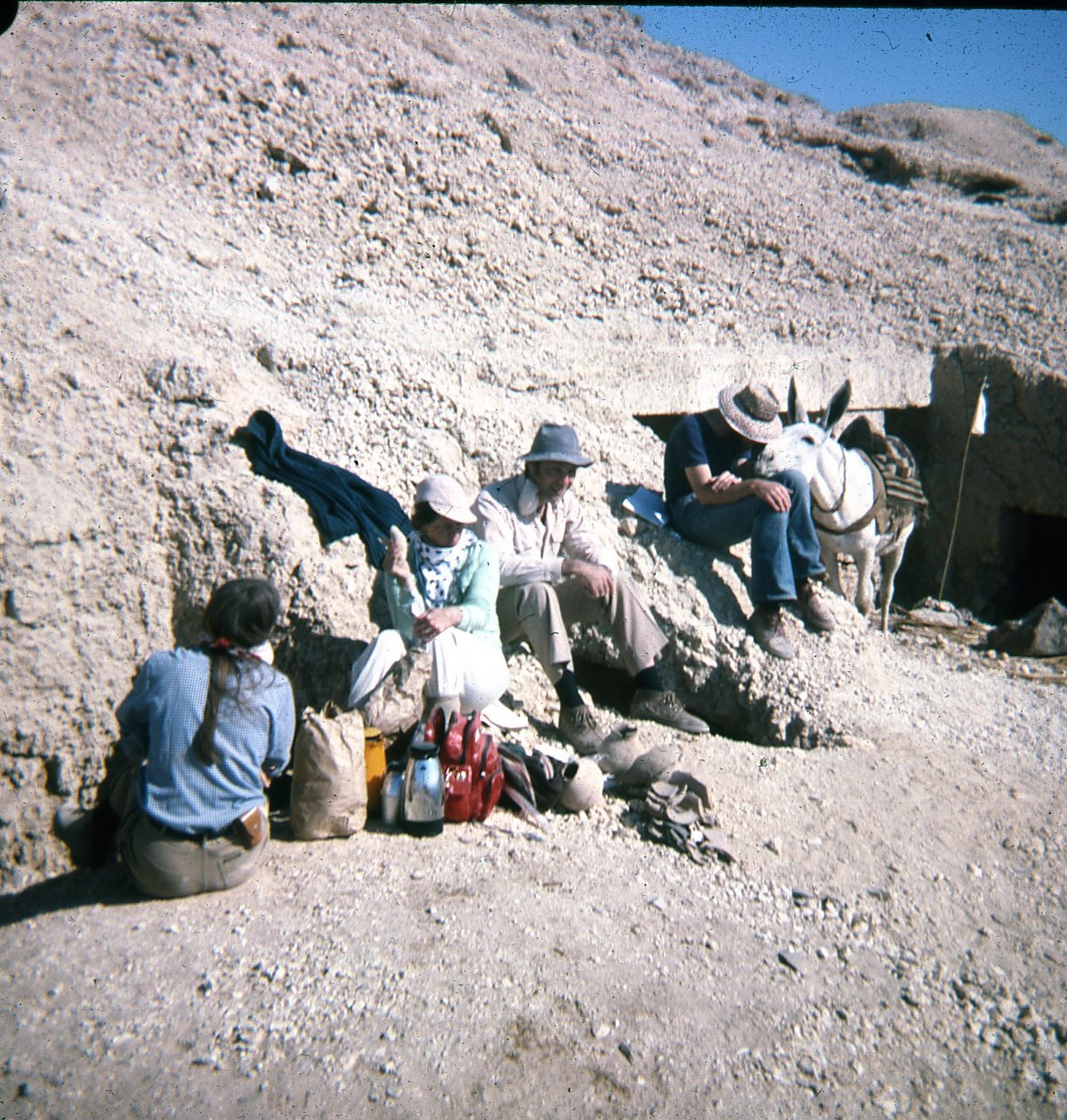
As this particular story begins, we are travelling to Luxor, sitting in the best seats on the train.
Egyptian trains at that time always kept one carriage free so that the governors of the various provinces could travel to Cairo night or day, should they be summoned there by President Sadat. In practice, these seats were almost always empty and cost a few pounds a head if you had a quiet word with the guard. This was the only way to get a decent seat.
It is indeed remarkable how quickly you adjust to bribery when it is woven into the fabric of a culture. But that is another discussion.
It is indeed remarkable how quickly you adjust to bribery when it is woven into the fabric of a culture.
As I may have mentioned, Shirley Temm, Veronica and I are sitting in some nice seats on the train to Luxor. Shirley is holding forth. She can do this without interruption because, at nearly 50, she is more than double my age, and not far off double Veronica’s.
Shirley had been primarily entrusted with the organization of the expedition, but she was a very able Egyptologist, and a force of nature. Catholic, and with more children than you could easily count, she still found time to tutor and lecture at the University.
Later, she would become a stalwart of Ancient History adult education entirely through her own energy and enthusiasm. When she died, in 2017, it was the end of an era. But I digress.
Shirley is sitting in a train carriage, heading to Luxor and telling us about the god Min.
In Ancient times, Min was the god of the area we were excavating. It was called Akhmim back then, and Min was an important deity.
However, unless you dig into some specialist literature on Egyptian gods, you are rather unlikely to encounter Min at all.
There is a reason. Min was a fertility god.
Egyptian gods were usually depicted with symbols relating to their story and to their godly attributes. In Min’s case, his godly attribute was located halfway down his figure and adds a sizeable and striking horizontal to any design in which he appears.
Min was invoked when people needed a well-endowed harvest, and well-endowed he was.
Shirley’s point, as she sat in the train headed to Luxor, was that, relative to the other Egyptian gods, Min had been relatively little studied (unsurprisingly) and that we consequently did not know much about the god of the very area we were working in.
But she didn’t phrase it quite like that. What she actually said, after some minutes of pre-amble, was “there’s nothing much you can hang your hat on about Min.”
“There’s nothing much you can hang your hat on about Min.”
Sitting on that train, rattling towards Luxor, Veronica and I looked at one another. The hatstand image that had just been painted hung large as a certain god’s attributes in the air before us.
We collapsed. So, too, did Shirley, though she roundly abused us for our dirty minds. It took about five minutes to pick ourselves up off the floor, at which point Shirley exacted a promise from us never, ever, to repeat this story to anyone.
I did not, as we continued our journey to Luxor, sniggering occasionally, ask myself how long a promise is meant to be kept.
In general, in Western culture, a promise is a promise and is kept until the person who you gave it to absolves you of it.
This is unlike Chinese business culture where, as I understand it, a promise, or agreement, is intended to be kept until such time as it carries no force. Which may not be very long. A promise, in such cases, is not absolute, but relative.
In the years since that train trip, I have mulled over this issue.
For a long time, I faithfully kept my promise to Shirley. I’m pretty sure I didn’t breathe a word. It was hard. It was such a good story. But I had promised, and keeping your promises is essential for trust.
More recently, though, it seemed to me that our culture had changed, and that there would now be less embarrassment associated with the story. Shirley’s reason for swearing us to secrecy seemed less burning, and I wondered if she would have done the same had the episode occurred in the early 2000s and not at the start of the 80s.
This niggle has meant that I have once or twice regaled the story to people who I knew would not repeat it. It’s a tricky story to retell in any case, if you are not familiar with Egyptian mythology.
Then Shirley died, and I had to decide whether a promise still carries force once the person you gave it to cannot absolve you of it.
I had to decide whether a promise still carries force once the person you gave it to cannot absolve you of it.
I’m hoping that if, by some remote chance, any of Shirley’s family come across this piece, they will be as amused as we were and will absolve me of the charge of breaking my promise. I kept it for a long time.
The ethical question that underlies this, however, remains one that bears thinking about. Is a promise just something to be kept while convenient, is it absolute, or can its context alter it?
Look out of the train window, watch fields and donkeys pass by (seemingly on repeat) and ponder that. I have.


In good company
Replies from signed-in readers. They open in their own space, so you can sit with the piece first.
In good company
Talk about this piece