
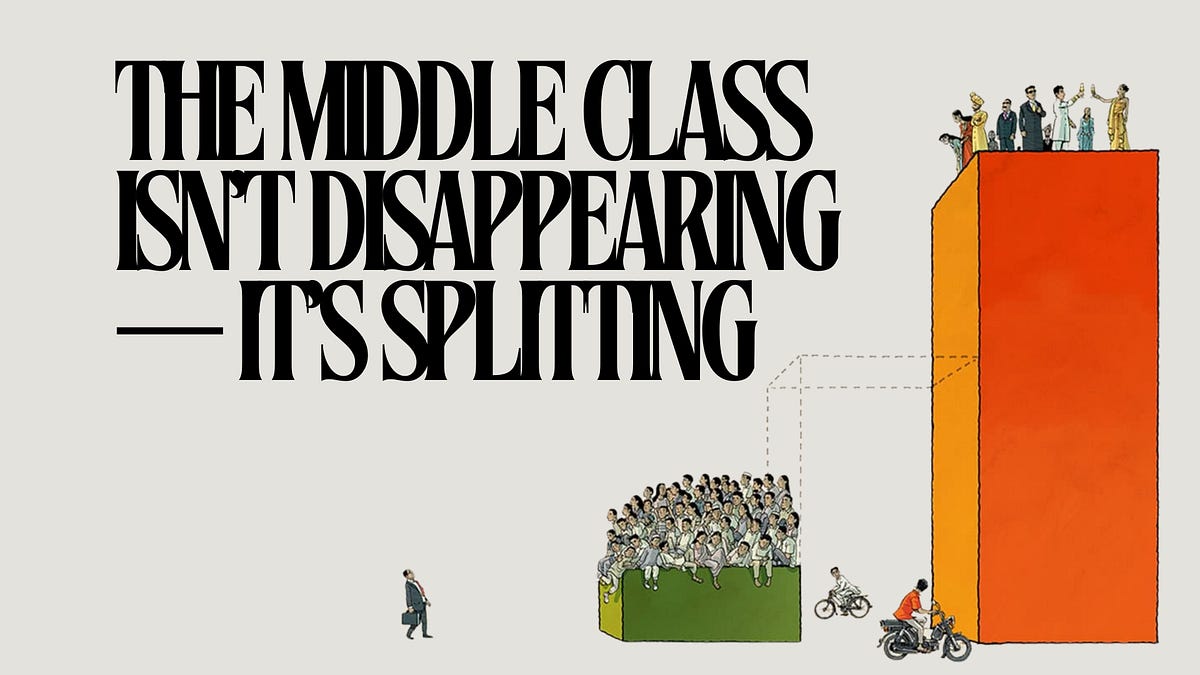
Financial planner Hanna Horvath offers a useful distinction between material precarity (when the basics are slipping away) and positional precarity (when you’re doing well on paper but still can’t reach the life you expected). The piece traces how the postwar “middle-class package” of affordable housing, education, healthcare, and retirement security was gradually unbundled, leaving many people feeling perpetually behind regardless of income.
The family earning $75K and the family earning $350K have more in common with each other – structurally, in terms of their relationship to capital – than either has with the family whose wealth generates its own income without labor. Both are running on the treadmill. One is running slower, but neither is able to get off.”
What lingers is the question of how much of our financial anxiety comes from personal circumstances, and how much comes from inheriting expectations built for a different economic reality. Pairs well with Alan Kohler's essay The Great Divide, which explores how housing shifted from shelter to investment vehicle and how that transformation reshaped class, opportunity, and intergenerational expectations in Australia.
In good company
Replies from signed-in readers. They open in their own space, so you can sit with the piece first.
In good company
Talk about this find