
ImagineMaker's ForgeFlirting with Wisdom
Stockhausen, Picasso, and Egg on your Face
Getting it wrong — and faking it — turned out to be useful. It taught me what real understanding takes, and how hard it is to ask for.

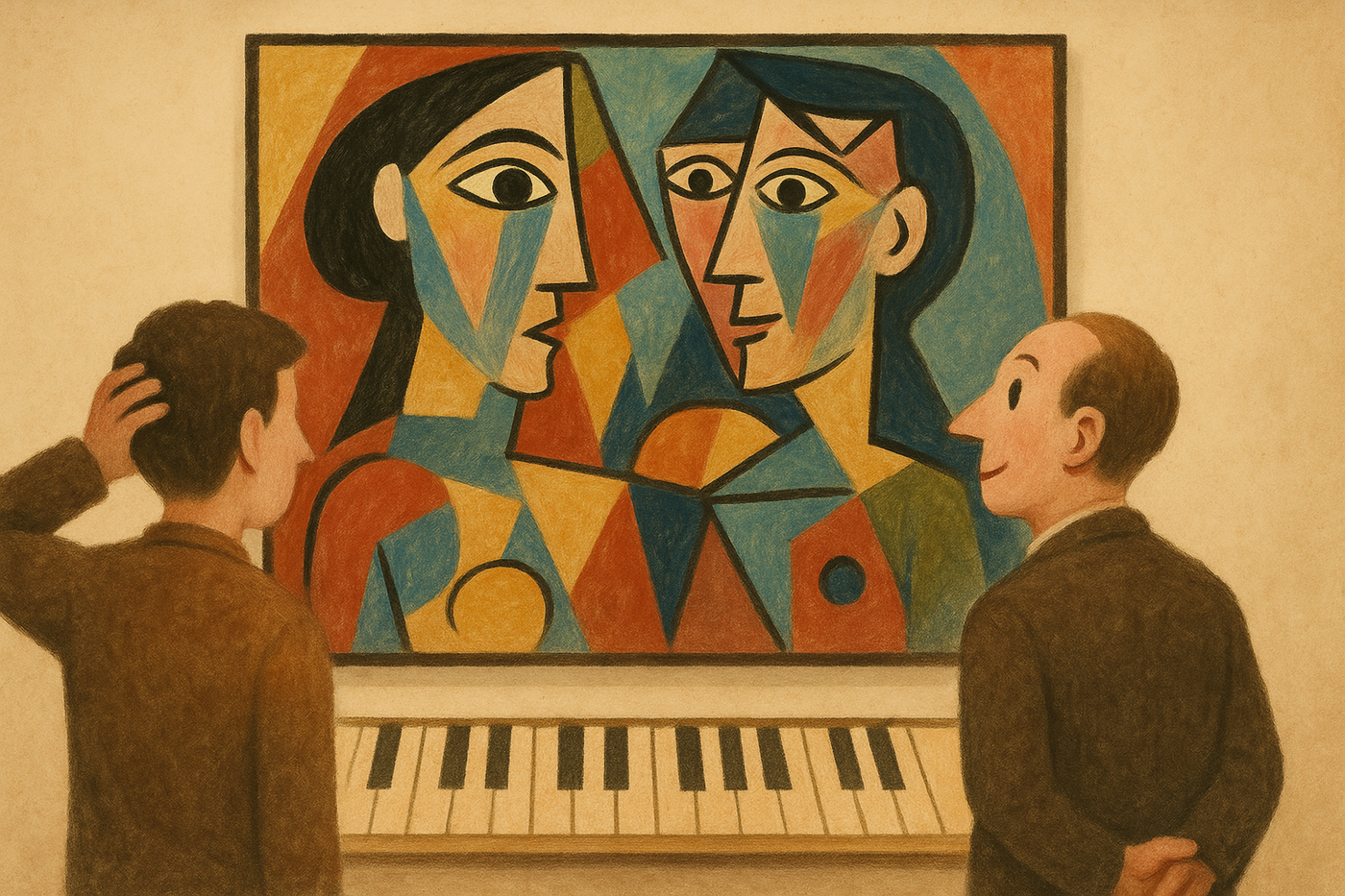
Karlheinz Stockhausen was a controversial but rather magnetic figure when I was at university – a leading avant-garde composer whose works tried to rewrite the norms of classical music.
He came to my attention when I heard some pieces he had written for musical boxes which, rather to my surprise, I enjoyed.
Emboldened by this discovery, when a university music group (I think it was a chamber orchestra) announced that it was putting on a concert of Stockhausen’s work, I decided to go. It seemed like an opportunity to impress some people I knew.
As a tenor, I had somehow snuck into the University’s elite ‘University Singers’ – a chamber choir of some twenty-five voices, most of them studying music.
But, having never formally learned any music theory at all, amongst these peers I suffered from a major inferiority complex.
The 1970s was still a time when people believed that being in the ‘avant-garde’ endowed one with huge amounts of ‘cultural capital.’ Hence, turning up to the Stockhausen concert seemed like a way of better blending in.
The concert turned out to be nothing at all like the music box pieces and soon I was faced with a stark choice. Remain, act like I was understanding the seemingly endless atonal ‘music’ and get out with my cultural capital somewhat intact. Alternatively, I could obey every instinct of self-preservation and run.
Dignity obliged me to make it to the Interval, but then I scuttled off, feeling like there was egg all over my face.
Dignity obliged me to make it to the Interval, but then I scuttled off, feeling like there was egg all over my face.
On the way home I made a very serious vow to myself never again to go to something musical for the optics.
This episode, embarrassing as it was, did have one upside.
A few years later, the Auckland Art Gallery hosted a major Picasso exhibition. It was the late 1980s, and Cubism was already art historical ancient history.
Nevertheless, the University’s ‘Continuing Education’ department predicted that there would be people who needed help understanding it, so I was asked to run an adult education course and gallery tour in association with the show.
I needed the money, so said yes, but privately thought no-one would want to attend. I was wrong.
The course was overflowing with university staff from outside the arts who genuinely wanted to understand why there was such a fuss about Picasso, because they just couldn’t see any worth in it. The perceived loss of cultural capital as a result, I think, rather grated on them.
Back then, within the arts, there was a subtle kind of arrogance that treated anyone who didn’t understand ‘Art’ (with a capital A) as being culturally poverty-stricken; a ‘philistine’ and somehow beneath contempt.
I could easily have fallen into that attitude if Stockhausen had not intruded.
Despite being an intelligent person, the musical language that Stockhausen used was, quite simply, beyond me. I lacked the background to make sense of it.
My Picasso-poor students were in the same boat, and my job as a teacher therefore became to remove the cultural-capital angst and find a way in which their intelligence could grasp what was going on.
My Picasso-poor students were in the same boat, and my job as a teacher became to remove the cultural-capital angst and find a way in.
To achieve this, I used the apocryphal tale of how the game of Rugby Union was invented.
According to the story, a student at Rugby School, one William Webb Ellis, picked up the ball while playing soccer and ran with it. By the rules of soccer, this was all wrong. But in the new game Ellis created the rules had changed.
Still, if someone looked at a game of rugby thinking that they were watching soccer, they would simply see a very muddy mess.
Visually, this was what people looking at Picasso experienced, when they looked at it though a rule-book that equated art with realism.
To appreciate rugby, you need to understand the rules. Hence, appreciating Picasso was about learning a new set of rules for looking – and then running with them.
To appreciate Picasso, you need to learn a new set of rules for looking — and then run with them.
This approach worked really well for my students, who, once they grasped the new set of rules for looking at art, could see Picasso in a rather less threatening way.
I was, of course, aware that I ought to apply the same approach to teaching myself Stockhausen. However, the scars of that concert were still a little too raw. And have remained so.
And, in some ways, I have now done an about flip and am trying to reclaim my philistinism. I still prefer music that has a melody, and these days I get as much joy from a good landscape – say by Peder Mørk Mønsted – as from a Picasso.
I probably always did, but I just wouldn’t have admitted it back then…


In good company
Replies from signed-in readers. They open in their own space, so you can sit with the piece first.
In good company
Talk about this piece