


Marcus's book Healing Fragmentation is being published section by section through Grokkist Press from September 2026, with a reader circle running alongside it. Details and sign-up here.
If there's one thing to come away with, let it be this. The complexity of reality isn't reducible to any single frame or observer. Not a creative process, not an ecosystem, not an economic system. None of them are a single game mechanism. In their essence they're multi-perspectival.
Everything else I want to say is downstream of that.
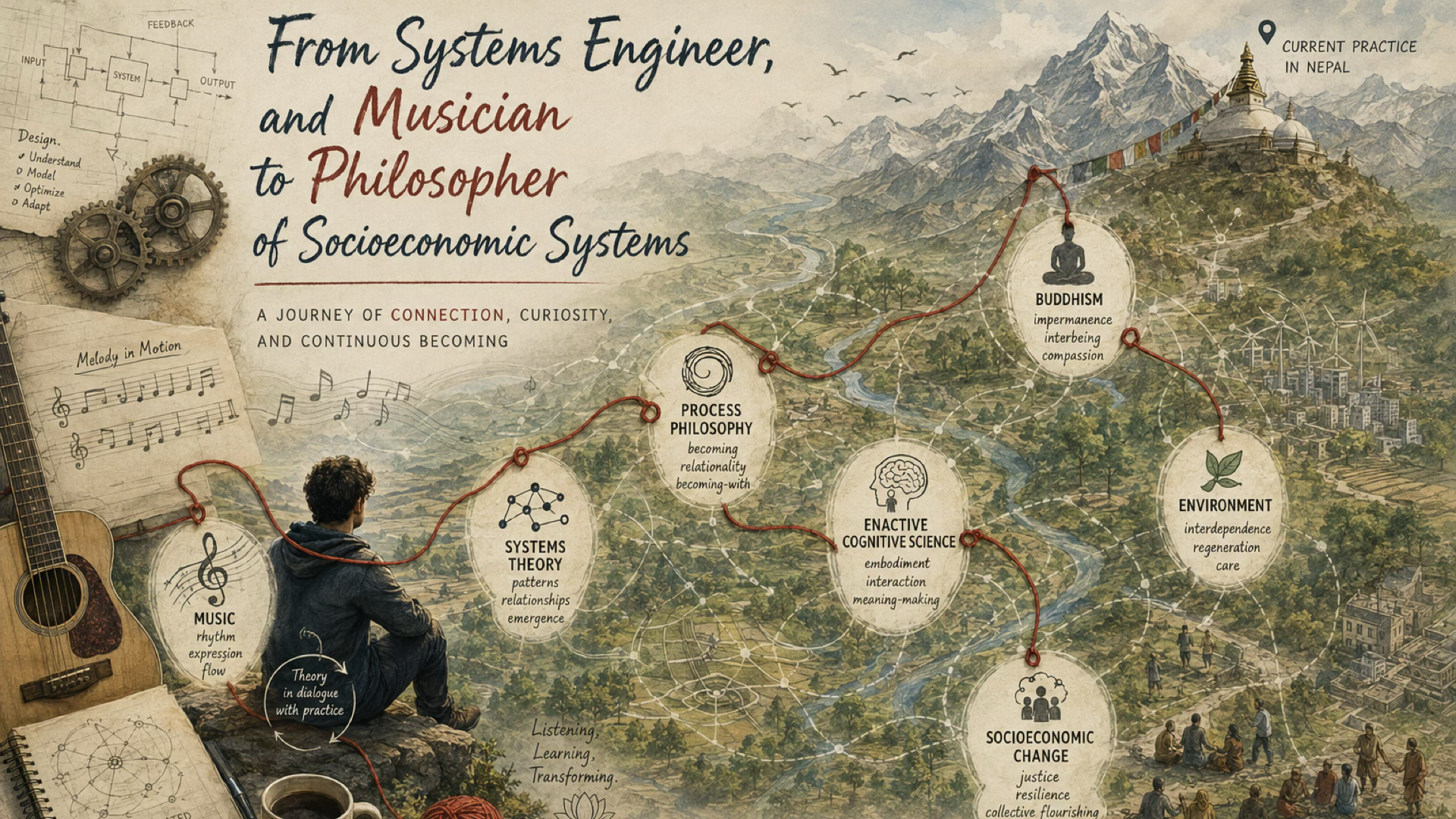
A seed was planted
It was pretty early in life that the seed was planted that our socioeconomic system was failing the planet and failing us, and that it would be genuinely destructive to all of life if we continued to let it guide our lives. Having that planted early, it soon became a North Star for the choices I made. It didn't just seem meaningful. I didn't imagine our socioeconomic system would actually still be here by the time we were due to retire. When you come to that kind of urgent realization, it doesn't seem there's a more responsible rationale than putting your trust into something else.
One statistic seemed particularly stark. Humans and our domesticated mammals account for roughly ninety-five percent of all terrestrial mammalian biomass. A lot of that is life turned into a product in a factory farm. It leaves only a small portion of mammalian life actually embedded in an ecological system, with evolutionary life cycles intact.
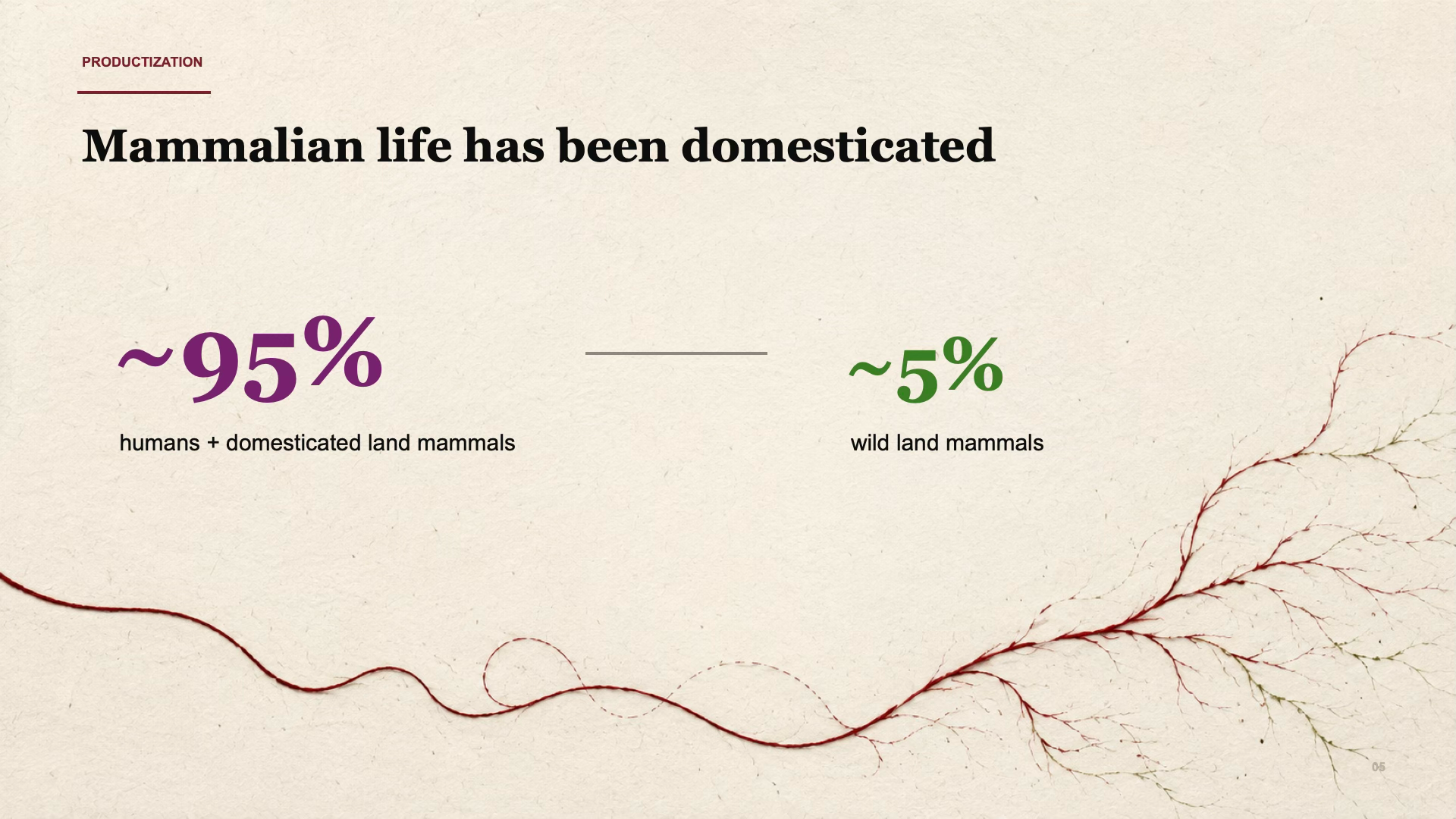
I also want to show you the previous extinction events. One of the earlier ones took about ninety percent of species. The last couple were around seventy-five percent. I think this productization of life, and this lack of being embedded in an ecosystem, makes our situation more precarious than the numbers alone suggest.
That seed was ecological grief, and it was also a feeling of absurd contradiction. And underneath the grief there was a potential for a new way. Maybe systems theory could help us understand how to change our systems. Fifteen years later, I'm glad to say I feel like I've arrived at a theory of change we can confront the meta-crisis with.
From a young age I felt that money wasn't a motivating factor in my life. The best sources of joy and meaning were experiences that were free. Being in nature, socializing, playing guitar. Money provides sustenance, of course, but the pleasures it provides pale in comparison to the suffering and death we need in order to create them. No industry would be profitable if it actually paid for all the true costs of the resources it consumed.
No industry would be profitable if it actually paid for all the true costs of the resources it consumed.
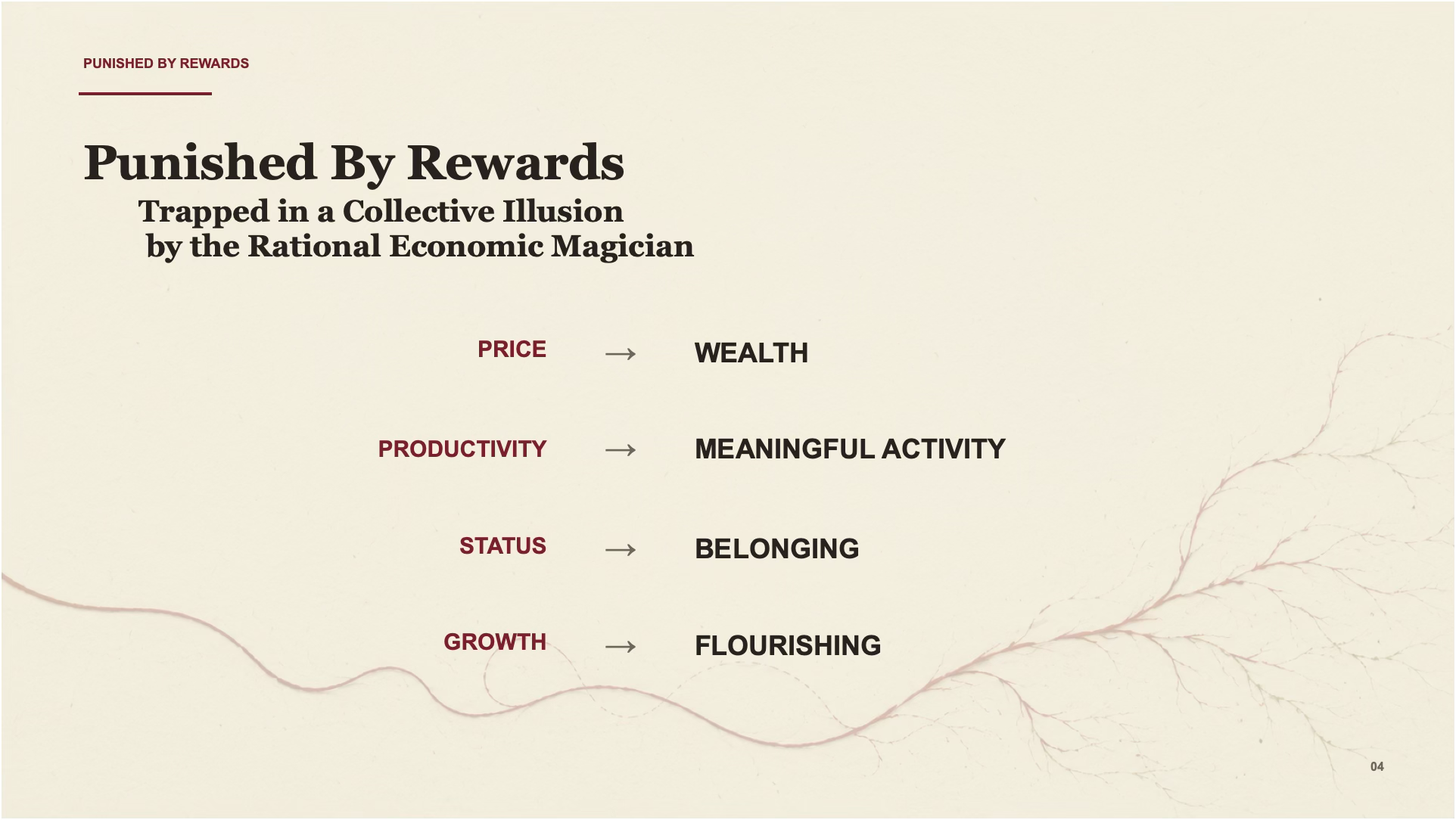
So we're in a collective illusion. It incentivizes our vices over our virtues and it isn't serving anyone. We're obsessed with the measure of value over the thing we're actually pointing at. We're looking at the finger that's pointing at the moon.
I playfully call this the rational economic magician. He brings our attention to the thing he can control, which in this case is money, and we forget about the real resources, the relational processes, the life support mechanisms. The quantitative metrics obscure what's unquantifiable or inconvenient to measure. They hide the negative externalities from our attention. In a similar way, Alfie Kohn says we're punished by rewards, which is a really good read.
That was my motivation. I had a why and I had a direction, and I found myself increasingly guided by questions about paradigms. What locks us into them. How we shift them. I became curious about the nature of reality and the nature of mind.
I went into engineering physics thinking I could point it toward neuroscience and keep both of those interests alive. Honestly I probably should have studied systems theory. I just didn't know that was a program I could study.
Emergent mind mapping
After university I had a huge surge of creativity. More time for reading, reflection and integration, and especially guitar. Even more so after I started living nomadically. I had a lot more time to enter deep contemplation and really integrate my insights.
I called it emergent mind mapping. Over the years, I'd accumulated a lot of notes and reflections, insights about paradigms and crises and mind and reality, and they felt like distant notes. I wanted to find the thread through all of them. So I slowly integrated them into a large digital mind map. I gathered them into clusters, and I used different fonts and color schemes to highlight the important ones and reduce the cognitive load.
The important thing is that I was entering it from the bottom up. I think that's what maintained the nuance. A single question could motivate several insights and then re-architect the entire structure of the thing. I kept picking away at it, and each time I returned I brought a different lens. A new conversation, a new question, different energy, a different intention. I got into a flow where all these questions and frameworks and fields began to cross-pollinate.
Eventually it grew like a tree, branching off into clusters, and I'd prune sections and graft them on somewhere else. It became a giant forest with a lot of cross-links. Kind of like an ecosystem.
I developed a kind of location-based memory from this map. I got the lay of the land and I could walk the paths I'd laid myself. With that location-based memory, I was surprising myself sometimes. I'd have a new entry and think, I should go here, and I'd get there and find the identical file was already there.
It's at around thirteen thousand nodes now, which is a whole different beast. Even at a smaller size it was pretty easy to handle, especially when I was fully in it and motivated by a felt sense that a shift is inevitable and that wrestling with these thoughts is worth my attention.
Honestly, the whole process was fun. Looking back on that time, it was really enjoyable. It kept disclosing overlapping insights, and it generated a lot of curiosity and flow states for me. I think it's totally worth doing for its own sake. I had zero intention to write a book out of it for years.
In a similar way, I didn't have a philosophical theory I was trying to push into the world. Bottom-up mind mapping is a lot more fruitful than top-down mind mapping, which to me closes off curiosity. Top-down puts a label on something and basically says our search is complete because we have a word for it. Nothing arises from that. No new questions, no nuance, no contextual information. I think that breeds a kind of scientism.
Bottom-up felt like an ecological system. Contextually sensitive information, multiple perspectives that could cross-pollinate and create real interdependence. When it gets digested into new forms like that, it feels like an evolutionary process. It gets to the heart of what feels important, and it keeps being relevant over time.
Top-down puts a label on something and basically says our search is complete... Bottom-up felt like an ecological system.
A little fun fact about etymology. The word contemplation comes from temple, which isn't a building but the ability to create space. And con means with, and thoroughly. So contemplation is creating space within. I thought that was kind of nice.
Two practices, one process
Looking back, I realize that for most of that time I was also really dialed into music, and I found my musical style in the same way. I call it dark ambient death metal.
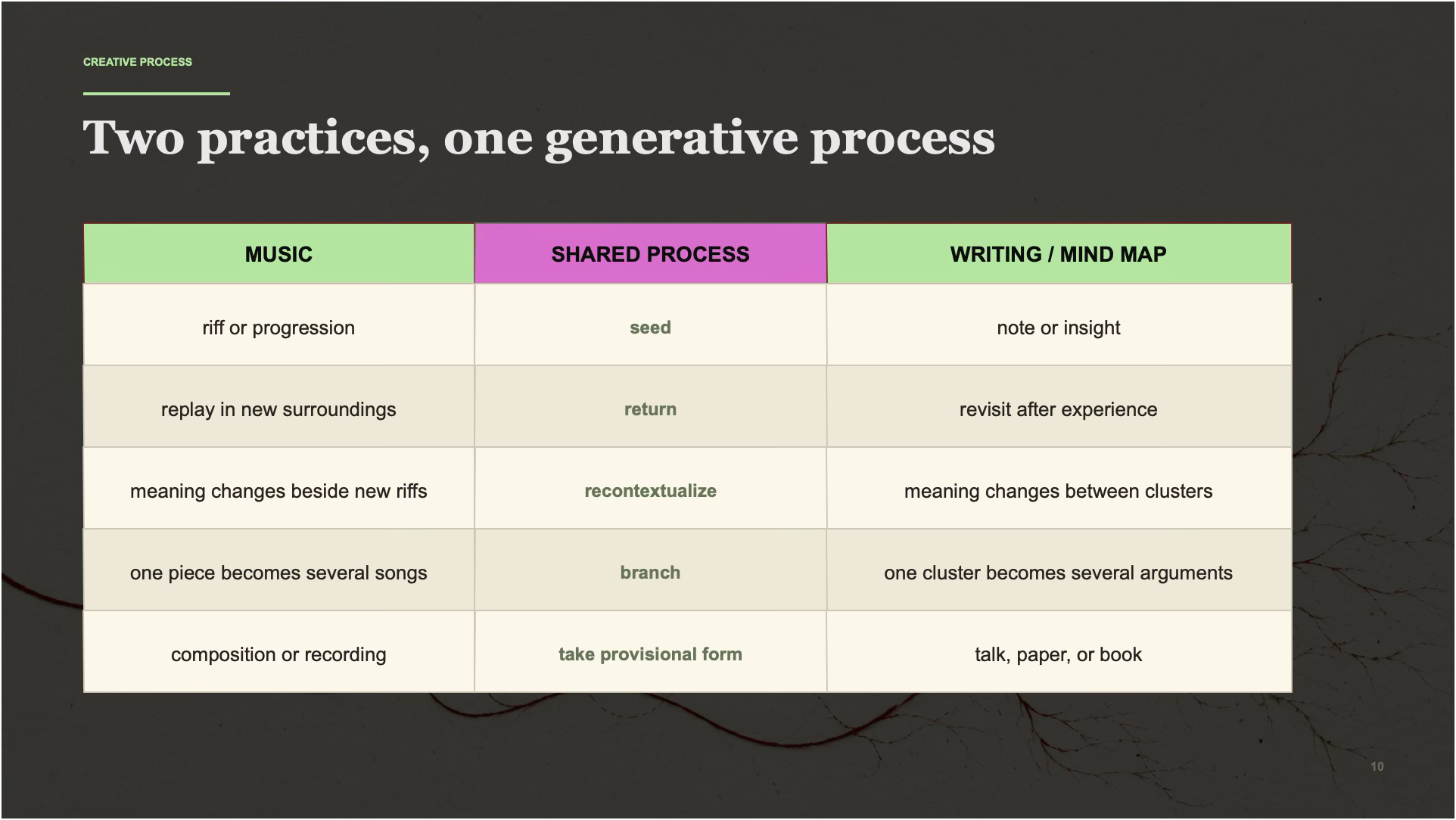
Music is basically a process of tension and release. I brought both of those to extremes and found a really dissonant and highly dynamic sound. From time to time I'd come across dense little motifs and rich progressions. They planted a seed. Honestly the motif was probably too dense to fit into one song, and that one motif would split off into several different songs.
It painted a whole soundscape of themes that I'd sit with, and stretch, and shuffle around. Feeling into the possibility space of what could be, or what needed to be said before or after, and painting in the space between. That created long hooks for each song. They felt like a whole journey. It let me move energy around in my system. I'd shift into a lot more ambience or a lot more intensity when I felt like I needed it personally, or when the song needed it, and it gave me access to a lot of flow states.
That search for dissonance posed a question, from a musical standpoint. It was exploratory and contemplative. Composing is quite a bit of a teacher, and almost a form of meditation in that way. And it was totally enjoyable for its own sake. I was happy playing guitar and writing songs faster than I could compose them and release them.
Preparing this talk gave me time to reflect on how similar the two practices were.
In a way it felt like they gave knowledge both above and below language. Music tapped into a sub-semantic space. Mind mapping gleaned meaning between conceptual frameworks, holding contextual information that was more informative than the content. I could interpret a lot of complexity without having to digest a bunch of words because of the way I structured the layout and the color schemes.
Music tapped into a sub-semantic space. Mind mapping gleaned meaning between conceptual frameworks...
Leaning into the ecosystem analogy, I could move a node into another cluster and it would change what it disclosed. In the same way that reordering riffs or songs on an album makes them sound different, feel different. So when I returned to a riff or a node, I wasn't returning to the same thing. Both its surroundings and I had changed in the process.
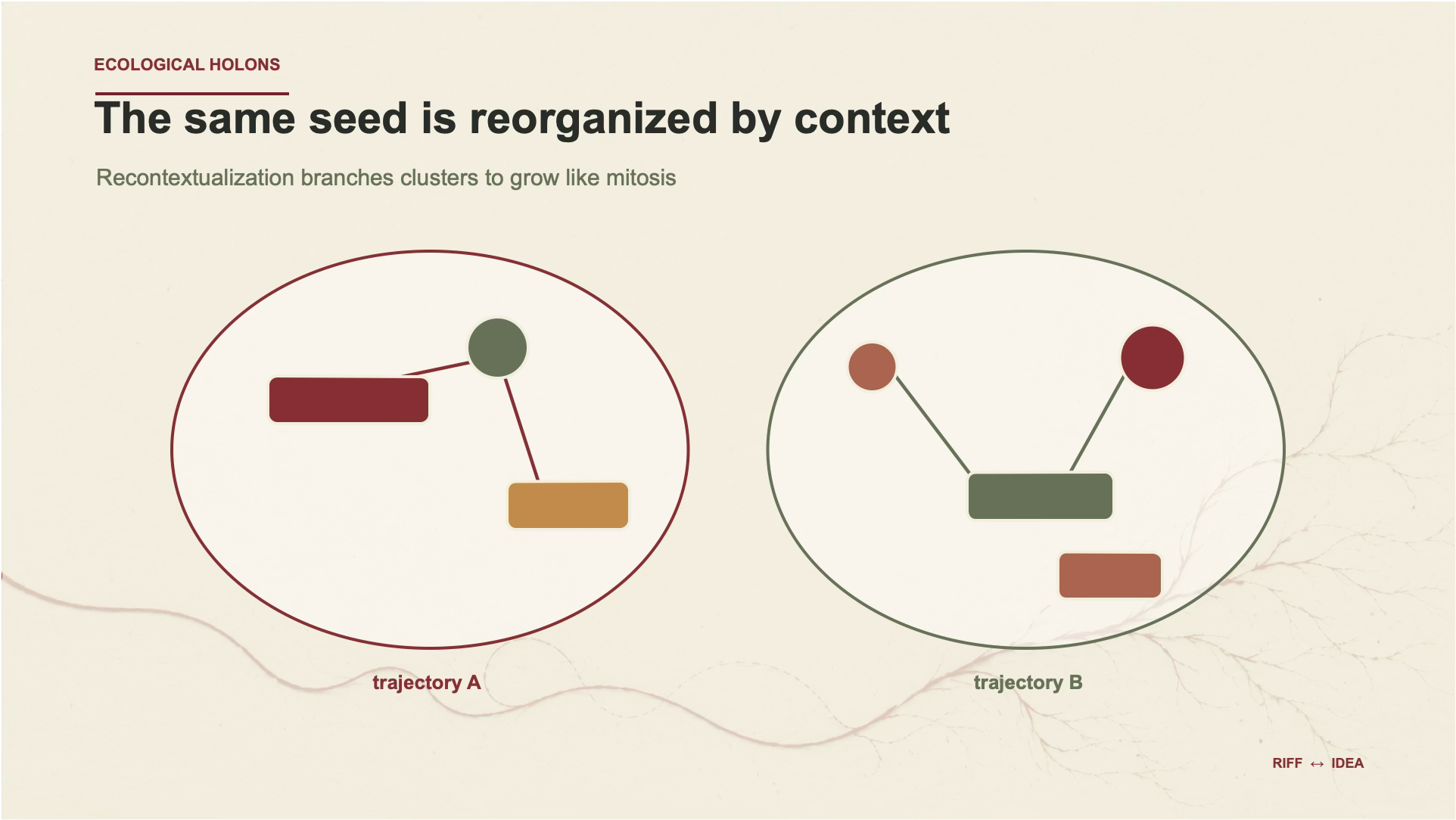
Those seeds of thought, whether a motif or a mood or an insight or a question, are dense with possibility. The process of being with them was a matter of finding the threads I could pull on through that possibility space. I could feel into an untapped coherence, and that was what guided my curiosity.
The seed didn't hold the blueprint for the end product. It unfurled in whatever new context or relationship it came through. From a music composition standpoint, if I set a certain chord structure or a certain time signature, it would dictate, and create a rigidity that wouldn't allow for that space of creative possibility. It wouldn't allow the energy or the process to speak through the creative journey and reflect on itself.
For better or worse, this gave me a really nonlinear way of thinking and expressing. The hard part, of course, is then linearizing it into a book or a talk, or making an album with a cohesive style and arc. It definitely takes a long time. But for any other creative or writer out there, this whole process meant I basically never had writer's block. It was just a matter of coming back and integrating and weaving different threads. The same can be said about my music. I never got stuck in a loop, which I feel happens with a lot of musicians. My style was progressive, always with movement and transition.
Ultimately, I think our minds work in these nonlinear ways, and I think we need knowledge, or interfaces of knowledge and communication, to do the same. If we abide by a rigid structure of folders and categories, I think we end up domesticating our minds.
Both projects matured and had a life of their own, and the fact that they were nurtured together helped me get into different headspaces and gain another perspective. I couldn't hold all that detail in my head at once, but I could remember the felt arc of what I was writing about. It's often said that writers get lost in the trees. It's almost like I could feel it, and that feeling would inform the instrumentals, and then reflect back on itself in a pretty cathartic way. I could step above the trees for a moment and see the forest, and that would motivate me to go through the more grinding aspects of editing and revising and audio engineering.
I thought the album would be instrumental, and then the lyrics ended up reflecting some of the themes in the book. Being the genre that it is, it's a little more dystopian fiction, of course. As you can tell, Domesticated Minds has a lot of meanings for me. The domestication of life. Our tendency to confine ourselves within narrow worldviews. And the dystopian potential of a strictly mechanistic or neuroscientific perspective on mind.
I'm working on another album now. I think that one will be instrumental. And because I was writing so much, I was doing a lot of poetry and a lot more lyrics, and that birthed a whole other creative avenue. Eco-philosophical rap, you could say. That'll be a third album.
Here's one of them. It weaves a lot of the themes we're getting to.
Nectar of the Gods, a spoken word piece
You call me a hypocrite cause I'm a lyricist trying to be legitimate
but I'm hesitant to deliberate this alliteration amongst the illiterate.
So while I sit on this delicious bit, I question how to deliver it.
But it's evident that when the clock is ticking, I need to be explicit.
Maybe I have a
short temperament for my critics saying "you're being inconsiderate,
your lyrics are too cryptic, you should be more articulate”
That sounds reminiscent of a degenerate who hasn't picked up an instrument.
So it's no coincidence you're not listening to what's implied in the implicate.
Nah, that's too intricate, so the inquisitive found relinquishment
of feeling insignificant by popping stimulants to stay vigilant.
Thinking our brilliance is so damn resilient, but if you were diligent
you'd see the limit in this grand experiment to map our neural correlates.
You forgot what's imminent cause your thinking it's just one increment
till you implement omniscience into a million little filaments of silicate.
So who's the hypocrite that's complicit in putting God in imprisonment?
Thinking that digits are equivalent to being intimate with the infinite.
But I wonder why these prophets make so much profit off it.
Ya, I made a deposit to buy a God-Slave that fits in my pocket.
And I can't grok it, so I pray to it with a plug-and-play socket, and
synced clocks with the man in the clouds sent up in a rocket.
But how is anyone gonna top it without the key to unlock it?
So don't knock it, till you find the homunculus in your cockpit.
But I can't stop it cause this is just fucking stellar
Now I'm so clever, it's like I've gotta lever for every sense of pleasure
It’s just pure treasure, I don't need to center to taste that sweet nectar.
but it's our evolution that never had a countermeasure whatsoever,
no error detector for whatever's been raising my blood pressure.
Oh, it's the projector in my telephone that's forever showing me terror
'Cause the director of Twitter owns the elector's throne in my sector.
His empty gestures have no texture or tone, just numbers and letters
When he spits conjecture, the tax collectors loan to the highest seller.
So whether that's Meta or Amazon or whoever's the next successor
is an aggressor shown to be no lesser know than these other oppressors.
That divide, conquer, then atone until every culture's been severed.
If you endeavor to unplug from their tether, clone yourself like Helen Keller.
(Effect to go quiet)
Shut up, heckler, it's no better alone cause we're going in this together.
Unless they divide, conquer, then atone when every culture's been severed.
So focus on Mind over matter
Go find the others and gather
to fund the things that matter.
till their fragile world shatters.
Or fight all the other crackers
and fucking climb the ladder
Just to feast on the last platter.
But I'd suggest the former not the latter.
See cause we brought on the rapture
while you were clicking the captcha
just to overreact and distract ya
with puppets like Reagan and Thatcher.
You know it's consent they manufacture?
cause after all it's not like they asked ya
what lands you want broken and fractured
Why're you led by leaders they captured?
Dropping the view from nowhere
I mentioned that I studied engineering physics, thinking I'd point it toward neuroscience. It didn't take too long for me to drop the physicalist interpretation of reality.
In physicalism, our felt sense of experience seems entirely alien to our worldview. The computational analogy of mind doesn't help describe how our rationality works or how we make the choices we make. Physicalism attempts to create a view from nowhere that cuts out the observer, assuming it can explain the conscious observer with its own abstractions.
It's almost ironic. This tendency of science to find the view from nowhere felt like a religious attempt to gain a God's eye view. And paradoxically, I noticed that in something like statistics or software, you apply labels and describe patterns, and you don't explain the function or how something came to be. You describe behavior and hope to predict future behavior.
Maybe you can hear it in the lyrics. That felt lacking in a lot of ways. The mechanistic narrowing of reality felt like a half-truth, conveniently grounded in what we could control.
Studying the mind under controlled conditions justifies outcomes based on control, which is how we've abused behaviorist psychology. Physics is in the business of highly controlled and repeatable experiments, and mind and consciousness are precisely a process that isn't repeatable. Just see what happens when you try to control your thoughts.
Physics is in the business of highly controlled and repeatable experiments, and mind and consciousness are precisely a process that isn't repeatable.
I had a visceral realization that this wasn't the way to approach it. It was antithetical to the motivation and curiosity I set out with. It has the potential to domesticate our minds. I was increasingly frustrated with that bias in industry and education, and I had a felt an inclination that whatever we study should be able to transcend that particular domain.
If we're going to choose physics or psychology or engineering or sociology, or even politics or economics, then it could give us more insight into the nature of mind and reality than a collection of disconnected fragments. Instead of isolating and fragmenting our thoughts into complicated silos, if we learn about an ecosystem it could teach us about community, or about our minds. It can deepen our participation with collective life. Whatever we chose to learn, we could integrate all these different concepts and arrive at truth and wisdom resonant with Life with a capital L.
Then systems theory returned in a deeper form. It felt like an integrator of science. Almost a science of science. It had already revolutionized so many fields, and it generated a lot of new questions and insights and frames. It wasn't fragmenting into parts. It could illuminate the whole. It helped me see recurring relationships between part and whole, between the individual and the collective. You might be familiar with psychological or sociological developmental models. They're not identical processes, and they really echo one another across scales.
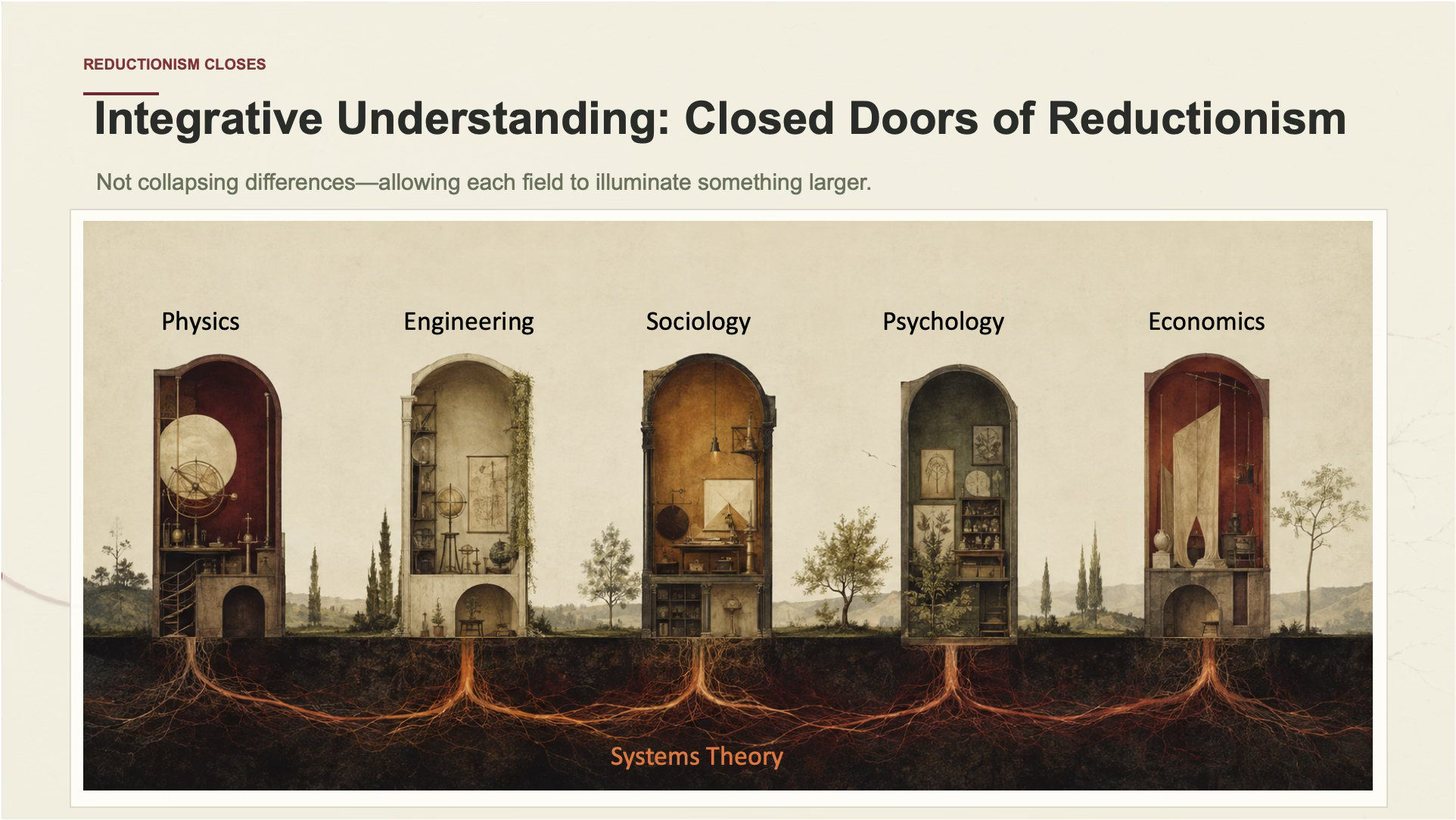
I have a lot more language for this now than I did then. Reality felt holistic. Instead of a view from nowhere, you could almost call it a view from anywhere. It didn't make claims on objective reality. It gave a better cognitive toolkit for not getting stuck on a certain view. That resonance between part and whole felt a lot more accessible from embodied or integrative approaches. I remember having several insights where I could see that I'm a part of a whole, and a whole containing many parts that are outside of my control.
My understanding of reality and my understanding of mind came closer and closer to one another over time. Both reality and mind are more like an ecosystem of interdependent parts and wholes, at all scales.
What's interesting is that I converged onto a whole field of process philosophy without really knowing it beforehand. And I do think that's the point. If process philosophy had been handed down to me as the status quo view within a school, I wouldn't have integrated it as deeply. I would have just labelled it. Because I found convergence with it, I had a lot more conviction in it, and once I discovered it, it gave me a lot more language, and I could pull on different threads.
In a similar way, curiosity into Buddhism and yoga let me stumble on 4E cognitive science. It integrates systems theory, process philosophy and Buddhism, so it felt like a natural home. Then looking into academics like John Vervaeke and Francisco Varela and Evan Thompson opened up a whole world.
Product and process
The talk is called Interrelating Our Collective Agency in a Fragmented Era, so you might be asking why I spent so much time on the creative process and on mind and reality.
I touched on all of that because it gives you a felt sense of a relational process, and of the fact that we're an ecosystem of perspectives. We're a collective within a collective. It gives you an experience of the creative potential and agency you might have in the world.
It's important to do it in a way that isn't couched in a productivity frame that can be subsumed by the current system, or done for some external reward. It's birthing from us.
When you play an instrument you get so many different kinds of cognition lined up at once, and that diversity brings a kind of insight and presence. The tactile sense, the embodied sense. I've been playing quite technical stuff, and it wasn't like I was in my mind. I could notice that my body had learned it. I think it's important to get that realization.
Whatever your creative process looks like, whatever your learning journey is, it's probably very different from mine. And I still think it resonates with the creative process of nature. I don't think it can be reduced into a product, and it isn't predictable. There's no rule set or strategy for how to get to that space. It's also the most generative aspect of life. It's the thing we find most meaningful. If we don't recognize this, or know how to support it, it gets shoved to the fringes, as it seems to time and time again.
Which brings us to the meta-crisis. There's a polycrisis, which just means there are many crises. Technological, educational, political, economic, and several more. The meta-crisis asks what the red thread through them is. What's the similar worldview or framing that interconnects them all.
To me it isn't resolved through any one of those crises, because there's such interdependence between them that any solution would be contingent on some other system also changing. The whole system right now is locking up.
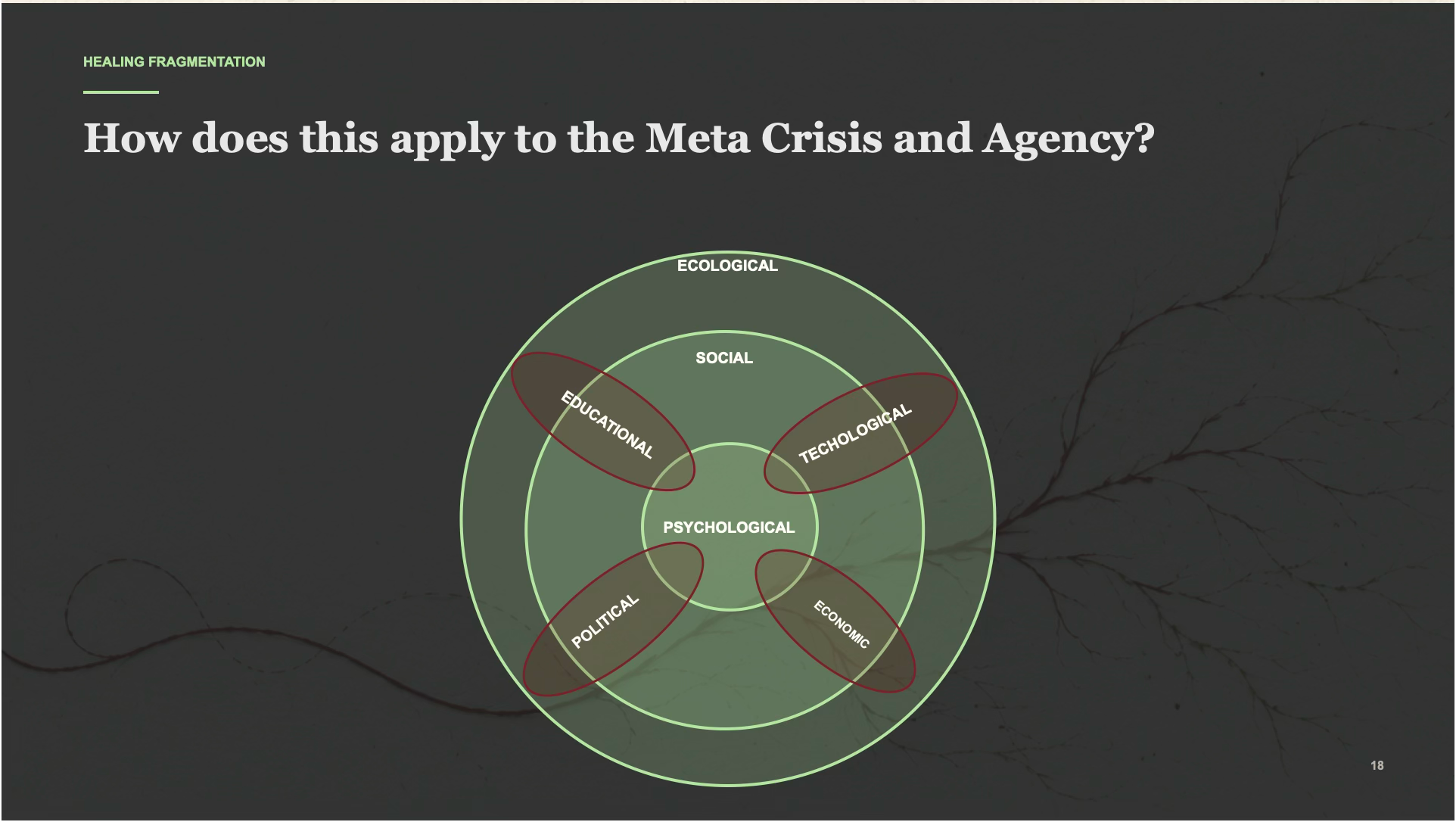
The crux is that it's paradigmatic. It's a whole worldview lodged deep into our history, into our identity, into our culture, and into the structures we're embedded within. My argument is that this bias toward products and representation is the thing that's fragmenting and commodifying life on the planet. And we need to understand how to move through that paradigm shift without reverting back to it.
My argument is that this bias toward products and representation is the thing that's fragmenting and commodifying life on the planet.
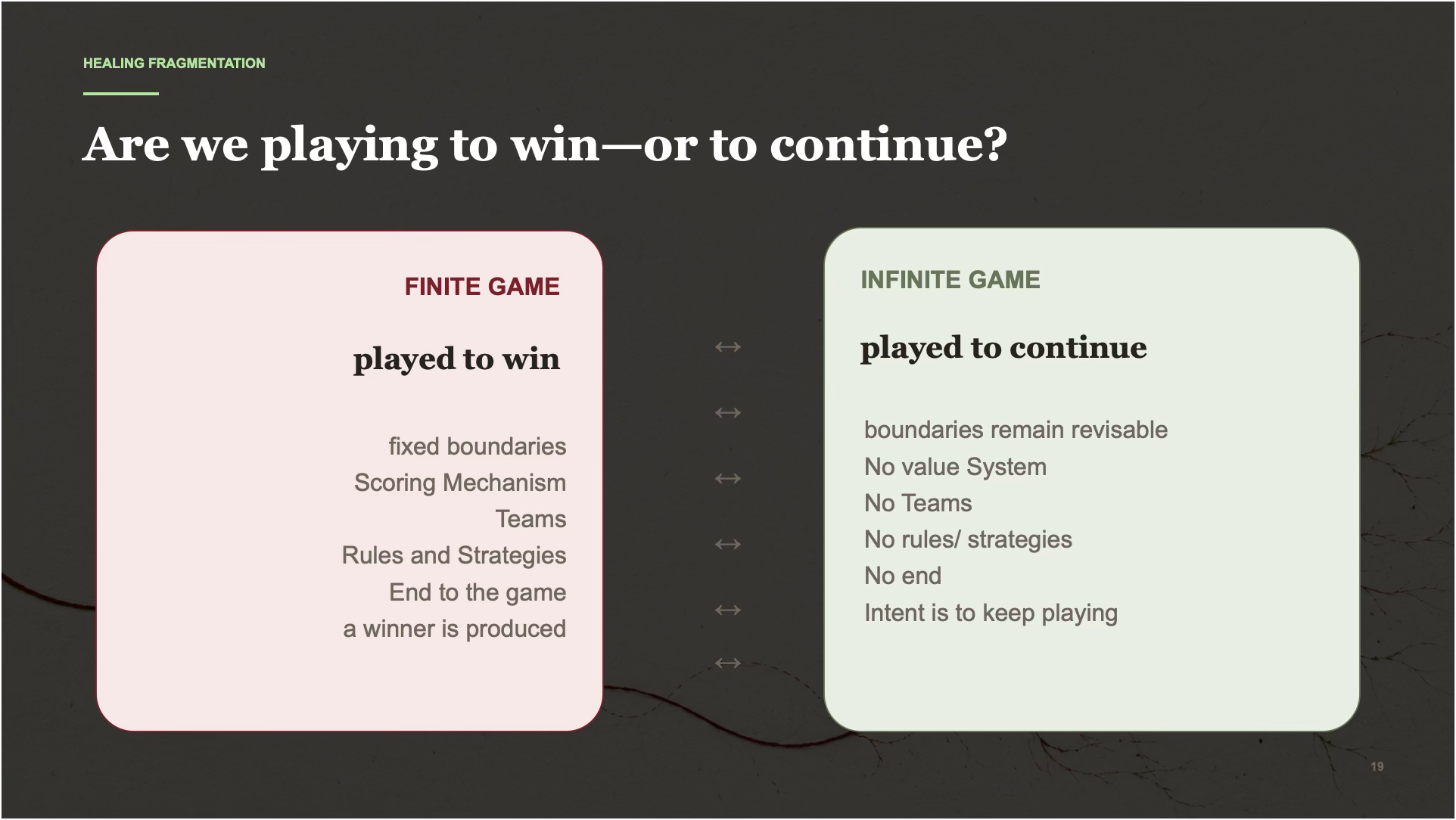
A really good framing for some of these distinctions is James Carse's Finite and Infinite Games. Finite games are played to win. They have boundaries and teams and an ending, and therefore a winner. Infinite games are played for the continuation of play. Any boundary or team is permeable and dynamic. The danger is treating businesses or countries or civilization or ecosystems as if they were finite games. As if there were a way to create a value system, or create boundaries around things. The more we're in a finite game mentality, the more existential risk we have, because there's an end to it.
What is an economy for?
Whenever we talk about the economy, it's so easy to immediately imagine currency and trade and ownership, and to imagine we're talking about something that happens at national scale. What's interesting is that national scale is precisely the scale at which we're not in relation to people. They're strangers, and we end up thinking in money and votes.
The good thing to know is that we don't need to work at that scale. We can work at a local, more relational scale, while also changing the old system to be a little more relational and less reductionist.
An economy doesn't really mean a market or ownership or transactions. It means the management of a household's resources. So the product economy is an anti-economy. It isn't actually managing the resources we have. It's incentivizing more consumption. Its values seem to be convenience and productivity, and that isn't what we need to be incentivizing.
So the product economy is an anti-economy. It isn't actually managing the resources we have. It's incentivizing more consumption.
I refer to anything from barter to feudalism to capitalism, and even socialism and communism, as a product economy. They're founded on representations of value, on representative governments, on individual property.
What I'm calling a process economy is incompatible with that. It's non-monetary. It arises from meaning or concern. It's deeply relationally embedded within community. It's more commons-based. A pinnacle example is care work, or education work, or ecological work. Honestly even something like real innovation falls into this. They're transformative and healing and some of the most important things that need to be done. And they're done without a goal in mind. Not measurable. Not a consumable object you can buy. Creative and regenerative. Really meaningful things we want to promote in society, and it seems like we're totally unable to.
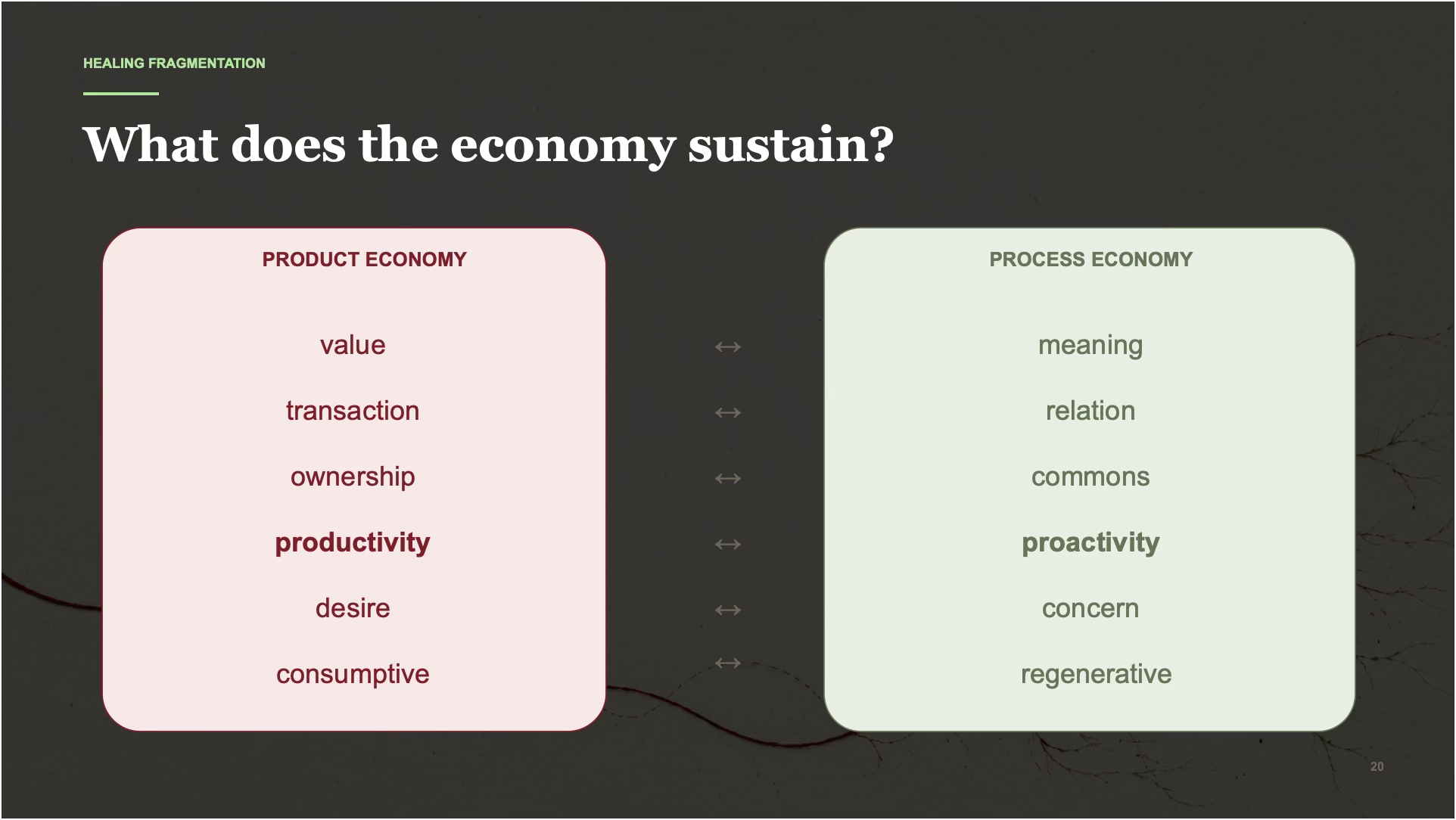
The point isn't to abolish the product economy. I'm teasing apart the distinctions of what an economy does and noticing that the product economy has abstracted and flattened and obscured a lot of it with money. The challenge is to tease that apart and rebalance toward a process economy. It's a parallel system, and I think it's actually good that it's incompatible, because it means the process economy can't just be subsumed by capitalism, the way so many other reforms have been.
These aren't arbitrary distinctions. I think it's a direct result of our productization and the lack of relationality that comes from an economic system that fragments. That's why I wanted to ground it in systems theory and process philosophy, rather than in the typical sociocultural arguments most people are making.
I'm also going a step further, because I'm describing a model of collective agency that runs like a through line between all the assumptions of a finite game. That model has been really useful in diagnosing the system, noting where the choke points are and where the contradictions are, and finding how to untangle that knot.
So the question is how we start coordinating a society on shared concern, on psychological and sociological and ecological proactivity, instead of the productivity frame we have.
There's no reason we should organize education, care and environmental work within a product economy. They're not products. I show several cases in the book where the more we attempt to quantify and productise these relational processes, the more it fragments social norms, stamps out intrinsic motivation, and creates fragile dependencies on our life support systems. At best, forcing them into a product mindset lacks the integration and depth that would allow for transformation or healing. At worst, it's precisely the thing that becomes exploitable and makes that value able to be abstracted or extracted. And whatever value is stolen in that regard is a small portion of the meaning and wealth we really have when it's situated in an ecological context.
We still don't know what healing is
One of the last things I'll mention is that it's kind of wild that we have so many marvels in modernity, and we still don't seem to know what healing is, or how it works.
Some things in the body can be fixed mechanically. Medicine is mostly killing off what's killing us. The best thing it seems to be able to do for actual healing is create the conditions for the body to heal itself.
That's a central frame and question for the book too. I don't really have answers in that regard. I think there's something about shifting to a more process-relational view that can speak to health, and that avoids us fragmenting things into parts. The way modernity's worldview fragments things into parts, the socioeconomic system also profits from that fragmentation because it keeps the whole orientation alive. And then when you ask how to actually heal certain systems, I just raise up my hands.
So this really calls to action, because I think we can do a lot better than this.
Over the coming year, we will be having five conversations around the book. These conversations will move from diagnosis, to a realization of meaning and value, through understanding the relationships that extend into collective agency, to how money is a communication and narrative device, and finally to a Process Economy grounded on a theory of agency. You get a section at a time and we come together and chat about it. You can find more details and sign up for the process here.
Until then, I'll leave you with a couple of questions to sit with.
Can you listen to what's implicitly meaningful?
What might your unique ecological niche be trying to express in you?


Member discussion