


Larry's book The Way was a Silver winner in the 2024 Nautilus Book Awards. He writes a weekly column, You Might Be Right.
Watch the Full Recording
The book I want to talk about is called The Way. I published it in 2023, and Jim Palmer wrote the foreword. What follows is a twenty-year journey that was distilled into a book, and then distilled again into five sets of bullet points.
I don't want to put anyone off with the title. People sometimes hear "the way" in a narrow sense, and I mean it in the broadest sense. The book is really about the perennial philosophy, where you're searching for the common thread that all of the spiritual traditions share. You can think of it as a golden-rule type of spirituality.
I don't want to put people off with the word spirituality either. I think of it in the broadest possible way, as a connection to something bigger than yourself. I don't like to use the word God, because it summons up a very anthropomorphic idea. I talk about ultimate reality, and I'm always clear that it's probably not personal, it's possibly not supernatural, and it's perhaps not even intentional. Ultimate reality is what it is. The phrase is just a placeholder for that great mystery.
So this is a case study of how writing the book led me to hold my beliefs up to the light, to confirm some of them, and to come away with some doubts I didn't realize I had. That practice has helped me in every other part of my life. I live in the Bible Belt, in Texas, where it's all about doctrine and belief, and being a progressive person in a conservative place is challenging to navigate.
You might be right
There's a story I like to tell, and it's a good explanation of where I come from.
A friend visited us in Colorado. He's a medical doctor, so a super smart guy and a scientific person. He said, "Tell me about your book." I was in the middle of writing it, and I started explaining, and he said, "Oh, no, no, no. I think the Earth is six thousand years old. I think everybody but Noah and his family, including the dinosaurs, died in the Great Flood."
I said, "Okay. All right. Now, this is just me, but we're sitting eight thousand feet above sea level right now. Did the water cover the whole Earth to eight thousand feet? Where did all the water come from, and where did it go? And shoot, how did all the kangaroos swim from Australia to the Middle East, take a boat ride, and swim back? They didn't stop anywhere. They didn't leave a trace."
And this is the important part. Then I said, "But you might be right. I was not here six thousand years ago. I was not here fourteen billion years ago. So I'll meet you in the middle."
He said, "Well, thank you for that."
I said, "Now you say it. Tell me I might be right. You weren't here six thousand years ago either. I extended you that grace."
"I'm sorry," he said. "I just can't do it."
I said, "I knew you couldn't, and it's not a problem. I love you like a brother. But I hope you understand your response was not as gracious as mine." And he said, "Yeah, I do understand that, and I'm sorry. That's just the way it is."
The next day, we're sitting there looking up at the mountain, smoking a cigar and drinking a beer, and out of the blue, he turns to me and says, "You know that conversation we had yesterday?"
"Yeah."
"You might be right."
To me, that was a magical moment. Nobody was saying, "I'm right and you're wrong." Nobody was saying, "I was terribly wrong and you're terribly right." It was two people saying reasonable people can disagree, and I'll meet you in the middle. I often think about how many more conversations in business, in politics and in our families should end that way. People conceding that there's not as much certainty in this world as we think there is.
To me, that was a magical moment... two people saying reasonable people can disagree, and I'll meet you in the middle.
I also want to say that the journey was transformative for me. Some people who have heard about me and haven't met me think, "My gosh, the guy used to be a Christian, and now I don't know what he is. He must be cynical. He must be jaded. He must be nihilistic. There must not be any joy or meaning in his life."
I meet a lot of people who are on this road, and I try to tell them, "I know it can be difficult and challenging and frustrating, and you can get angry. But as somebody who's been at it a long time, there is a way through." In my case, I cry more and I laugh more. I have more friends, and deeper friendships. I have joy and meaning in my life, and that's a result of asking questions. It's not because I avoided them. It's very freeing. I have all these questions, and I don't think I'm going to live long enough to have all the answers, and that's okay.
Jesus had the wheel
This is where I started out, and I was here for a long time.
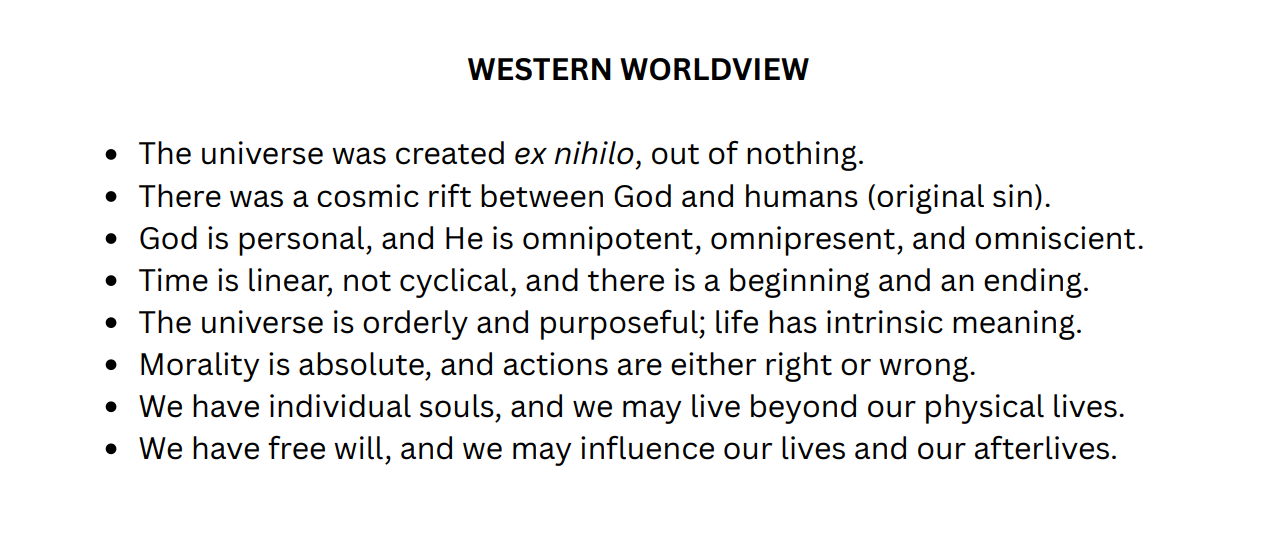
I assumed there was a creation, and a creator. They said it was a talking snake and an original man and an original woman, and they fell out of favor with God. God is a person. He's omnipotent, omnipresent, omniscient. Everything in my tradition had a beginning and an end, and a linear path between them. God was in charge. Jesus had the wheel. The universe was orderly and purposeful, and meaning came from outside: from the book, from the person, from the tradition. There were rules, some of them inscribed in stone, and you either obeyed them or you didn't, and there were consequences either way. And all of this assumed we have selves and souls and free will.
I started my journey in midlife. I didn't have a crisis, but I was asking questions. It really started with 9/11. When the plane hit the building, I thought, "What kind of religion inspires people to do that?" It took me about five minutes to figure out that's not Islam. That's not in the Quran. That's a pretty fundamentalist take on a pretty meaningful religion.
But it made me realize I didn't know that much about my own religion. So I did a deep dive, really thinking I would confirm everything I'd been told. I thought, "Shoot, how could this go wrong? Two billion believers. Two thousand years of history. There's a book, for crying out loud."
It didn't really work out that way.
A match to my entire belief system
It's not that I decided this was all horse poop. I did realize that a lot of things I'd thought were absolute, authentic, original, rational and unchanging were not. All religion is cultural, and all theology is speculation.
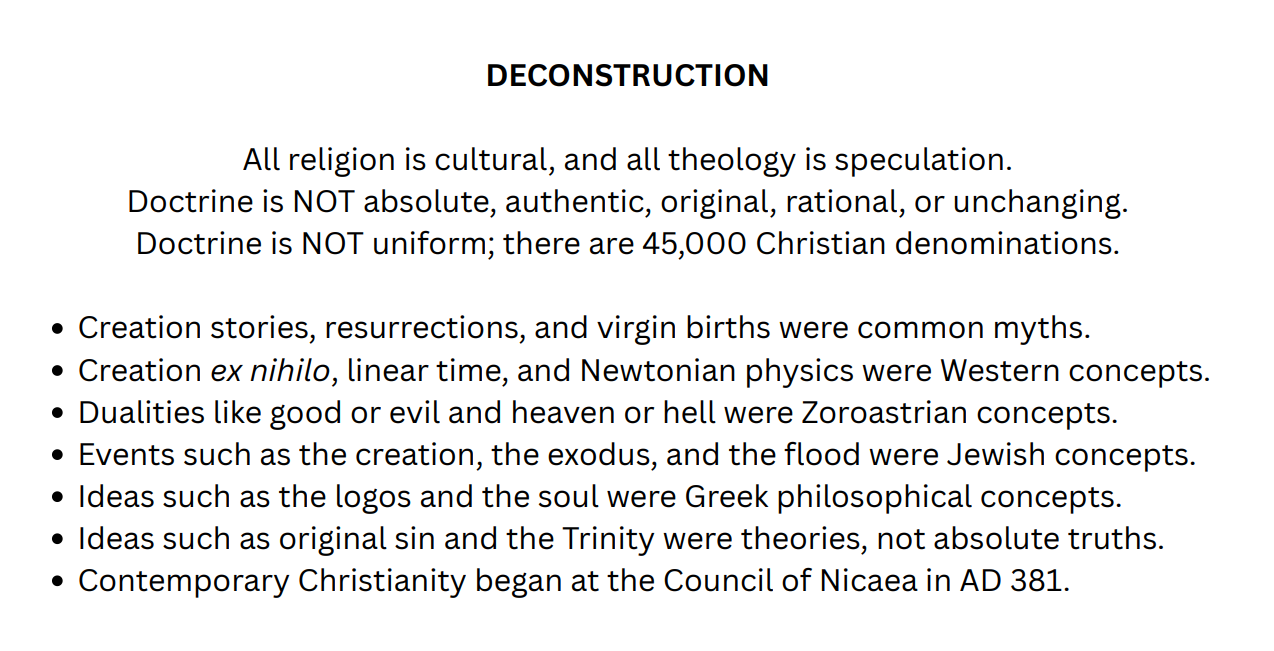
Christianity is somewhat unique among the traditions in being so focused on belief rather than practice. You have to believe the right things. Well, what are the right things? There are forty-five thousand denominations, so there are forty-five thousand ideas about the right things to believe.
And a lot of what I'd thought was original came from other places. There's mythology about creation and resurrections and virgin births. Linear time and Newtonian physics and separation are Western concepts. The Jews did not really believe in angels and devils, heaven and hell, until the Babylonian captivity, when they absorbed a bunch of Zoroastrian ideas. If you read Jewish scholars, they'll say: the creation, if it happened; the Exodus, if it happened; Adam, if he existed. It's not literal, not the way many Christians have adopted it. Even something like the soul doesn't really appear before the Greeks started talking about it. The Trinity, substitutionary atonement: these essential doctrines developed hundreds of years after Jesus's death.
If you pick up a big thick book on the history of Christianity, chapter one is always about Jesus, chapter two is about the apostles, and chapter three fast-forwards three hundred years to the Council of Nicaea. People in this tradition like to say, "Let's go back to the beginning." And I say, I'm all for that. In the beginning there's no Bible. There's no creed. There's no hierarchy. There's a pretty simple message of loving your neighbor as yourself and turning the other cheek.
In the beginning there's no Bible. There's no creed. There's no hierarchy. There's a pretty simple message of loving your neighbor as yourself and turning the other cheek.
Today, I hope I come across as somebody who's in a good place. At the time, though, try to imagine it. I had just taken a match to my entire belief system. If it's not about this, what is it about? Of course God's a person. How could God be anything but a person? Of course there was a creation. How could the world have come about otherwise?
As I started to explore, I came to realize it's not definitional. You're in a pretty small silo. There are eight billion people in the world, two billion of them are Christians, and they can't agree among themselves about what they believe. For the other six billion, this is not the way they think.
Softening the soil
A really good friend encouraged me to look into the Eastern religions. At the time I thought, "How can you have religion without God? Do they worship idols?" But I stuck with it, and I'm really glad I did.
The very first chapter of the book sets the Western worldview against the Eastern worldview, to let anyone reading know we're going to soften the soil here a little. We're going to talk about a way of looking at things that turns inside out the way many of us have been told to look at things.
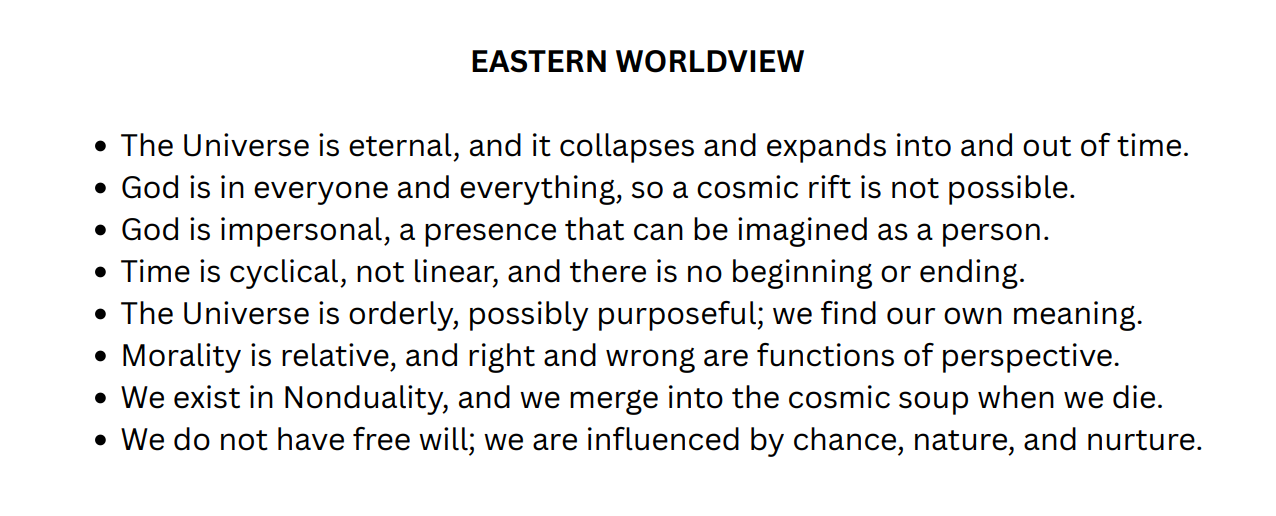
It's a generalization, and it's meant to set up the contrast. As I looked at these things I thought, "I don't know. This makes at least as much sense as the other. Maybe more."
The universe didn't have to be created. It might be eternal. The Big Bang might have been one of many big bangs. In Hindu cosmology the universe is in a constant state of creation and destruction, and destruction isn't bad. It's a necessary part of the cycle.
God is not a being. God is the ground of being, and God is in everyone and everything. In Buddhism, which is a principal tradition for me today, there isn't fullness, there's emptiness, and there isn't a god, or at least they're agnostic about God. The idea is the same: an underlying lack of separation. There are two aspects to reality. One is the relative reality, where you and I have different names and bump into each other in different places and times. The other is an absolute reality of no separation.
There are two aspects to reality. One is the relative reality, where you and I have different names and bump into each other in different places and times. The other is an absolute reality of no separation.
I know that sounds speculative and a bit woo-woo. We're going to get to that, because I also look to the experience of the mystics, who in my view directly encountered a reality much closer to the Eastern one, and to the quantum physicists, who say it's not woo-woo at all. It's the way the physical universe works.
There's agreement, I think across the board, that the universe is orderly. Whether that's by design is, to me, the most interesting question I've come across. I don't have an answer. It's conceivable that there's some kind of intention in the universe. It's just as likely, in my mind, that this is the way universes evolve. They become more complex, more diverse, more interrelated. Somebody says, "How could you possibly get all this through evolution?" And I say, "How much time do I have?" An eternity. "How many tries do I get?" An infinite number. Either way it's a spectacular outcome.
There's a strong sense in the Eastern religions that morality isn't absolute. I remind my Christian friends: "You're never supposed to kill, right?" "Right." "What about in self-defense?" "That's the one exception." "A just war?" "That's the other exception." If you have ten statements inscribed in stone, it really helps you with the easy questions, but morality is a lot more nuanced than following a set of rules. When the lion eats the lamb, is that a good thing? It's good for the lion and bad for the lamb.
One of the essential tenets of Buddhism is no self. That doesn't mean I don't have a different name from yours, or different experiences. It means everything is impermanent. If you say you have an essential self that's driving the train, I'm less and less convinced. I'm less and less convinced that anybody's driving my train.
About ninety-five percent of what happens in my head is unconscious, and that includes important stuff like beating my heart and digesting my food. Beyond that, a lot of what I do comes down to my chemistry, my conditioning, and cause and effect: things I've done in the past, and things other people have done. And I think there's randomness in it. I don't think the universe is random, and I don't think it's predetermined. I think it's probabilistic. If I like coffee more than tea, I'm probably going to drink it more often.
So I don't think I have as much free will as I used to think I did. My Christian friends say that's one of the linchpins of the tradition. If we don't have free will, why would somebody have given us laws? Good question. Why would we be judged for what we did or said or thought if we didn't have much control over what we did or said or thought? Good question.
I'm not certain about any of this. I'm not trying to convince anybody they don't have a self, or a soul, or free will. I'm saying soften the soil. Hold it up to the light, look at it, and live your life the best way you can with the understanding you have.
When the filters drop
Somewhere around thirty to fifty percent of us have had what's called a mystical, peak or transcendent experience. It might come through meditation or prayer, through art or nature or music, through psychedelics, through a seizure or a stroke. All kinds of things happen to people where, bam, all of a sudden they're in a different place.
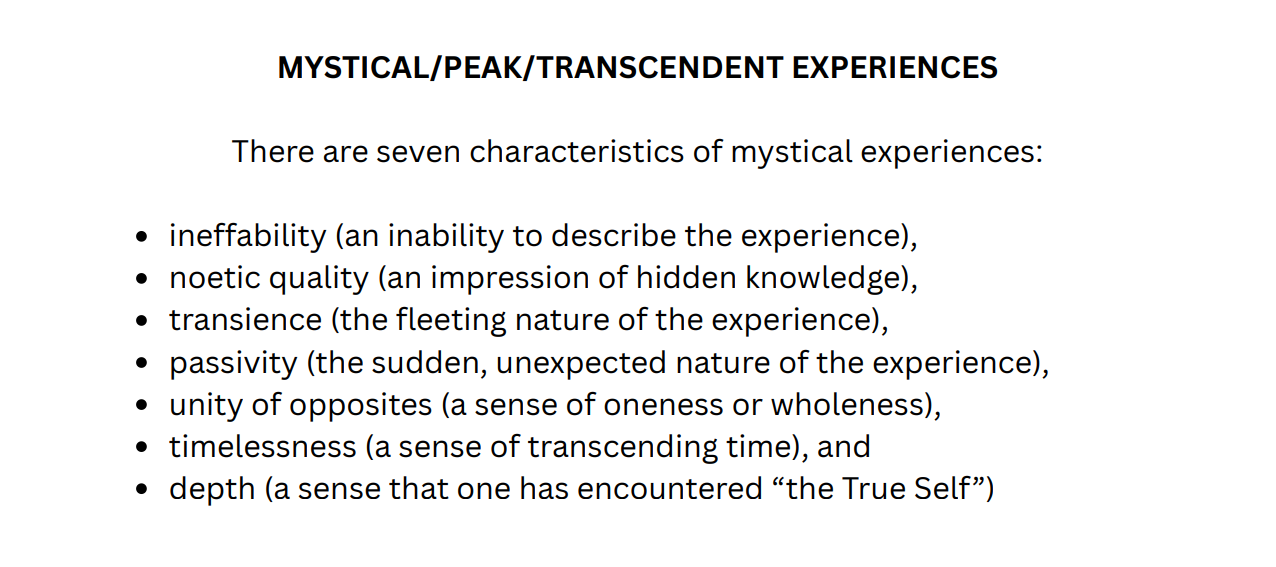
There are some hallmarks. There's an ineffability: it's really hard to describe what happened, and people usually just say it was the most powerful experience of their life. It has a noetic quality: "I was exposed to things I had never seen." It's transient. It's passive. People who wake up hoping for a transcendent experience usually don't have one, and plenty of people who'd ask "What's a transcendent experience?" are, boom, transported. There's a sense of oneness. People describe holding out a hand and not knowing where the hand began and everything else ended. There's timelessness: did it last three seconds, or three hours? And there's depth. People feel they've touched their true self, the ground of being, or in Buddhist practice, emptiness and no self. Still, there's that underlying lack of separation.
There's a really interesting talk, also a book, called My Stroke of Insight, by Jill Bolte Taylor, a neuroscientist who had a stroke in the left side of her brain, the part that organizes. She recovered, and remembered enough to describe exactly what was happening. It's about twenty minutes of your time, and it's worth it. It's a scientist talking about her brain in very clinical terms. She doesn't talk about God or mysticism, yet it was clearly a transcendent experience.
The explanation that makes most sense to me is that we have filters. Plenty of people, Iain McGilchrist and Michael Pollan among them, have looked at the hemispheric studies. The left side of the brain is analytical. It categorizes and separates things. The right side is creative and intuitive, where everything is one. Imagine how hard it would be to cook breakfast, get the kids to school and go to work if you were perceiving every blade of grass, every drop of dew and every ray of sunshine. So in order to function, I think we naturally filter. We pay attention to what's important.
Imagine how hard it would be to cook breakfast, get the kids to school and go to work if you were perceiving every blade of grass, every drop of dew and every ray of sunshine. So in order to function, I think we naturally filter.
In those moments when you've taken a hallucinogen, or you're lost in prayer, or you're inspired in front of a waterfall, or you're having a stroke, the filters drop. And what people describe is exactly that. I saw every blade of grass. I saw every drop of dew. I saw everything connected to everything else. I didn't see a boundary between myself and the rest of the world.
I don't think that's something you make up, and I don't think it's something supernatural. I think there are two ways of viewing the world, and they correspond to the two ways of thinking about ultimate reality: the absolute, the oneness, and the relative, the separateness. In these experiences we're seeing parts of reality that are there all the time and are normally filtered out. It may very well reflect a part of reality that's always there.
Weirder than we thought it could be
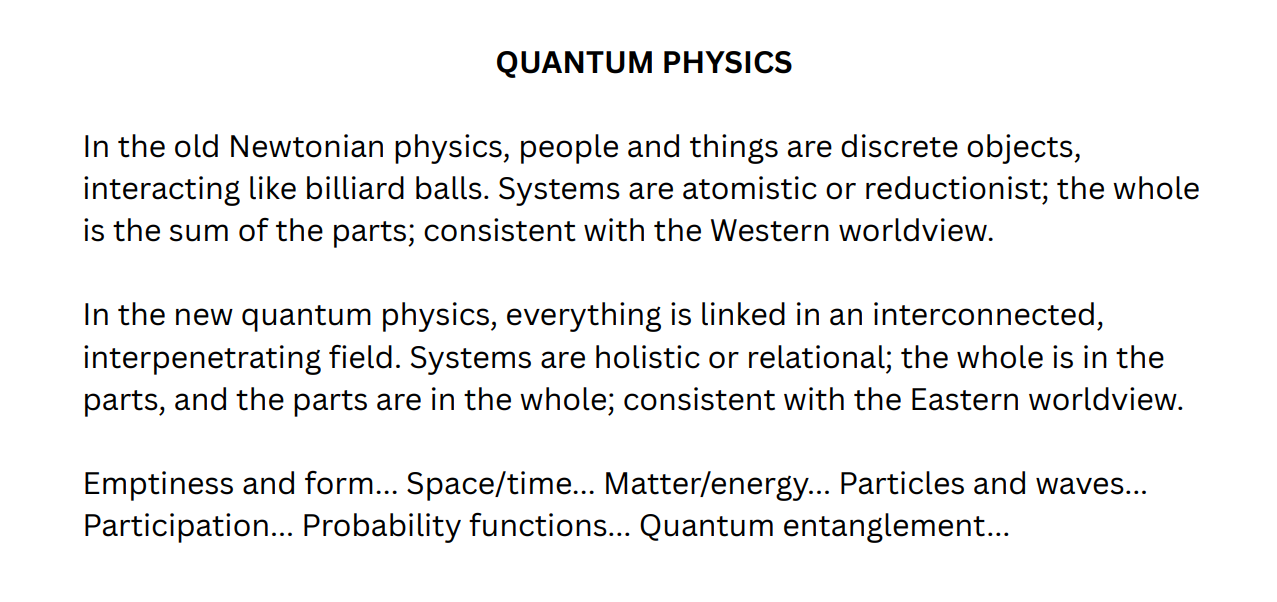
In the old Newtonian physics, people and things are discrete objects interacting like billiard balls. The whole is the sum of the parts. That's how we thought about things until about a hundred years ago.
Then people like Einstein and Oppenheimer started finding really weird stuff in the physical world. In quantum physics, everything is linked in an interconnected, interpenetrating field. The whole is in the parts, and the parts are in the whole. That's much more consistent with the Eastern worldview.
In my old Catholic upbringing I thought, "I'll go to heaven. I'll see the three people of the Trinity on the throne, all the popes lined up on one side and all the saints on the other, and I'll see Grandma." Mystics who feel they've really encountered ultimate reality don't see that. They don't see a person. They're not transported to a different place or time. They see this world through a different lens, and that's what the physics is telling us too.
People say, "This all sounds weird to me." Well, it is weird. The science is weird. The table is ninety-some percent empty space. Space and time are really spacetime, and it curves. Matter and energy are not two distinct things. Is light a particle or a wave? People studied it with a particle machine and said, "Look at that, it's a particle." They studied it with a wave machine and said, "Look at that, it's a wave." Which made them realize we're not really observers of the universe. We're right in the middle of it. We're participants. And if somebody asks where a particle is going next, it's not a certainty. It's a probability function.
… we're not really observers of the universe. We're right in the middle of it. We're participants. And if somebody asks where a particle is going next, it's not a certainty. It's a probability function.
Then there's nonlocality. You take two particles that are entangled and move them to opposite ends of the universe. You reverse the spin on one, and simultaneously, faster than the speed of light, the other reverses its spin. Einstein called it spooky action at a distance. Somebody said that not only is the universe weirder than we think, it's weirder than we thought it could be.
I'd point you to The Tao of Physics, by Fritjof Capra. It's a bit of a difficult read, though not if you skim it, and some of it you're supposed to skim. Capra had some experiences with psychedelics, so he was familiar with the mysticism as well as the science, and he identified commonalities between Eastern mysticism and quantum physics.
I say commonalities on purpose, because some people take this too far. They say, "I believe in Eastern spirituality because the physics confirms it." That's too far a reach. One doesn't prove the other. But if you study both, there are really interesting parallels.
Everything's connected and everyone's related
When I got through the deconstruction, I was asking, "Where am I? What do I believe?" Now I think, "Wait a second, I don't have that many beliefs." And the ones I have, I don't hold too closely.
I guess the only thing I believe, and I almost know this, is that everything's connected and everyone's related. How do I know it? It's the framework of the earliest religions, the indigenous religions and the Eastern religions. It's the experience of the mystics who go looking for ultimate reality. And it's what the scientists find when they go looking to understand how our physical world actually works. A hundred years ago, these quantum physicists were reading the Upanishads, and you can see a hint of it in the film Oppenheimer. They were saying, "For crying out loud, these guys in caves three thousand years ago had an understanding of the physical universe that has been lost until now."
You might say, "The conclusion is that everybody's related and everything's connected? I don't see the big deal." It is a big deal. I live in the United States, and while I was writing this book there was a guy banning Muslims, building walls, marginalizing LGBTQ people, taking away people's healthcare and separating families. My politics are very obvious now, and I don't apologize for that, because my politics come from my spirituality. If I understand that everything is connected and everyone is related, that's how I'm going to behave. You might think your spirituality and your politics belong to different realms. I know people like that, and I respect it. For me, this is a much clearer roadmap than the one I had for the first fifty years of my life.
… my politics come from my spirituality. If I understand that everything is connected and everyone is related, that's how I'm going to behave.
The point of this was never a book. At the end of this process of deconstruction and exploration, my adult children sat me down and said, "What happened to you?"
"What do you mean?"
"You know what we mean. You used to be this conservative, Catholic, type A, capitalist investment banker, and now look at you. You've got a ponytail. You're warm and squishy. You cry more, you laugh more, you have more friends and deeper friendships. Whatever you're doing, more people need to do it."
I said, "I couldn't tell you in a sentence. I read a thousand books, and every book sent me to three other books. I went all the way through psychology and quantum physics and mysticism and Eastern religions and Zoroastrianism. On top of that, I baked in a sweat lodge, I chanted to Shiva, I meditated in a zendo, I whirled with the dervishes. I'd need to write a book."
And they said, "Well, you need to write that book."
"Nobody's going to read a book by a no-name investment banker who read a bunch of books and chanted to Shiva."
"We would read it." And they were earnest about it.
Part of me thought, I really have learned a lot. More questions than answers. And some of the learning was reaching the frontier: I can't find anybody who knows the answer to this question, I probably never will, and that's okay. I think it was fortunate it happened that way, because I didn't have a pile of notes. I was dictating something like a testimony to my children and grandchildren and friends.
And I do look at the world differently now. I can read Joseph Campbell, Carl Jung, Baruch Spinoza, Marcus Aurelius, Lao Tzu, the Buddha and Jesus through this new lens, and things make sense to me that didn't before.
It depends
There's a humility in it too. In business I'd sometimes push back on people who were speaking with a certainty they didn't really have, relying on the conventional wisdom or an expert. That's not said to be confrontational. I just think this is all a little squishier than you think it is.
During this transition I kept asking, "Now what am I supposed to think?" I used to be a conservative guy who thought the minimum wage was bad for business and bad for the economy. Now I'm more progressive, and I think the minimum wage is good. It puts food on the table and roofs over people's heads. I'm looking for truth with a capital T. I want to see the world as it is, without it being filtered by people's biases or guesses. So I did a deep dive on the minimum wage, and whether it's a good thing or a bad thing kind of depends on the economic cycle. It kind of depends on the industry. It kind of depends on the geography. It depends.
… whether it's a good thing or a bad thing kind of depends on the economic cycle. It kind of depends on the industry. It kind of depends on the geography. It depends.
I talked to my daughter about it. She's a psychologist and a very wise person. I said, "Every time I do a deep dive, the answer is 'it depends.'" And she said, "That's probably right. When you ask a complicated question, that's very often the correct answer."
I saved the best for last. My wife Jill and I were recently on a trip to Svalbard, about seven hundred miles from the North Pole, with a boatload of scientists. Their rock-star scientist was Richard Dawkins, the evolutionary biologist and prominent atheist. I studied up on him and hoped for some private time. As much as anything, I wanted to see whether he would bat me down and tell me I'd been drinking the Kool-Aid.
I found him an engaging guy. He actually had an appreciation for things like mind beyond brain and transcendent experiences, and an interest in psychedelics. The one thing that seemed paradoxical was that he was hung up on men competing in women's sports. So I asked him what his deal was there. He said it's binary. It's the one binary established in biology: men have male sex organs and women have female sex organs.
I let it go, but when I came home I looked into it. Is this a bright line, where men have male organs and women have female organs? Usually. That wasn't the answer I expected. Is it that men have certain chromosomes and women have others? Usually. Now you're talking about ambiguity and mystery and uncertainty. Okay, hormones. Men have testosterone and women have estrogen. Actually, men have both and women have both. Presumably men have much more testosterone and women much more estrogen? Usually.
So I wrote an article, and I braced myself, because it was a pretty ambitious article. I said we're coming to believe that gender is a spectrum, and I'm coming to believe sex may be a spectrum too. Usually, usually, usually. And of course I ended by saying, "If you feel differently, you might be right. But if you're going to challenge me, then tell me where the bright line is." I huddled under the desk waiting to be dive-bombed, and there was no response. There really isn't a good answer to that question.
All of this has brought me a lot of appreciation for the ambiguity, the paradox, the mystery, the uncertainty, the things we thought we knew and maybe don't. Sengcan, one of the old Zen teachers, said you don't have to go looking too hard for truth. You just have to let go of your opinions. I think that's such a beautiful expression. The truth is in front of you.
It's been a really interesting journey, and I'm glad I could share a little of it with you.


Member discussion