
Who sets the table
A note on conviviality, the two doors of dependency, and why the journey has to pay for itself.
Watch the letter · or read it below
Hey friends,
I've arrived back in New Zealand with Lars and we don't have a home yet.
That part is on purpose. We've landed in Auckland after taking a couple of weeks off along the way, and over the coming months we'll move around the country a few weeks at a time so he can see the place and we can work out where we'd like to settle. It's a deliberate arrangement and a fun way to be for a while.
But being placeless with intent does something to your thinking, and what it's done to mine is bring an old problem to the surface.
I have never had a good word for exactly what we're building here.
I've reached for a few over the years and they all come back contaminated.
I spent a long time working in universities, and I still have real affection for what they're supposed to be.
But institutions read people. They have to — they need you in a form they can process, so they can decide where you go. And you learn to present yourself in the shape the form is expecting. Most of us get quite good at it.
What almost never happens is the reverse. You don't get to read the institution back. There's rarely anyone to ask what it actually wants, or why the shape is that shape, or who chose it.
The reading only runs one way. That's the thing I don't want to reproduce here — so whenever I catch myself reaching for the word university, I stop. You don't name the new thing after the thing you left.
School is no better, and for different reasons. I'm largely with Ivan Illich here — that institutionalised learning teaches dependency more reliably than it teaches anything else. That learning is something done to you by qualified people. That competence isn't real until somebody certifies it. That the correct posture is to wait until you're admitted.
Illich's alternative to schooling was the learning web. Far from a funnel that admits and sorts and graduates people, but rather peers finding each other, skills exchanged directly, access to models and mentors you choose for yourself, everything started by the learner rather than administered to them.
That feels closer to what we're doing with the Grokkist Network.
Illich's other word is another I'd like to keep: convivial. A convivial institution is one you use on your own initiative, when you want it, without being ranked on the way in or made dependent on the way through. The root is convivium, a feast — people at a table together — which I think is about right.
That's a test I'd like us to be held to. The Network and the Press are the heart of the Grokkist project, and both are free. Nobody is admitted. You find your own people rather than being assigned them. You read everything. You take what's useful and you leave when you like.
Here's the part that usually goes unsaid, though, and it's where I think a lot of good projects come apart without anyone noticing.
Conviviality is not free. Somebody pays for it. And who pays decides whether it stays convivial.
Illich watches one door carefully — the one where an institution makes you dependent on it. But there's a second door, and things like ours walk through it all the time. If the free thing can't pay for itself, then a funder arrives and the agenda slowly becomes theirs. Or volunteers carry it, and it extracts from the people who love it most. Or the founder's savings carry it, and there is a clock running that nobody is discussing.
All three end in dependency. It's just that two of them get to feel virtuous on the way down. (This is why Grokkist is a social enterprise and not a charity.)
And it's the same problem each of us has at our own personal scale.
We all have to make a living on this planet. There isn't a version of being here where that stops being true, and I've watched a lot of people who insist on relating to the world with curiosity and care treat their own livelihood as a sordid afterthought to the real work. Refusing to charge feels like integrity. But it's extraction too — it just extracts from you, slowly enough that it passes for good character.
My friend Bo Alroe has been running a monthly Revenue Café on precisely this, and Lars has produced a recap of the first two that's worth a look if you haven't been along to one yet. One of Bo's observations that comes up often:
Don't wait until the end of a journey to make money. Because the end is never there. We are always in transition.
Since I'm asking who pays, I should show you our own working.
Grokkist is an experiment in whether something like this can pay for itself without turning into something else.
The heart of Grokkist always stays free. What keeps it free is that some people choose to pay — for membership, or for working with me (or others like me) directly. In practice they tend to be one of two kinds of person, and often both at once. People who want this thing to exist and would like to help it carry on existing. And people somewhere in their own long process of becoming legible, who'd like a bit of company for it.
So far it sort-of works, which is not nothing, and we'll have another town hall event before long to share more of the detail and how we plan to travel the next stretch.
Which brings me to the work itself.
The recording of my recent talk for the Association of Sustainability Practitioners, The Work That Brings You Alive Hasn't Learned to Pay You — Yet, is now up. It's the first time I've put a lot of these ideas together in one place, and it'll give you a good idea of where my thinking and energy are at the moment.
And from next week there's a room where you can watch this being worked on rather than described. The Legibility Lab is an hour where one person takes the chair and we work on whatever's most alive for them, out loud, while everyone else gathers round. Bring a talk you're workshopping, a piece taking shape, an offer that won't move, or an honest "I don't know what this is yet." You don't have to take the chair — the knot we loosen for someone else is usually one you've been carrying too. The first is on 3 September.
Two books are being made in company at the moment, and I'm pleased about both.
Marcus Barrick gives his Red Thread Talk later today, and his book Healing Fragmentation is being published by the Press in a way we haven't tried before.
The book goes after the whole knot. It starts from the claim that our psychological, social and ecological crises aren't separate problems but one orientation turning up in different places — modernity's habit of treating living processes as static products to be measured, owned and managed. From there it travels a long way: finite and infinite games, what goes wrong when we govern by proxy measures, how concern extends outward through concentric scales of belonging, what property looks like if you treat it as a process rather than a thing, and what an economic system grounded in commons and gifts rather than transactions might actually be made of. There's even a chapter on right livelihood, which is either a coincidence or isn't.
His name for the character at the centre of the old story is the Rational Economic Magician, which will tell you something about the company you'll be keeping.
But the claim underneath it is the one that decided how we'd publish it. Marcus doesn't think we're short of theory. He thinks we're sitting on a century of revolutionary insight we've never embodied, and that the present system is remarkably good at absorbing its critiques and selling them back to us. He argues for prefigurative agency — enacting the thing rather than petitioning for it.
Which is awkward to argue from inside a conventional book that arrives finished, gets bought, and is consumed alone.
So we're having the book enact its own argument. It comes out in five sections over the next year, starting on 11 September, with a reader circle receiving each one as it lands, questions attached, and gathering monthly from mid-October to work through it together. The circle isn't an audience waiting for a finished object; it's part of how the thing develops, and it's the main way the book will find its readers. The collected edition follows once all five have arrived — and alongside it we'll publish our own account of how making it this way actually went.
Skin in the game, rather than theory advocated from a safe distance.
At the other end of that road, we've locked the manuscript on Jim Palmer's The Practice of Being Alive. Reader circle, endorsements, a foreword by Jes Böhme, a cover by Lars. Author Kate Eckman describes it as being about "the unnerving moment when your life is technically working and you realize you are no longer fully inside it," which is a good way to understand what's at stake in it. Out in October.
Quite a professional operation really, for a fledgling Press.
One more piece of working, while we're back here behind the scenes. From September the online Press moves to fortnightly drops rather than weekly, in step with this letter. Partly that's us organising our time better. Mostly it's that I want a Grokkist email to be a care package you're pleased to open rather than one more thing in the general panorama of noise. Which means not being constant, and giving you a fair chance to miss us.
We leave Auckland soon. I know this country well; Lars doesn't yet, and the next several months are mapped out rather carefully. The one thing not decided is the thing the whole trip is actually for — where we're going to live.
So we are, in the most literal sense the word will bear, coddiwompling. Purposefully, toward somewhere we can't name, with a spreadsheet.
Until next time, coddiwomple with care.
With curiosity and care,
Danu
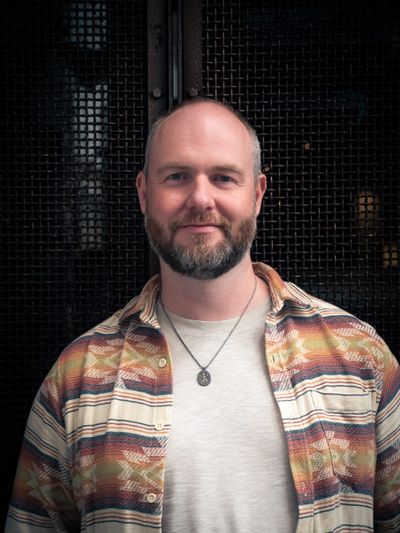
With curiosity and care,Danu Poyner
Write back
Replies from signed-in readers. They open in their own space, so you can sit with the piece first.
Write back
Replies to this letter