
All the help we can get
A note on asking, the structures we build instead, and what care looks like when it's stored.
Watch the letter · or read it below
Hey friends,
When I need help, I build something.
The building isn't a substitute for asking — it's real work, I'd defend every hour of it, and it usually leaves behind something worth having.
It's the elaborateness I've started to notice. Between me and a two-line message to somebody who would almost certainly say yes, I will cheerfully construct an entire architecture: a page, a structure, a considered offer, conditions arranged so carefully that by the time anyone arrives the help has already happened and nobody has had to be asked for anything.
Scaffolding for being helped, erected around something that would have taken an afternoon.
I've done a version of this my whole life, and the instinct underneath is something that has kept me safe.
What broke my heart early was rarely a person; it was an institutional arrangement. A systemic wound. Institutions don't merely fail to care, they reliably make it difficult for the people inside them who do care to act on it.
So my deepest reflex is to repair the arrangement first, on the theory that then the practice can happen safely.
It's also, I've come to suspect, somewhere to hide. A page cannot say no to me. A person can — and building is the version of the effort with no rejection surface, demanding enough that it never once feels like avoidance.
The most durable defences get built out of our real talents, which is precisely why they're invisible from the inside.
For years I took this for a skill I lacked, or else a preference — that I simply don't like asking.
The truth is more interesting, as is usually the case.
I know perfectly well how to write the message, I've written far harder ones, I'm good at asking on other people's behalf; and I want the help, badly enough that its absence occupies most of my worrying.
So it isn't can't and it isn't won't.
What's actually there is a belief — that it wouldn't come to anything, that anyone saying yes would be doing it out of politeness, that I can't picture a person actually glad to have been asked — bolted to a moral fear, that the act of asking is a species of false pretences. Over-claiming. Letting somebody down. Instrumentalising a relationship I've taken care to build and making it transactional.
But as a friend put to me recently: there is no transactional that's not also ecological. The Guardian didn't stop being a commons the day it began asking its readers for money — asking is what made the commons possible.
People often offer to help, unprompted, but the signals don't always register, or the hypervigilant part of me finds it difficult to believe them.
And yet, declining to take people up on their sincere offers of help treats a friendship as too fragile to carry any weight, which is its own small insult. Being easy to help is a kindness, not an imposition.
I'm labouring this point because it isn't only mine. Some version of it surfaces in nearly every conversation I have around here — the belief and the moral fear bolted together, wearing the costume of a practical problem about pricing or timing or not being ready yet.
And the belief is the part nobody can hand you. Convictions don't transplant; only your own evidence will move one, and evidence means doing the thing once and finding out what actually happens.
What other people can do is be there while you do it — which is what all the rooms here are, at their various depths.
A café where you say the hard thing out loud and nobody flinches. A monthly group that has known you long enough to notice when you're hiding behind a project. A reader circle where the question you thought too basic turns out to be the one the room needed. Somebody sitting beside you while you press send.
None of that is anyone handing down a conviction; it's company while you gather your own evidence, which is the only kind that counts.
Which brings me, by a route I didn't plan, to the thing I've actually been building.
Lars has been having conversations with members these past weeks — how it's going, what you'd like more of, what you'd like less of, what's missing. Unhurried ones, with no agenda beyond wanting to know. And among the things that keep coming back is this: people would like more ways to support the Grokkist project, for themselves and for others.
What Grokkist is trying to be isn't a business selling access to a community, and it isn't a charity. It's a commons: money moving through it so the door stays open, and so that care accumulated through one person's generosity becomes the seed of somebody else's project of aliveness.
So — the Seedbank, which is the other half of something that has been here since the very beginning. Forget About the Price Tag is our standing promise that nobody is kept out by money: you take the code and that's the end of it. No application, no means test, no explaining your circumstances to a stranger, nobody weighing up whether your need is real enough to count.
It's one of the parts of Grokkist I’ve long been proudest of. The part we never said out loud, of course, is that somebody pays for it, and until now that somebody has mostly been me, which was fine when we were just starting out but is the wrong shape for what we're becoming.
The Seedbank is where the promise of Forget About the Price Tag becomes shared, and visible. Care goes in, possibility comes out, someone you may never meet gets to stay. It runs the other way too: if you have work of your own with real costs — a workshop series, a zine, a gathering that wants to exist — it can underwrite those, because a commons where everyone gives and nobody asks is only a queue of people being polite at each other.
So my ask is a small one. If you like what we're doing here, go and have a look at The Seedbank. Not a donation — a look.
And if you'd like one of those conversations with Lars, you can book one here.
Meanwhile, the Grokkist Festival is gathering momentum. We're deep in the venue hunt — currently very taken with the Danish folk high schools — for somewhere around the middle of next year, with Alan Raw building the production scaffolding and the Grokkist Elves helping out.
The part I keep enjoying is that it's being built around the Realms: the same landscape you already move through here. The Crossroads where you arrive and get your bearings (and where in-person meets online participation). The Hearthlands, where you settle in and nobody has to be on. The Entangled Vale for sitting with complexity without rushing it, the Unfolding Realm for whoever you're becoming, the Soma Isles for the body, the Wild Margin for the work that reaches outward, the Maker’s Forge for acts of creation. The working principle is one festival, seven realms, any city — it should be able to happen in Copenhagen or somewhere none of us has thought of yet, without being redesigned from scratch.
Which means the festival isn't a separate thing bolted onto the Network. It is the Network, in a room, for a weekend.
There's a list now for anyone who'd like to be involved or simply watch it come together. You'll get to hear about the venue search, the course corrections and the whole sausage-making, because the further you are from the room where a thing gets made the more competent and well-resourced you imagine the makers to be, and it seems more useful to show you how it goes. We’ll be starting our Grokkist Festival Diary soon, so if you want in, go add your name to the list to get in at the beginning.
Elsewhere. The What We Carry Hour, our latest regular affinity group gathering, opens on 1 October — grief, joy and everything in between, hosted by Naomi Sonne, for the stories that arrive in fragments rather than straight lines.
Marcus Barrick's Healing Fragmentation begins going out in sections this week, with a reader circle alongside each one — a book that can't be finished without its readers, which is the most literal version of 'all the help we can get'. You can still sign up and be there from the first page, with no prerequisites and no need to have read a word yet.
And our next Town Hall is on 12 October, four and a half years in, where we'll talk about what Grokkist is growing into — and you shape that with your presence and participation.
A more personal note to close. We're still moving around New Zealand a few weeks at a time, and Lars goes into every new town in his usual ornate and eye-catching outfits.
Strangers stop him in shops to tell him they love what he's wearing, and I don't think it's only about the clothes — they're picking up something at an energetic level, that his inside is showing on his outside and that it's allowed. A few respond the other way, which you could say is the same recognition showing up differently: something in them that got put away long ago, noticing itself.
Which is what we're doing here — helping people back into contact with their own aliveness, in a form others can actually encounter. Most of us are passing, getting through the day looking acceptable, having made ourselves smaller to manage it and quite often forgotten that's what we're doing.
It needn't be outfits. It only has to be something true, showing. And you don't have to work that part out on your own, which is the thing I'd most like you to take from any of this.
Until next time, follow the breadcrumbs that catch your attention.
With curiosity and care,
Danu
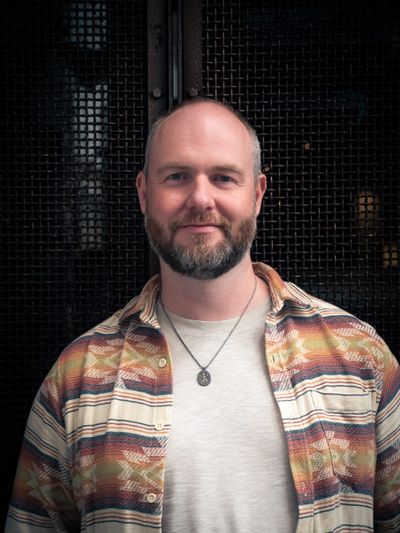
With curiosity and care,Danu Poyner
Write back
Replies from signed-in readers. They open in their own space, so you can sit with the piece first.
Write back
Replies to this letter