


If I agree to let the other person lead, will I have to do what they want?
This is a common concern among folks curious about dancing Tango. But it isn’t really about dance. It’s about people. Life brings us variations on this theme, again and again.
The dance floor offers one beautifully simple way to answer. Get people into a dance hold, then ask: Are you now compelled to do what the other person wants?
They laugh: No, it’s still up to me how I move my limbs.
That’s a great discovery to make, isn’t it?
It is the flipside of recognising that you can’t move someone else’s feet: nor can other people move yours (assuming that dragging you along bodily is off-limits).
… you can’t move someone else’s feet: nor can other people move yours (assuming that dragging you along bodily is off-limits).
Of course, freedom to move your limbs is only a small part of the question. The bigger part is about the rules.
If I let the other person lead a Tango, will the rules of Tango demand that I obey?
It’s not an unreasonable question, in a country where the rules of marriage once demanded exactly that. Correction: marriage rules only asked for obedience from the wife.
You may find it surprising that I also hear a mirror-question: if I take on the leading role, will the other person have to comply with my lead?
Why would people wonder or worry about that?
Because they’re imagining themselves into a role which may be new to them. They're trying to size up the kind of responsibility involved. If you’re expected to obey my lead, which makes you my puppet, and I walk you into a wall, the fault is mine. But I’ve never done this before! Extra responsibility can feel scary.
Partners share responsibility
When my son was in primary school, we played a game of leading one another. It began one night, when I came to collect my son from his after-school club. He complained of feeling tired. It had been a long day. The walk home was only a couple of blocks, but he was already looking limp. So I told my little lad to close his eyes and pretend as if he was asleep. I would walk him home, his hand in mine. When we got in, I tucked him up on the sofa with a blanket, and went to make supper.
The game became a favourite. A year later, when I was the one to complain of feeling tired, my son offered to swap roles. Picture a seven-year-old leading his mum by the hand along a city street. He kept checking that my eyes were completely closed. Closing your eyes really helps you rest, Mummy! I confess: I only half-closed my eyes, because I knew my young son had no experience of getting two people safely from A to B. Peeking from under my eyelashes, I could see when I was in danger of walking into a lamp post. So although I was playing the follower role, I nudged us to take half-a-step to the right and avoid the collision.
… although I was playing the follower role, I nudged us to take half-a-step to the right and avoid the collision.
Was my son being careless? Not at all! He was fully focused on the task he had taken on. But he was not yet familiar with how wide a curve you need to safely lead two people around an obstacle.
How long did it take for my son to learn? How long before he could safely steer the wider unit: him and me side-by-side? How long before I could trust his lead so comfortably that I could actually close my eyes? It took four or five goes, at most.
Why did I choose to take discreet action to course-correct that first time? Two reasons. I believed then – as I still do – that early successes matter. So I chose to help my son’s first go at guiding me by hand to work out well. I knew that, if he didn’t get scared off from the greater responsibility, there would be time to help him master the finer points.
Which brings me to the second reason. I knew that letting someone lead does not mean I have to do what they seem to want. Because my son was not yet experienced enough to take on solo responsibility for walking us along, I chose to treat that first stroll with him in the lead as a partnership.
From that perspective, I was certain that it was not my son’s intention to walk me into a lamp post. So I could help our partnership to work out well by taking self-chosen action, even from the follower position.
This helped our partnership succeed at the larger goal: for my son to experience that he could lead both of us, and to carry on refining his skill until he had it down pat.
(In case you’re wondering, my now-grown-up son is happy for me to tell you this story. I know because I checked.)
Let’s bring this back to the question we began with:
If I let someone lead, do I have to become their puppet? Do I have to fold away my autonomy and my power to choose?
Here is what I’ve learnt from Tango:
- leading ≠ domination
- following ≠ obedience
- responsibility ≠ control
Crucially: agency is available on both sides of a partnership. There is a seed of leading within following, and there is a seed of following within leading. Like in the Yin-Yang symbol, where the light seed of Yang appears within the descending wave of Yin, and the dark Yin seed is present at the heart of the ascending Yang wave. That’s why this series will talk of Lead+Follow, as well as Follow+Lead.
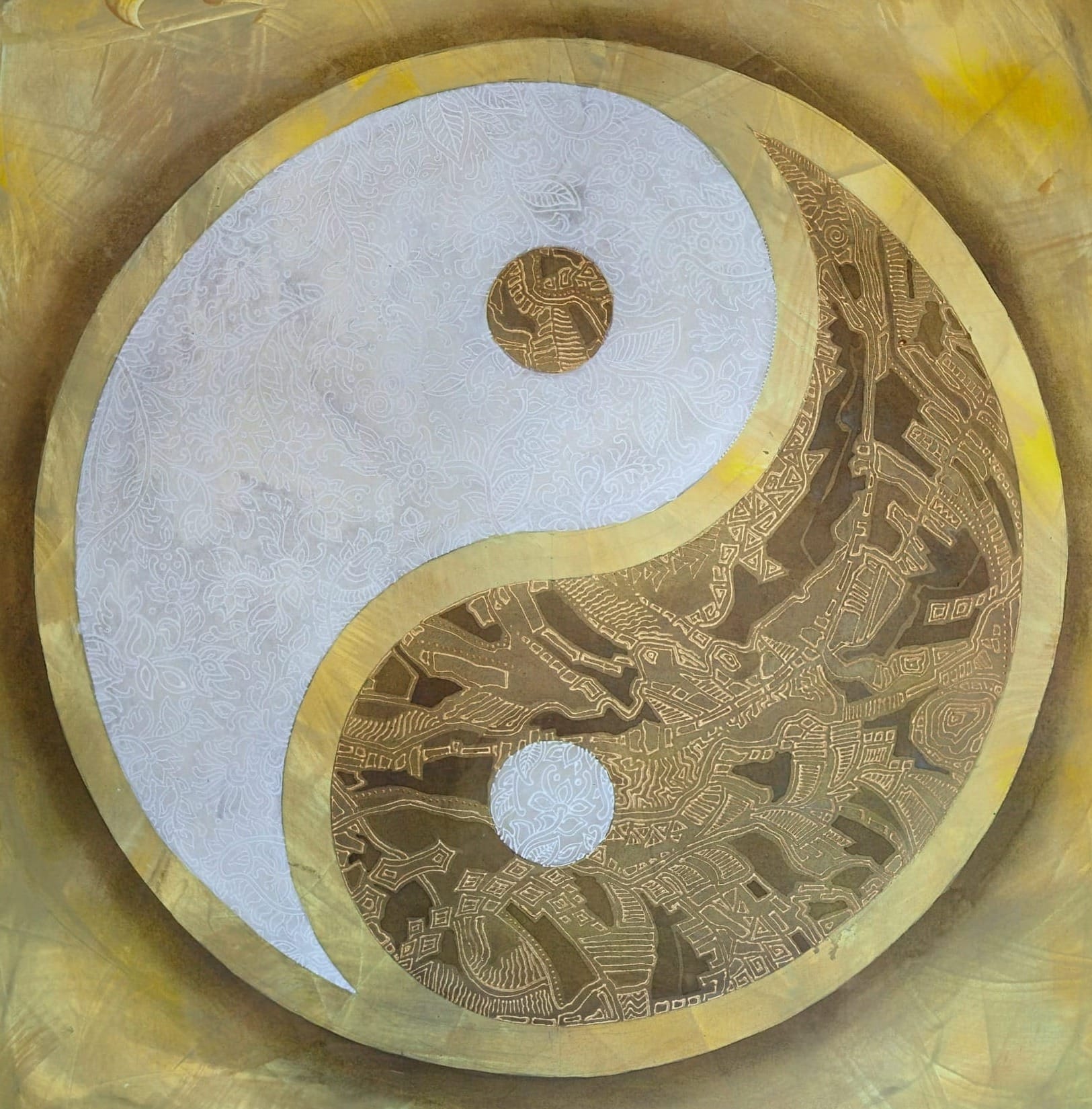
I showed you how I could lead from the follower position, by adjusting the trajectory that my son and I were walking. Perhaps you’ve already seen examples of agency on the follower side in your life or work?
Examples of following-within-leading are equally commonplace, in families and organisations. Some are dramatic U-turns, like when government leaders retract policy initiatives which meet with public pushback. Many more adjustments happen invisibly, under the radar, almost too quick to spot by the naked eye.
Fear of loss
In case you’re thinking, Margarita, this isn’t rocket science: I agree. This is what people do, every day… until they don’t.
Sometimes people don’t adjust, don’t pitch in, or don’t see what’s unfolding as a partnership.
That’s when we learn this fear:
If I don’t come along with what the other person wants, they may sever the connection – and it may be hard, or even impossible, to get them to change their mind.
If I don’t come along with what the other person wants, they may sever the connection – and it may be hard, or even impossible, to get them to change their mind.
This is the fear wincing in the corners of dating apps, meeting rooms, family kitchens.
It takes two Yes’s to keep a connection – but just one No is enough to end it.
The stronger the fear of being cut off, the harder it is to keep seeing what’s happening as a partnership where you have choices.
The fear pushes people towards one of two extremes: rebellion or submission.
Rebellion says: sod them, I can do without them. This is the path of the lone wolf: high on autonomy, low on connection.
Submission says: this loss would be devastating, I’ll shut up and put up. It points us to the other extreme: low on autonomy, inwardly cut off, high on social connection.
Both are attempts to cope with the pain of potential (or remembered) loss.
It is at such times that the lens of Autonomy-in-Connection really comes into its own. It serves to remind us that there is a third option to explore: the entire field of varying proportions of autonomy (which in the original Greek meant “living by one's own laws”) and connection (with its core meaning “to bind or tie”).
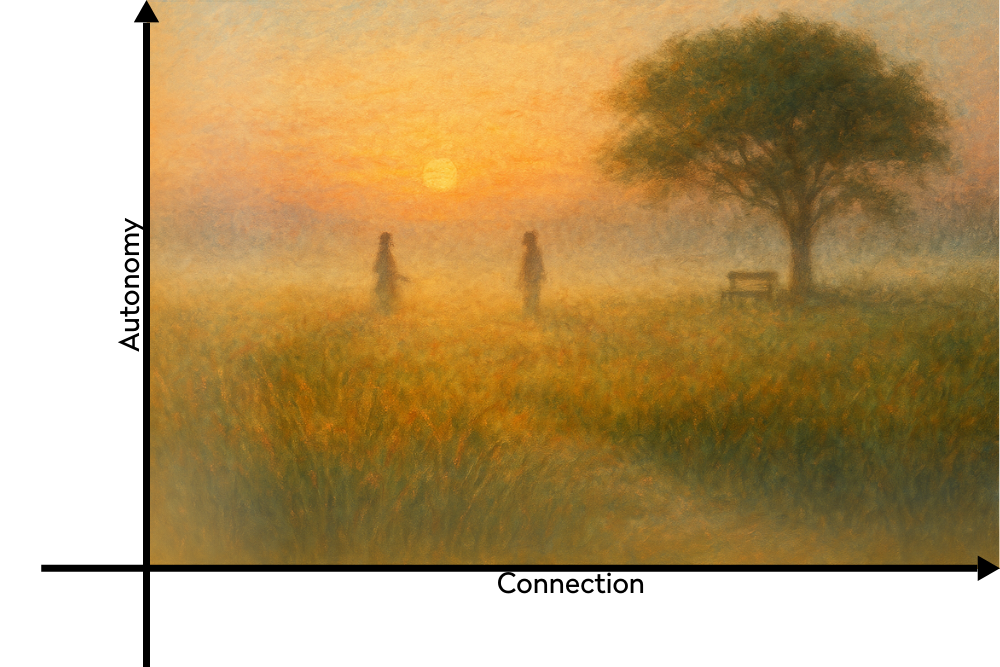
Why does this matter?
Because the more options you can stay aware of, the greater your chance of directing events towards an outcome of your own choosing.
When the road forks
Now, let’s acknowledge something tender. Even with the very best Lead+Follow moves, it may not be possible to always get the outcome you want. There are times when you have to countenance stark choices.
One such stark choice showed up for a university friend of mine whose family had come from India. This girl had grown up in London and was studying for a degree in biochemistry. But the call of tradition hadn’t disappeared from her life. Half-way through her studies, her family began to make arrangements on her behalf. If these arrangements went ahead, she would get married into a rural household in a small Indian village. She would become a wife and mother, leaving behind much of her earlier life. To refuse the marriage would mean that she’d get shunned by and excluded from her entire extended family.
There was no easy answer. Each course of action came with stark implications: sever ties of love, or abandon who you are in order to belong.
Each course of action came with stark implications: sever ties of love, or abandon who you are in order to belong.
It was painful to watch my friend grappling with her decision. It was as if her soul was reaching out to her family to say,
This is an impossible choice:
If I stay, I lose myself;
If I keep myself, I lose you.
In my friend’s case, she chose the anguish of separation… from her family, rather than from herself.
Fortunately for my friend, several years later her family relented and welcomed her back. But at the time of choosing, there was no guarantee that this would happen. It doesn’t happen for everyone who makes that choice.
My friend’s story reminds me that sometimes we can find no middle ground. Sometimes, we are looking at a fork in the road. Sometimes, submit or sever is where it’s at.
And then the next heartbeat may bring you a fresh set of choices.
Dancing with the tides
It can become a lifelong practice:
finding ways to stay grounded in your autonomy
without needing to cut off from others.
No matter how far along that road you travel,
there will be moments
when it feels hard to stay yourself
and stay connected.
If you keep looking,
you can find more options,
beyond fight — or flee — or fold.
Sometimes, you fight to stay.
Sometimes, you flee so that you can return.
Each new wave of the dance
will bring you something new.


Member discussion