


Have you ever let someone in too far, too fast — and felt astonished at how swiftly they managed to take over too much of your world?
The concept of personal boundaries is meant to help with that. It’s a sound idea – but in practice it can feel… unobvious.
Where should your boundary land today, with this specific person?
And how do you know when it’s time for it to move?
I wrestled with those questions years ago, as I tentatively entered the bustling arena of modern dating. I was meeting lots of people. Figuring them out felt like a strain.
Because I care about treating people well, I found myself pulling punches. Unsure how to slow some people down, invite others closer in, or even name what I wanted, amid the jostling of their wishes.
It took time for me to realise that the real hurdle wasn’t how to manage all those other people.
It was how to locate myself.
For years, I had lived as if exiled to the outskirts of my own world — not as its ruler, but its Cinderella. My concern for others had crowded me out. It was as if everyone else mattered more than I did.
For years, I had lived as if exiled to the outskirts of my own world... My concern for others had crowded me out.
I did not yet know how to matter in my own world, without diminishing anyone else.
There’s a phrase in Russian that translates as “I am the last letter of the alphabet.” The last letter is Я — which also happens to mean “I.”
I remember hearing this phrase repeated in my family as a warning not to get too big for my boots. Don’t take up too much space. Don’t count yourself first.
I had lived like that. Last.
But as I prepared to re-enter the dating pool, I wasn’t just hoping to meet someone. I was determined to create a new world for myself — one where I could truly belong. A world that felt like mine, so that when I welcomed someone into it, I did so as its sovereign.
As I tested the waters, I realised that, when you live exiled to the outskirts, you become familiar only with the outer gate. Your only power there is to let people in or to push them out. (We talked about these extremes in Letter 3.)
Now I needed something, some way of thinking, some metaphor that could help me navigate the field of options combining Autonomy and Connection.
Some way to re-order my world with me at the centre, to help restore my command of its full depth.
I had to keep reminding myself: ruling your own domain is not selfish – it is responsible and necessary.
Drafting my citadel
As I searched for a way to do this, I chanced across a picture of Minas Tirith, the seven-tiered fortress-city of Gondor in J.R.R. Tolkien’s Lord of the Rings.
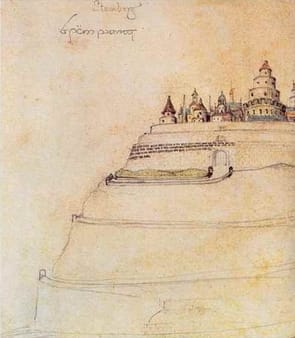
It looked both beautiful and strong. Perhaps my inner domain could look like that? Only, I wouldn’t want my world to become a barren fortress. I wanted it luscious and lush! So I turned my fortress into a tiered garden, and became its Head Gardener.
My garden is built on a conical hill. The grounds are arranged as eight concentric rings descending from the central circle, creating nine tiers: nine steps down to the outlying plains.
Each tier represents a certain level of trust and proximity with people in my world. Beyond the outer wall is the wider world: the many people who are not part of my social life.
The top tier is Level 1. It is my base. The count begins with me. To be my world’s custodian and steward, I need to count myself first. The outermost level – Level 9 – is where newcomers arrive. Each tier offers a space where people can get to know me, and where we can progressively build more trust with each other.
To be my world’s custodian and steward, I need to count myself first.
For someone to move inward is not a right. It is a process.
Trust, consistency, mutuality — these open the gates from one level up to the next.
Movement is gradual. No one leaps from the outer rim to the innermost circle in a single bound. And movement is not only inward. If trust erodes, proximity can adjust.
The structure remains steady. I no longer reinvent my boundaries from scratch with each new person. My world has a shape of its own.
As this vision formed in my mind, the relief was immediate.
I no longer felt bewildered. I had a way to see and think, to notice and decide.
Regulating others’ access and position
Let me show you how this works in practice. I offer the Citadel to clients as a way of thinking about their relationships. Here’s what such a conversation might sound like. In this example, my client is talking about wanting to restore trust and intimacy with her husband.
We began with me asking: Where in your Citadel do you feel your husband is right now?
Client: Level 4, I think. She nods to herself. Yes, Level 4 makes sense: I’ve been bottling up a lot. It hasn’t felt safe to let him know what’s really going on with me, below the waterline.
Margarita: Okay, Level 4 is where you feel he’s at. Where would you like him to get to next?
C: She gasps as she speaks. Level… Level 3.
M: This is not what you expected yourself to say?
C: No! Not at all! I thought… I thought all the barriers were from his side. I thought I just wanted us back to how we were, back to how we were on our honeymoon.
M: Hearing yourself say Level 3 – what is that telling you?
C: It tells me… that I’m not ready. I’m not ready for us to leap to Level 1. I thought it’s what I wanted. But now I realise I’d need the trust to notch up slowly, bit by bit.
M: And how does imagining that feel: him shifting from Level 4 to Level 3?
C: It feels much more possible. I hadn’t realised it, but imagining him going from Level 4 to Level 1 felt too abrupt. Too big a leap. Which made it seem unlikely. Or even… not possible.
M: And what would be different at Level 3, from how it’s been at Level 4?
C: It would seem like he is trying. Trying to reach out to me. Oh! Wait… maybe he has been trying. Her eyes are brimming up. He said this thing the other day. It sounded tense. But now I’m thinking about it, I think maybe that was him trying to reach out to me.
The Citadel doesn’t make decisions for you. It’s there to help you notice things, inside and outside yourself, that might get overlooked otherwise. It’s meant to support your freedom to decide. From your base at Level 1, you can often see and sense more clearly.
A stable structure for a dynamic dance
At first, the Citadel may seem too rigid a framework for the complex, fluid interplay of Lead+Follow.
See if this concern dissolves when you picture a delicate dance taking place in a landscaped garden. The structure provides a shape, it doesn’t determine what you do.
In a future Letter, we’ll walk through some of the everyday situations where this way of seeing can bring clarity: dating, friendships, family expectations, workplace dynamics, and the modern maze of digital intimacy.
For now, here is a shorthand way to tackle what we might call “Citadel puzzles.” For each such inter-personal puzzle, you could ask:
- Where is this person currently standing in my world?
- What behaviour are they showing?
- Does that behaviour match the level they occupy?
- Has the next gate been earned?
Instead of asking “Is this person in or out?” I could ask a subtler question: Which level are we on right now — and have they earned the next gate?
The Citadel is yours; it’s not there to impose categorical rules. It’s there to give you categories with which to think. The keys to unlock the gates from one level to the next are still in your hands.
Many years after I came up with the image of the 9-level Citadel, I discovered a psychology modality that brought me a new perspective on the numbering I’d used.
Solution Focused Brief Therapy (SFBT) uses a technique called Scaling to help people make distinctions in their thinking and feeling that they otherwise find it hard to put into words.
Steve de Shazer, developer and pioneer of SFBT, talks about Scaling in his book Words Were Originally Magic:
[W]e took a cue from some of our clients’ spontaneous use of scales and developed ways to use scales as a simple therapeutic tool. (p 92)
Having trained in Solution Building Couples Therapy (a version of SFBT tailored specifically for work with couples), I now use scales in many other contexts, not just to map proximity and trust.
The most common scale I use these days is 1-10. Other ranges can be just as valid (I chose 1-9 for the Citadel to keep to single digits).
Scaling can be used to talk about anything intangible: levels of confidence, how happy you are in a new job, or how ready you feel to try something new.
Even so, the Citadel remains a metaphor I return to often. Its spiral of social connections continues to bring much-needed gifts.
An ecosystem of relationships
Over time, the Citadel has grown beyond the sphere of romance or friendship. More recently, I’ve used it to imagine into the web of relationships around my work.
A business, too, is a world.
It contains intimacies and acquaintances. Collaborators and passing contacts. Long-term companions and curious newcomers at the gate. For a while, all of this felt diffuse to me — as if everyone existed in one bright, undifferentiated field. I responded to every email with the same urgency. I extended access without noticing I had done so. I oscillated between overexposure and retreat.
So I drew it.
To make the shape visible and tangible, I turned to a practice called NeuroGraphica — a meditative drawing process that begins with lines and intersections and slowly transforms them into an integrated image. As the lines meet, you round their sharp angles. You soften collisions. You create coherence.
It struck me that this is precisely what we do in relationships.
On the page, I began with a central point. Level 1. Me — not as ego, but as steward. From there, concentric layers emerged. Clients with whom I work closely. Long-standing collaborators. Professional peers. Occasional partners. Readers. The wider public.
As the drawing unfolded, something in my body settled.
Not everyone needed the same access. Not everyone required the same intensity of response. Some relationships were meant to be seasonal. Some spaces were pathways inward. Others were part of the surrounding landscape.
Seeing this did not make me colder.
It made me calmer.
Because once the ecosystem had shape, I could respond appropriately instead of reactively. I could tend what was near without neglecting what was further out. I could allow certain connections to remain light and porous, without mistaking that for failure.
… once the ecosystem had shape, I could respond appropriately instead of reactively.
The garden-citadel reminds me that relationships — whether personal or professional — flourish when they are placed well. When proximity matches trust. When depth is earned. When movement inward is gradual and mutual.
And at the centre, there must be someone who belongs.
Your Citadel
What makes you belong is both what you do,
and how you are received.
When it comes to belonging in your own world,
you are the host.
As the First Citizen of your Citadel,
you have the power to welcome yourself in.
Your realm is unique to you.
It will look vastly different from mine –
which is great, and how it should be.
May those who come into your orbit
tread a respectful dance
in your terrain.
If you had the power
to shape your world as suits you best,
how would you like it to be?


Member discussion