







Unforgetting becoming legible to yourself
Wisdom you can't see in yourself
Tacit knowledge, the tomato in the fruit salad, and a playful way to name what you know best: your Greatest Hits set list.


“We can know more than we can tell.” — Michael Polanyi
Picture a teenage Lionel Messi picking up the ball near halfway and going. He feints, ducks and weaves past one defender after another, five or six of them, and scores. The whole ground stands up.
Watch the real goal.
How did he do that?
He couldn't tell you. And if he'd had to think about it, he would have lost the ball. It was too fast for thought and too precise for luck.
That's tacit knowledge: knowing that lives in the body as much as the mind, and turns up just when it's needed. The philosopher Michael Polanyi put it in a single line. We can know more than we can tell.

Where it comes from
Nobody is born knowing how to do that. It comes from years of repetition, until the body remembers what the mind no longer needs to process. Experience builds a feel for patterns, so you read a situation before it unfolds. A firefighter senses that a building is about to go before they could explain why. A jazz musician stops monitoring the scale and lets the moment lead.
It looks like magic. It's deep experience playing out at high speed.
You have this too. Probably in places you'd never think to look.
From skill to wisdom
Skill is half the story. What turns it into wisdom is judgement: knowing the right thing to do, at the right time, for the right reasons. The ancient Greeks called this phronesis, practical wisdom. Aristotle thought of it as the master virtue, the one that ties the others together.
Take the firefighter from earlier. Skill is knowing how to put out the blaze. Wisdom is knowing whether it's worth sending the crew back into the building at all, and when to hold everyone back. It's the same expertise, put in service of what matters most. That's practical wisdom.
There's a line usually credited to the writer Miles Kington: knowledge is knowing that a tomato is a fruit; wisdom is not putting it in a fruit salad. It's a joke, but it points at a serious difference in how we decide what's good.
One way is to judge by results: if the outcome is good, the means matter less. That's the logic behind most public policy. Another is to get the rules right and then follow them, trusting that good outcomes will come; that's the logic behind codes of conduct and human rights. Aristotle's tradition, virtue ethics, offers a third. Good action comes from good character, and the work is to become someone who can see what a situation needs and respond well, in ways no rulebook or forecast could have spelled out in advance.
That kind of knowing is real, and for people who've learned across many worlds it's often the most valuable thing they have. But because it can't be written down, it's also the hardest to see.
Invisible to the untrained eye
The brothers Hubert and Stuart Dreyfus, a philosopher and an engineer who spent years studying how people become expert, describe a study with six people filmed giving CPR. One was an experienced paramedic. The other five were trainees. Viewers were asked which of the six they'd want to resuscitate them.
Experienced paramedics picked the expert almost every time. Students managed it about half the time. The CPR instructors, the people who teach the theory, did worst of all: fewer than a third chose the experienced paramedic.
Sit with that for a moment. The people who knew the rules best were the worst at spotting real skill, because real skill doesn't look like the rules. The experienced paramedic was skipping steps the textbook insists on, for reasons the textbook can't hold. The social scientist Bent Flyvbjerg retells the study in Making Social Science Matter for exactly this reason.
Expertise is often invisible to anyone who hasn't lived it. Very often that includes the person who has it.
Your deepest expertise is often invisible, even to you. And until you can name it, nobody else can see it either.
A bootstrapped apprenticeship
Traditional crafts have always passed this kind of knowing along by apprenticeship. You stand beside the smith. You learn how hot the iron should look and how the hammer should feel in your hand. Nobody writes it down. You watch, you copy, you start to modify, and one day you improvise.

Most curious, many-sided people never had a formal apprenticeship in the thing they're best at. They cobbled one together from the episodes of their lives. For me it was years of retail and hospitality, long before any degree. The jobs are on my CV. What isn't is everything the shop floor taught me: reading someone's mood in the first few seconds, knowing when to joke and when to just listen, helping someone who has already decided to be angry. I draw on that in my accompaniment work every day, more than on anything else I've learned.
Knowledge gathered that way is every bit as real. It's deeply embodied, and deeply yours. But because there's no line on a CV for it, it's easy to decide it doesn't count.
From repertoire to set list
Making this kind of knowing legible means naming its shape. A procedure would flatten it. A name lets you find it again, and use it on purpose.
Think of it as a repertoire: a lived library of what you instinctively know how to do. The best performers also know how to read a room and play the right song when it matters. So here's a playful way in. Write your Greatest Hits set list.

Here are a few of mine. Tumpty Tum is the five minutes at the start of a gathering when I say a few calm words and the room arrives. A Breath of Fresh Air is a phrase people kept using about me at work, until I gave up arguing and claimed it. Ventriloquise Me Baby is when someone reads what I've written for them and says, that's what I would have said, only better. (A ventriloquist is literally a stomach-talker: you get into someone's guts and speak from there.) And Emotional Support Labrador is the one nobody can explain, me included: things just become possible when the Labrador is in the room. It has since become an actual song, which is what happens when you take your greatest hits seriously.
None of these would survive on a CV. All of them are true. And naming them as songs makes them easier to play on purpose.
Someone in an earlier group dreaded this exercise and came back with Bloom Where You're Planted: I don't always get what I want or what I need, but wherever I land, I can make something beautiful. It brought the house down.
As you try this, you may feel a flinch. Does this even count? Just notice it. You don't need to solve it. That flinch is a threshold of its own.
Try this
Give yourself about half an hour. Start by priming the pump. In place of “What am I good at?”, try these:
- What do people often come to you for?
- When do you feel most in flow, doing something without effort?
- What have you learned the hard way that now feels obvious?
- If you disappeared, what gaps would people notice, straight away or after six months?
Then go back through your memory for things other people have said about you. The compliment that embarrassed you. The thing two different colleagues said years apart. Write those down too.
Now give each pattern a name, as if it were a song in your repertoire. Like a good song title, it only needs to make sense to you. Then put them in order:
- What's your opener?
- Which one brings the house down?
- What's the quiet ballad near the end?
- What's the encore?
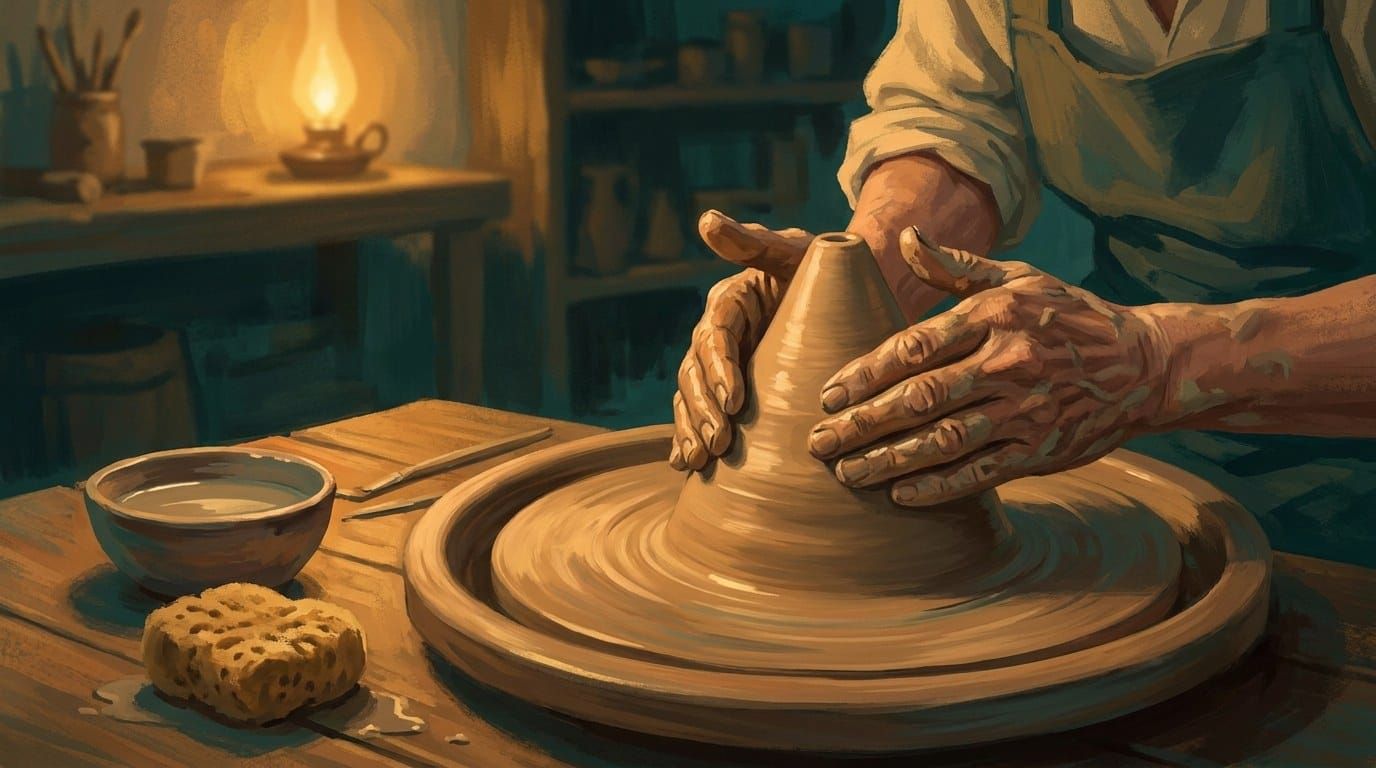
If you're feeling brave, give the whole tour a name. Early drafts are rough. That's fine. There's clay on the wheel.
For a printable version of the warm-up questions, the steps and a set list poster to fill in, there's a sheet to keep: Greatest hits set list (PDF) ↗
Preparing a Red Thread Talk? Your set list is a page of your kit. Keep it close.
Alongside this piece
Try it for yourself
Two small things to do with what you've just read. Open either one.
1 Could you write it down?
Make the call on each one before the answer appears.
2 Your Greatest Hits set list
Prime the pump first, then name the songs. It saves in this browser as you type, so you can come back and add to it. When you're ready, gather it into one set list you can keep.
Prime the pump
Rough is fine. Skip any that don't spark.
Name the songs
Give each pattern a title, like a song in your repertoire. It only needs to make sense to you. Use the arrows to put them in running order: opener first, encore last.
The tour
Nothing you write here leaves your browser.
Unforgetting · becoming legible to yourself

In good company
Replies from signed-in readers. They open in their own space, so you can sit with the piece first.
In good company
What came up for you?