







Unforgetting becoming legible to yourself
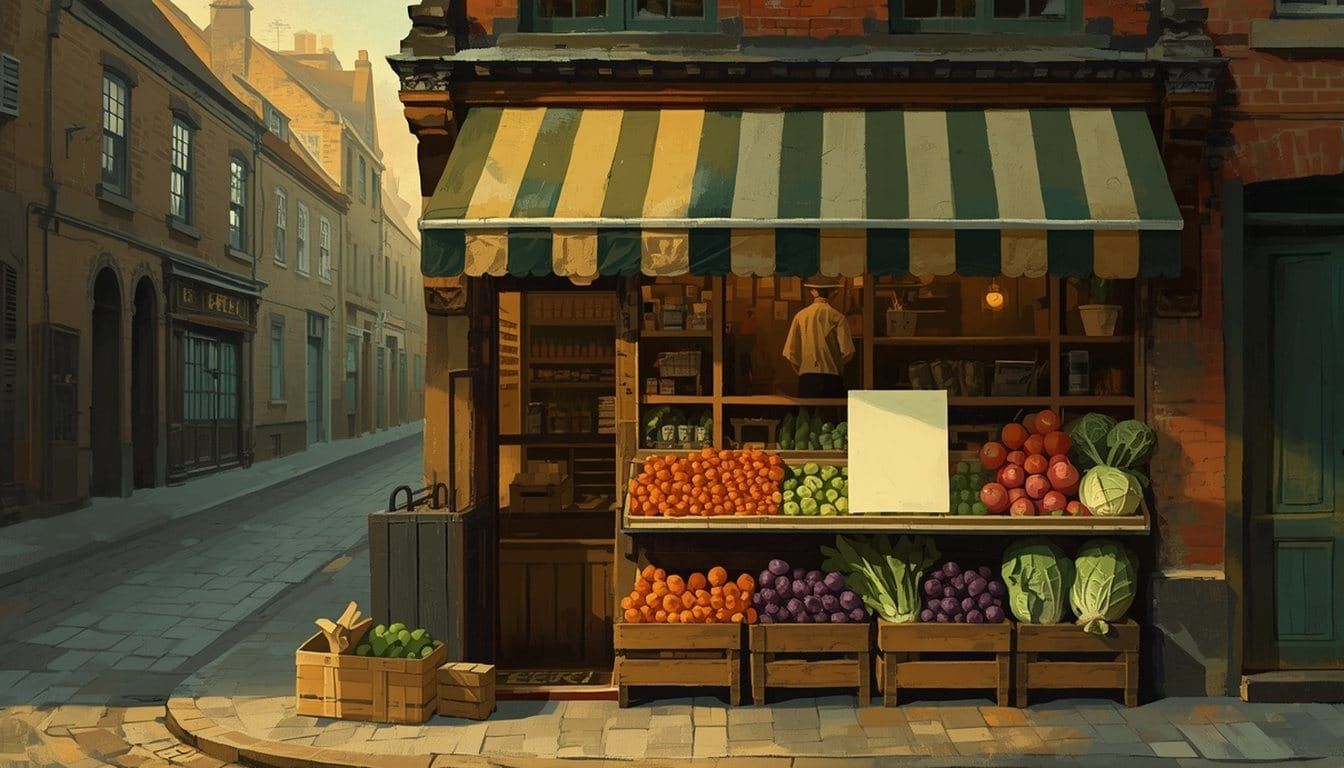
The Greengrocer's sign
Where your care was trampled on, the reasonable rules you learned from it, and what it means to take the sign down.


“History is what hurts.” — Fredric Jameson
Ask someone what they care about and you'll usually get a tidy answer. Family. Honesty. Making a difference. Ask at a job interview and it's teamwork and integrity. Ask a company and it's innovation and respect, painted on the wall of the lobby. It's all true, and it tells you almost nothing. Nearly everyone reaches for the same few words, and none of them explain why one person walks away from a secure job over a principle while another shrugs the same thing off.
There's a faster way in. Look for the moments when your care was trampled on: when you were dismissed, or shamed, or made to feel small for caring at all. Those moments stay vivid for decades, and they point straight at what matters.
The yellow crayon
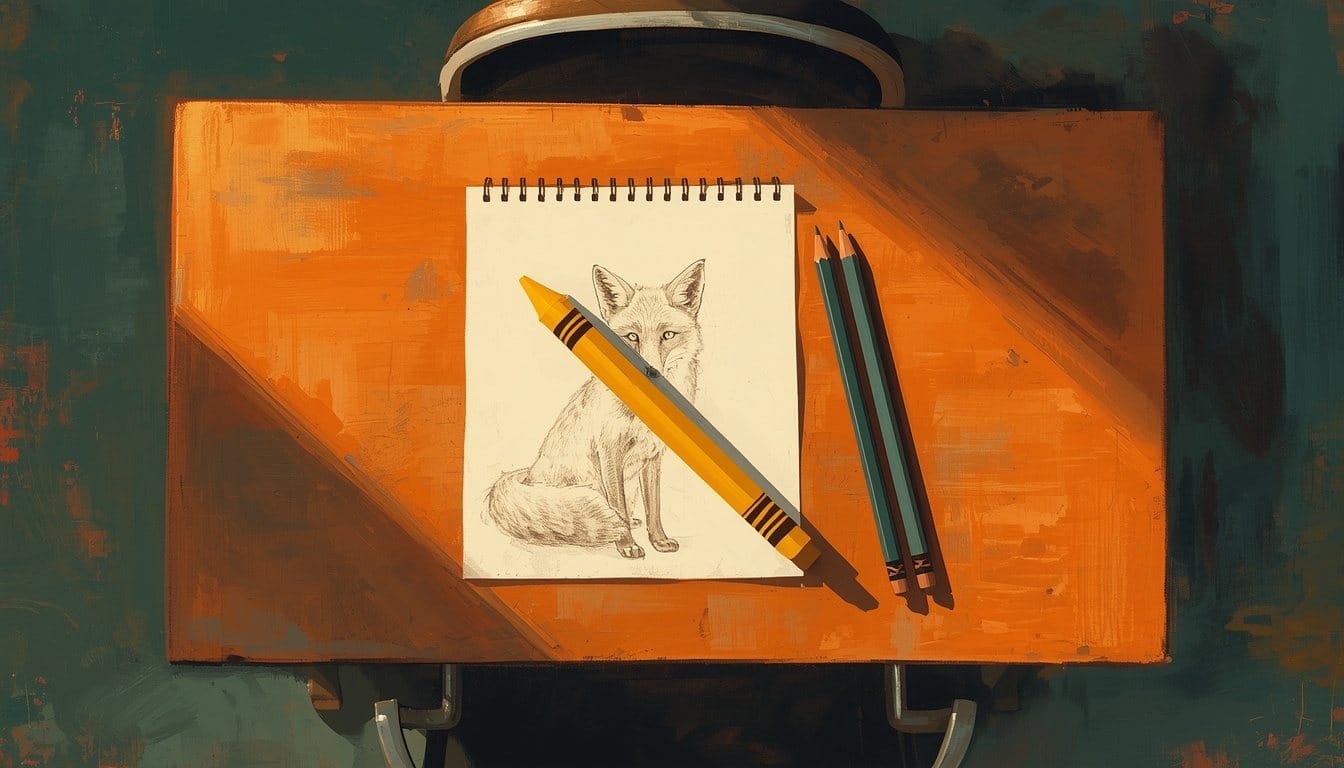
My mum is a fine pencil artist, and one of the mildest people I know. At fifteen she had just moved from England to Australia, and in her first art class at the new school the teacher set a drawing competition. She took out her pencils. The teacher stopped her. She was to use a yellow wax crayon instead, so she wouldn't go over the lines.
She'd been producing good work for years, and she felt like a five-year-old. So she said, flatly, that she would not be using a yellow wax crayon, and went on drawing in pencil. At the end of the lesson her classmates voted her drawing the best in the class. The teacher disqualified it for not being in crayon.
That was more than fifty years ago. When she tells the story now, you can still hear the rage under her mild voice, and she always ends it with the same question about that teacher: What on earth was she trying to teach us?
Everyone has yellow crayon stories. One of mine comes from university, in one of the rare classes I loved: sociolinguistics, the study of how language and society shape each other. I put real effort into the assignment, and the lecturer called me pretentious for using the word preternaturally. I'd chosen it because it was the precise word I needed. From most people that would have been a quibble about style. From a linguist, someone whose whole field is the power of language, it felt like a betrayal of the very thing the subject was meant to love. I tried to talk it through. They weren't interested.
Before that, at school, I was regularly accused of plagiarism. I hadn't copied anything; my teachers just didn't believe someone my age could have written it. I took it as a backhanded compliment for a while, until I saw it for what it was: low expectations dressed up as suspicion. Eventually I stopped handing work in at all.
Small infractions, remembered in sharp detail. That sharpness is the clue. Something you cared about was stepped on, and part of you took note.
What we learn instead
The yellow crayon rarely teaches the lesson it was meant to. What it teaches is that it's unsafe to show up that way.
So we adjust, usually without noticing. If we've learned that we're too much, we start censoring ourselves. We stop asking hard questions, so we won't be thought of as difficult. We stop saying “I love this!” in case it sounds childish. We stop offering the idea in the meeting, because last time it was laughed off.
Or the care finds another way out. Someone who was never allowed to be angry becomes very funny instead: sarcastic, ironic, quick with the self-deprecating line. A child who was seen and not heard grows up to tell the truth through fiction, perhaps under another name. Even our games give it away. Offered a role-playing game where we could be anyone, most of us play as ourselves first. The second time through, we try the shadow version, the one who does what we never could.
Whole cultures do this too. Many of us grew up somewhere uneasy with visible sincerity. Show how much something means to you and the response is a polite wince: settle down, put it back in the box. Effortless cool gets rewarded and trying hard gets mocked. So plenty of us learn that the safe way to love something is to look relaxed about it.
The care stays put. Repression works like a beach ball pushed under water. The harder you push, the more energy it stores, and sooner or later it comes back up. Sometimes as burnout or rage. Sometimes as a private passion you can't quite explain.

The lessons from your yellow crayon stories turn into rules you live by. And the rules sound perfectly reasonable.
The sign in the window
In 1978 the Czech playwright Václav Havel wrote an essay called The Power of the Powerless. Czechoslovakia was then a communist state under Soviet control, ten years after Soviet tanks had crushed the Prague Spring. Open criticism could cost you your job, your children's education or your freedom. Havel's plays were banned, and he was in and out of prison. (Eleven years later he became his country's president.) At the heart of the essay is a greengrocer.
The greengrocer puts a sign in his shop window, among the onions and carrots: Workers of the world, unite! Havel asks what the sign really means. The greengrocer gives little thought to the workers of the world. The sign came with the vegetables, and he puts it up because everyone does, and because there might be trouble if he didn't.
If the sign told the truth, Havel suggests, it would read: I am afraid and therefore unquestioningly obedient. The greengrocer would be embarrassed to put that in his window. So the slogan does the work for him. It lets him signal that he'll go along, while looking as though he's expressing a belief.
A whole system can run on small gestures like this. Nobody has to believe the slogans. Everyone just has to display them, which makes each of us both a victim of the system and one of its supports. Havel calls these small gestures a bridge of excuses between the system and the individual: each slogan lets the person displaying it tell themselves, and everyone else, that nothing much is being asked of them.
Then Havel asks: what if one day the greengrocer simply stops putting up the sign?
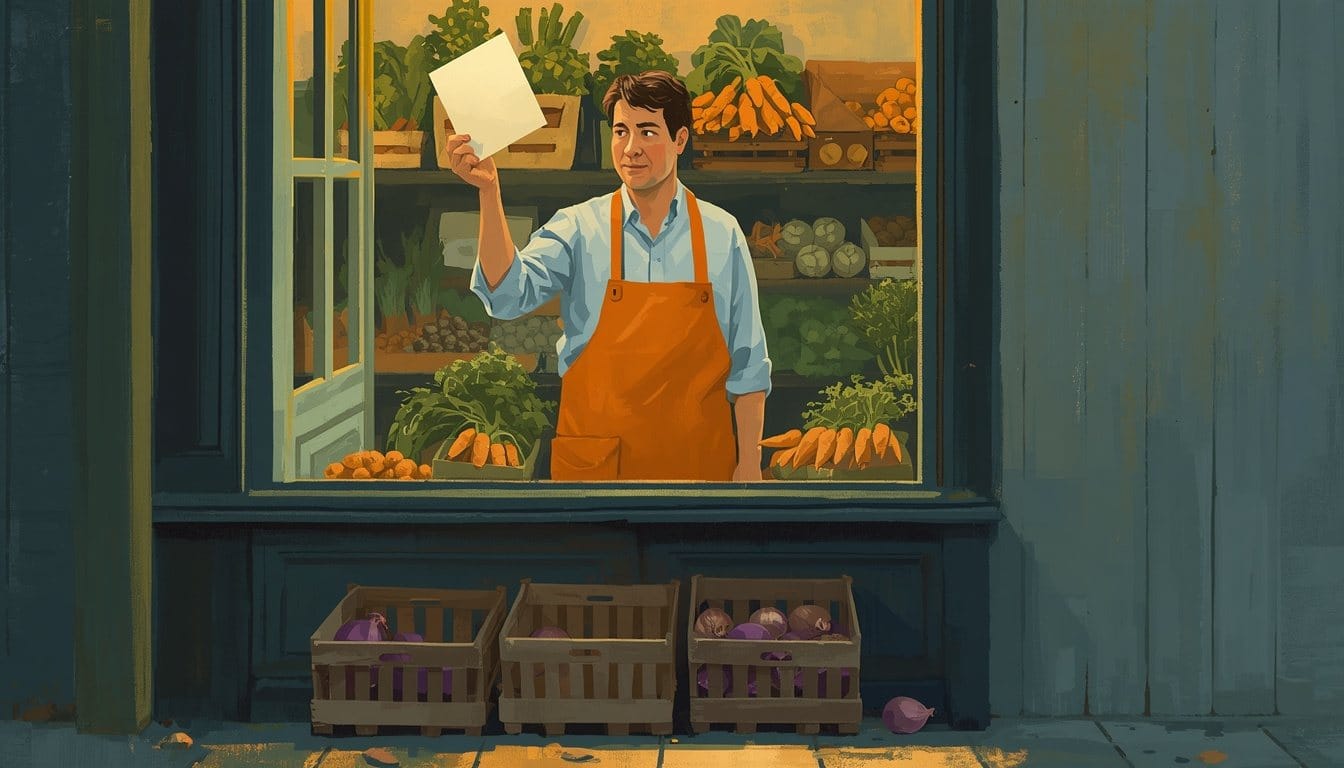
In a regime like that, he'll pay for it. Havel spells out how: the greengrocer is moved from managing the shop to the warehouse, his pay is cut, his holiday is cancelled, and his children find their way to university quietly blocked. Neighbours with nothing against him look away, because being seen with him is now a risk.
And yet he will also have done something significant. Havel calls it living in truth. A system built on everyone pretending can only stand while the pretence is universal. One person stepping out of line shows that the emperor has no clothes. That's why the punishment comes so fast: the danger was never the greengrocer, it's the example he sets.
In Solomon Asch's conformity experiments in the 1950s, people asked to match the length of lines often went along with a room full of actors giving the wrong answer, against the evidence of their own eyes. When just one other person gave the right answer, most of that conformity fell away. Most of us are waiting for permission to say what we can already see. Living in truth is contagious.
Your own sign
Few of us live under a regime like Havel's. But the greengrocer's move, displaying something we don't believe so we'll be left alone, turns up everywhere. Brought home into ordinary life, Havel's question becomes: where is your own sign?
A Greengrocer's sign is anything you do to perform alignment with a system you don't actually believe in.
Most of our signs are quieter than a slogan in a shop window. They sound like ordinary good sense. Pick your battles. Keep the peace. Stay humble. We picked them up from our yellow crayon stories, and we display them to ourselves as much as anyone.
Under each one sits an honest fear. Translate Pick your battles the way Havel translated the greengrocer's sign, and it might read: If I point out the problem, I'll become the problem.
Naming the fear changes things. Sometimes you're ready to take the sign down. Sometimes you're not yet, which shows you what you'd need first. When you are ready, there's usually a truer line waiting underneath. Pick your battles can become Some battles pick you: some things matter enough that staying quiet would cost more than speaking up.
Trudi Boatwright, who I talked with on the Still Curious podcast, teaches people how to play. She has done it with seriously ill children in hospital, with women in prison preparing for job interviews, and with corporate teams. For years, though, she avoided the word. Say creativity, she told me, and people revere it. Say play and they dismiss it. So when someone asked what she did, she'd stall and reach for something more respectable: “Oh, I'm a, um, well, I've got the arts… and I'm experiential… and it's communication…”
One day she was too exhausted to keep it up. “I just didn't have the energy to bullshit,” she said. So she told someone, “I teach people how to play.” And they said, “Oh yeah, I like it.”
For years she had been translating her life's work into the language she thought the gatekeepers wanted, and the translation was what made people's eyes glaze over. The sign was hers, not theirs. Once she took it down, the work found her. She now speaks about play all over the world.
Living in truth rarely arrives with a fanfare. Mostly it happens in small moments that come and go quickly. The room agrees with something and you find yourself clapping along, then think: hang on, I don't agree with that. Someone is being picked on in the office or the schoolyard, and there's a second in which you could step in. You perform busyness, or the corporate smile, when neither is how things really are. You make the case for what you care about in the gatekeepers' jargon, because their language feels safer than yours. Each of these is a chance to take the sign down: stop clapping, step in, say how things actually are, describe your work in your own words.
Occasionally a small refusal becomes public. When the American footballer Colin Kaepernick took a knee during the national anthem in 2016, in protest at police brutality and racial injustice, the uproar was out of all proportion to the gesture, because the gesture questioned far more than a song. Rosa Parks simply stayed in her seat. Most of our acts will never be seen beyond a meeting room or a family dinner. They ripple anyway. In Asch's experiments, it only took one.
Try this
Do this on paper, in order. Stop wherever feels like enough for now.
- Find your yellow crayon. Read the list below and mark any you recognise. Choose the one to three that feel loudest.
- Name the sign. What reasonable-sounding rule did you take from each? Write it as a slogan.
- Translate it honestly. Under the slogan, write the fear it covers, as If I…, then…
- Check if you're ready. Could you take this sign down? If not, what would you need first?
- Write a living-in-truth line. A sentence you could put in the window instead.
Some yellow crayon moments to start with:
- Swallowed my frustration to keep the peace.
- Chose “practical” over what I really wanted, because I was afraid of looking foolish.
- Stopped myself from saying “I love this!” because it seemed childish.
- Didn't push for what I wanted, because I didn't want to be difficult.
- Made myself smaller so someone else would feel more comfortable.
- Played it cool instead of showing how much something mattered to me.
- Learned that challenging authority gets you labelled difficult.
Then, over the next week, notice when the old sign goes back up, and try one tiny act that contradicts it. Say what you actually think. Ask for what you need without apologising.
For a printable version of the bingo card, the sixteen signs with their fears and truer lines, and the five steps, there's a sheet to keep: The Greengrocer's sign (PDF) ↗
Alongside this piece
Try it for yourself
The same ladder as the article, one rung at a time. Open either part.
1 Yellow crayon bingo, for one
Tap every square you've done at least once. Be generous with yourself; nobody is checking.
2 Take down the sign
Choose one moment and climb from the story to the sign, the fear, and a truer line. Each step has a translation you can peek at if you're stuck. It saves in this browser as you type.
The moment
The sign
The honest fear
Ready?
Either answer is useful.
Living in truth
Nothing you write here leaves your browser.
Unforgetting · becoming legible to yourself

In good company
Replies from signed-in readers. They open in their own space, so you can sit with the piece first.
In good company
What came up for you?