







Unforgetting becoming legible to yourself
Coddiwomple
Travelling purposefully toward somewhere you can't see yet, and coming back round to the same questions, changed.



“We shall not cease from exploration, and the end of all our exploring will be to arrive where we started and know the place for the first time.” — T.S. Eliot, Little Gidding
Most of us were taught to know where we're going before we set off. Where, why, and how we'll know we've arrived, preferably before the first step.
School asks what you want to be when you grow up. Job applications ask where you see yourself in five years. Even holidays come with itineraries.
Some of the most meaningful journeys start somewhere else: in not-knowing. That can be vague and accidental. It can also be chosen, with real trust in what hasn't shown itself yet.
A word for the chosen kind
There's a word for it. To coddiwomple is to travel purposefully toward a vague destination. You don't know exactly where you'll end up. You do know how you want to travel.
It's purposeful wandering, guided by what resonates. It's active readiness.
There's a line often credited to Lewis Carroll, though it's really a paraphrase of the Cheshire Cat that George Harrison later turned into a song: if you don't know where you're going, any road will get you there. It usually gets trotted out as a warning about planning.
It can also mean something kinder. If the destination is open, what matters is how you travel, and who you are while you do.
You've probably been coddiwompling for years without a name for it. Think of the most meaningful things in your life: a friendship, a piece of work, a place you love. How many of them came from following a plan, and how many from a detour you nearly didn't take?
The wellspring and the spool
This whole sequence started with an ugly question: so, what do you do? Any polished answer you could recite would be frozen at the moment you made it, and you keep moving.
So the aim was never the perfect answer. It's to get better at finding your way back to the place the answers come from.
Think of it as a wellspring. It's the curiosity, care and wonder that bubbles up again and again, whether or not anyone asked for it.
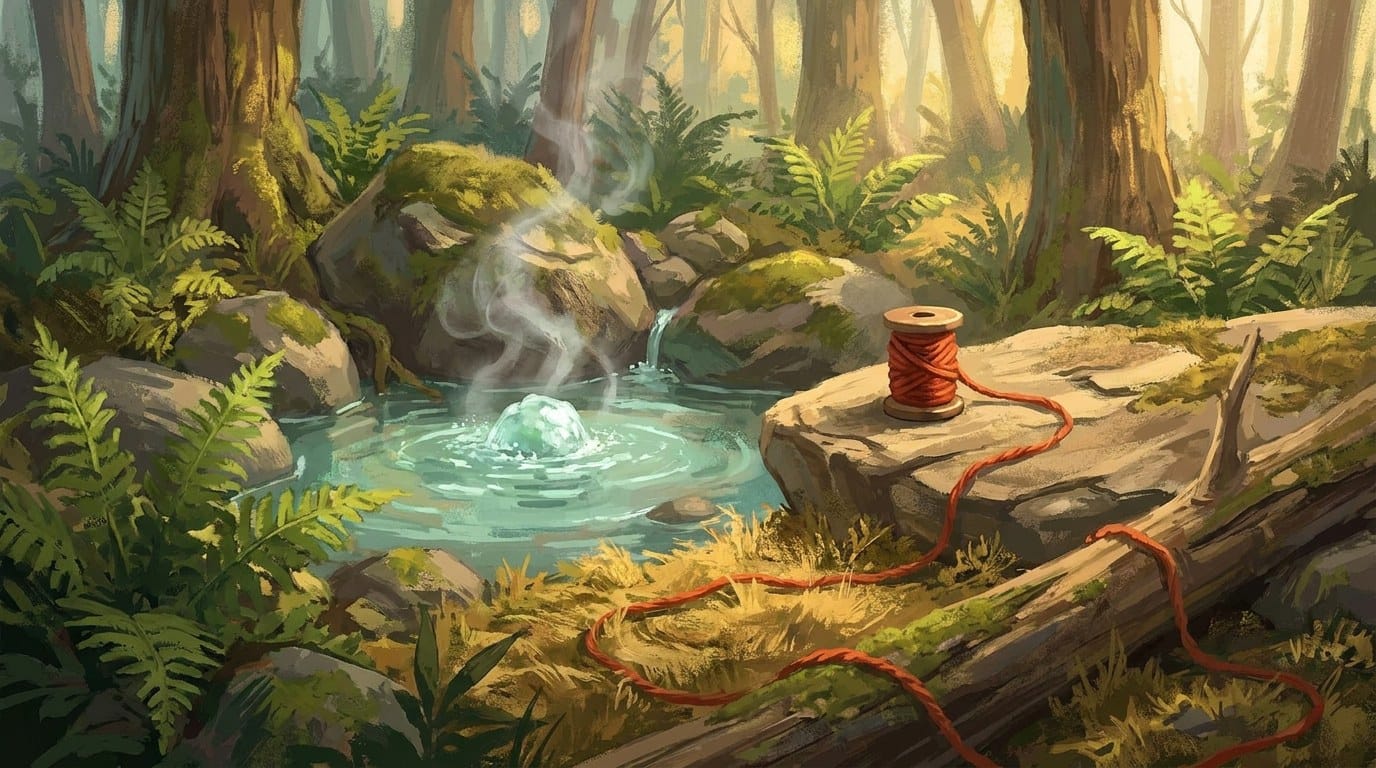
Your red thread goes underground sometimes. You get busy, or pulled in other directions, and lose touch with it. Months go by and you realise you haven't thought about the thing you love in ages. That's ordinary. What matters is knowing the way back.
Follow the thread back far enough and you reach the spool, where it's wound tightest and the energy is clearest.
When someone speaks from their spool, you can feel it, even if you couldn't say what it is. Their voice changes. They lean forward. The nearest everyday word we have is that they light up.
Three strands
Everything in Unforgetting so far falls into three strands.
Resonance is what stirs you. Your enduring cares, fascinations and recurring frustrations. Whenever something in you says this matters, that's resonance. The rooms of your inner home live here.
Repertoire is what you draw on without thinking. The stories, patterns and metaphors you've gathered, the set list you reach for under pressure.
Role is what other people come to you for, and the names they give you. It's worth asking whether they're right. Sometimes the name is the sign in the window, and sometimes it's truer than the one you'd choose.

If you like an extended metaphor, think of weaving. Resonance is the warp, the strong steady threads that keep the tension. Repertoire is the weft, moving across from one experience to the next. Role is the pattern that shows up between them, the part other people see.
No single strand is the whole cloth. Someone who only knows your role sees a pattern without knowing what it's woven from.
Curiosity as care
Coddiwompling depends on a particular kind of curiosity. I think of it as a commitment to not knowing: a stance that delights in detours, relishes what emerges, and loosens the grip of the predetermined.
The Latin root of curiosity is cura, care. Curiosity is the care behind the question. I've written more about that pairing in Curiosity and care: the essence of being a grokkist, and about designing rooms around it in Curiosity as a design stance, which is where much of this section began.
None of this means you can't plan. Bring a plan you're ready to throw out. Structure works as scaffolding. A good plan is like kindling: it gets the fire going, and once the flames have caught, you stop reaching in.
A few simple rules help. One I like: only say yes to things I'd still want to do if they flopped. It takes the pressure off the outcome and puts it back on the doing. Then trust what follows.
Along the way, watch for signs of aliveness:
- Your posture shifts and a story spills out.
- You hear yourself say I've never said this before, but…
- You speak in your own voice instead of your professional one.
- Something happens that nobody planned, and you're grateful for it.
Those are signs you're near the wellspring.
And if it all feels too big, ask what the smallest, most playful step would be. Not knowing where it leads, knowing that it matters. As the line attributed to Rumi goes, as you start to walk on the way, the way appears.
The spiral return
Heraclitus said, roughly, that no one ever steps in the same river twice, because it's a different river and a different person. Some things stay the same only by changing.
We seem to go round in circles most of our lives. The same questions, the same longings, the same old frustrations, turning up again just when you thought you'd dealt with them.
Look at those circles from the side, in three dimensions, and they turn out to be spirals. You come back to the same place on the circle, a turn higher each time, and see it from somewhere new.

If you doubt it, look back. Something that feels obvious to you now once confused or frightened an earlier version of you. What feels tangled today may feel obvious on the next turn.
Your red thread doesn't end. It reweaves.
So there's no need to ask why you haven't solved this yet. You are figuring it out. You have figured it out. You will be figuring it out.
Try this
One question, which rhymes on purpose:
If your red thread spoke for you, what would it say? Just for today.
- Start at the wellspring. What keeps bubbling up for you, however much time passes?
- Look back one turn of the spiral. What feels settled now that wasn't settled for an earlier you?
- Then let the thread speak. A few lines, in its voice, about what you actually do in the world. Leave out job titles. Rough is fine.
Date it. Put it somewhere you'll find again. Next time the thread goes underground, ask the question again and see what's changed.
For a printable version of the three strands, the Red Thread worksheet and a just-for-today log to fill in over the months, there's a sheet to keep: Your red thread (PDF) ↗
Where this leads
This is the last piece of Unforgetting. Everything in it is work you can do alone, and you've been doing it.
The next part needs other people. Becoming legible to peers means saying the true thing out loud and hearing it come back. A Red Thread Talk is one way to do it in a single evening. The Legibility Lab is an open room for exactly that. Between Shells is my small accompaniment circle, for people in the middle of a crossing.
Here's a last question to take with you. What circle are you drawing in the world, and who might have been waiting for you to draw it, so they can step inside?
That's the end of Unforgetting. Come back to the start whenever the thread goes underground. You'll arrive somewhere new.
Alongside this piece
Try it for yourself
Two small things to do with what you've just read. Open either one. Both save in this browser as you type.
1 Your three strands
A quick look at the warp, the weft and the pattern between. A few words each is plenty.
2 Just for today
If your red thread spoke for you, what would it say? Keep today's version, then come back on another turn of the spiral and write a new one. Your earlier versions stay here, dated, so you can see what's changed.
Look back one turn
Let the thread speak
In its voice, about what you actually do in the world. No job titles. Rough is fine. It only has to be true today.
Earlier turns
The next part needs other people. When you're ready, there's the Legibility Lab and Between Shells.
Nothing you write here leaves your browser.
Unforgetting · becoming legible to yourself

In good company
Replies from signed-in readers. They open in their own space, so you can sit with the piece first.
In good company
What came up for you?