







Unforgetting becoming legible to yourself
Magic circles
What turns kicking a ball into scoring a goal, where meaning lives in your work, and how to stay sincere in a room that's only pretending.


“She could see things that were really there… which is much harder than seeing things that aren't there. Everyone does that.” — Terry Pratchett
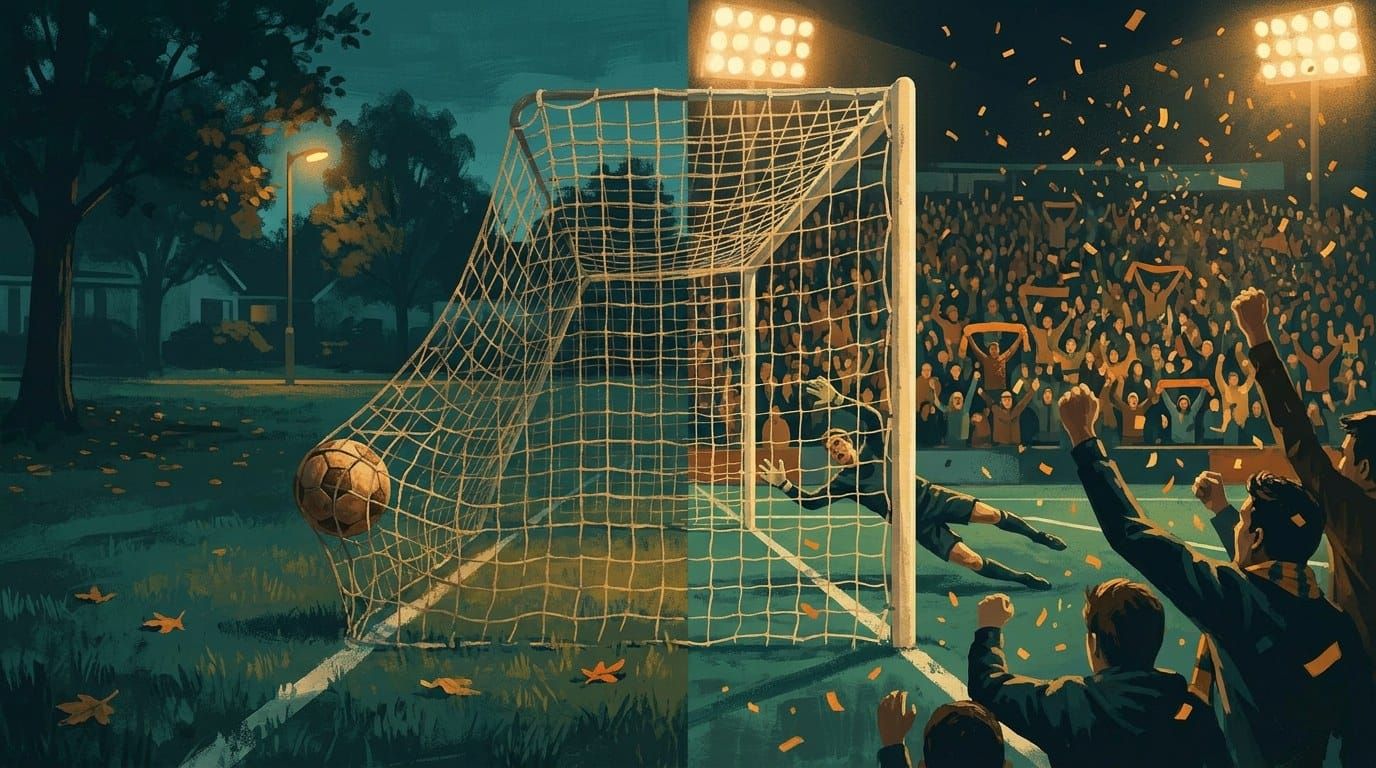
Picture yourself in a park with a dog and a football. You give the ball a kick and it rolls into an empty goal net. What did you do? You kicked a ball into a net.
Now do exactly the same thing in the last minute of a cup final. Same leg, same ball, same net. This time you've scored a goal. People leap out of their seats. Strangers hug. Someone will remember it for the rest of their life.
The action is identical. What changed is that you stepped inside a magic circle.
The circle
The phrase goes back to Johan Huizinga, a Dutch historian who wrote about play in the 1930s in Homo Ludens, and game designers have used it ever since as the magic circle. A magic circle is a space where everyone agrees to take on a different set of rules, and inside it, things mean more. A carved piece of wood is a queen. A pawn that makes it across the board gets promoted.
We draw these circles constantly, usually without noticing. A wedding, where catching a bouquet means something. Taskmaster, where grown adults race to reel in a toilet roll without knocking over a glass of whisky, take it completely seriously, and so do millions of people watching at home. A Friday night ritual with someone you love: the same two glasses, the same silly show. Fandoms and online subcultures, with their in-jokes and their unspoken sense of who belongs.
Some circles are sacred. A marae is a tapu space, set apart, and there's a whole ritual for how you enter it. (Tapu is where English gets the word taboo; Captain Cook brought it back from Polynesia.) The hongi isn't really about touching noses, as visitors tend to think. Two people bring their faces close to share the hā, the breath of life. The space between them is what connects them.
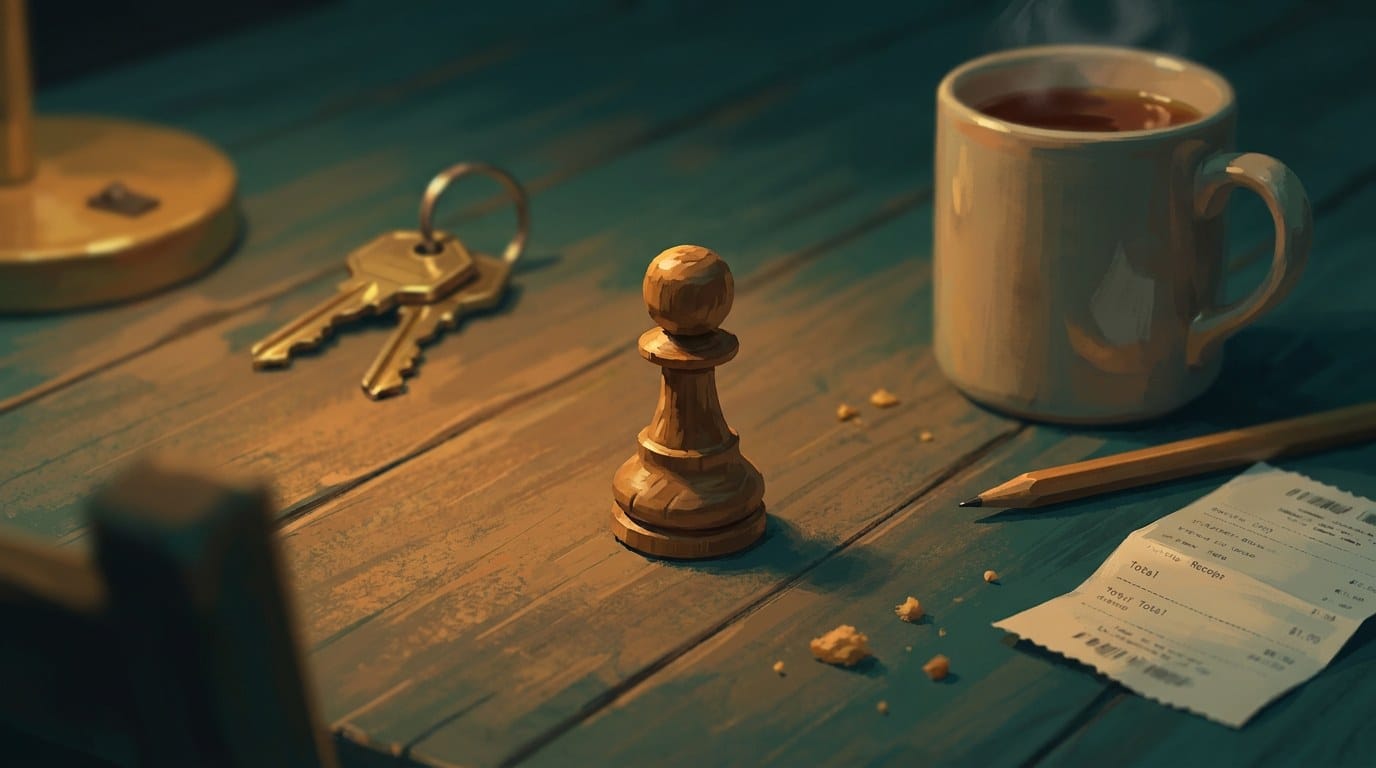
Inside the circle, an ordinary act becomes enchanted.
Where did the magic go?
There's a well-known story that the modern world lost its magic. The sociologist Max Weber called it disenchantment. Science, reason and bureaucracy pushed out the spirits and gods, and left us in an iron cage of efficiency, where life runs like clockwork: predictable, and a bit hollow.
Weber was one of the great scholars of bureaucracy, and he could see where it led. “Rational calculation… reduces every worker to a cog in this bureaucratic machine,” he said, “and, seeing himself in this light, he will merely ask how to transform himself into a somewhat bigger cog.” If you've spent time in a large organisation, you'll have met people who don't just put up with the machine but seem to enjoy running it on each other.
It's a persuasive story. It's also very old. People have been saying the magic is going out of the world since at least Chaucer. And the great champions of reason never quite gave it up. Isaac Newton spent years on alchemy. Respectable Victorians founded a society to investigate séances and telepathy with proper scientific method. Freud built psychoanalysis out of myths.
The scholar Jason Josephson-Storm, in The Myth of Disenchantment, argues that Weber's word is better read as an ongoing disenchanting, a struggle that never finishes, than as something that already happened. Magic never actually left. It got hidden, misnamed, or dismissed as irrational. It became illegible.
That matters if your work has gone flat. Often the job has lost its magic while the thing you care about is still alive, somewhere the job description never looks.
Professions and practices
The philosopher Alasdair MacIntyre draws a useful line here. A practice, in his sense, is something people do together with a shared purpose, shared rules, and shared ways of telling whether it's being done well. Its best rewards are internal to it: the skill, the character and the community it grows. Whoever wins the trophy, the practice itself is enriched.
A profession is a title. Doctor is a job; medicine, as healing, is a practice. Lawyer is a career; justice is a tradition of reasoning about fairness. Journalist is a role; journalism, as the pursuit of truth, is a practice. Artist is a label; art is an exploration of meaning. The meaning lives in the practice, not the title. Justice doesn't live in the courtroom, and truth doesn't live in the university. The real work happens in the doing.
MacIntyre also separates effectiveness from excellence. Effectiveness is external success: targets, money, awards. Excellence is living out the goods of the practice itself. In the 2017 Australian Open final, Roger Federer and Rafael Nadal, two of the best players who have ever lived, played for nearly five hours, all the way to the fifth set. Ask a tennis fan who won and they may have to stop and think. What they remember is what tennis can be. Lance Armstrong won seven Tours de France and was stripped of every one for doping. He had all the external rewards, and he'd betrayed the practice to get them.
The same split runs through every field: the journalist chasing clicks and the journalism that seeks the truth, the lawyer bending the law for a client and the public defender working for a fair hearing. You can do a job effectively for years and barely touch the practice inside it.
Professionals work in a field. Practitioners serve a tradition.
MacIntyre describes a living tradition as “an historically extended, socially embodied argument … precisely in part about the goods which constitute that tradition.” Traditions stay alive by being argued over, and you can see the arguments everywhere once you look.
In tennis, Nick Kyrgios serves underarm, plays to the crowd and infuriates his opponents, all within the rules, as a running argument that the game has grown too stuffy to draw new people in. Pickleball takes the argument further and leaves: shorter, cheaper and easier to learn, and pulling players off tennis courts all over the world. In the 1960s and 70s the New Journalists, Joan Didion and Hunter S. Thompson among them, broke the rule of neutral distance because they believed a first-person view could get closer to the truth. When photography arrived, painters called it cheating and mass production. Much the same argument is running now about AI and art. And people have argued about what counts as real punk for as long as there's been punk.
Love or hate any of these, the arguing is the sign of life. A tradition dies when nobody cares enough to argue about it anymore.
Sincerity in a kayfabe world
Professional wrestling has a word for its own magic circle: kayfabe. Everyone knows the fights are staged, and everyone agrees to keep up the illusion of real competition. In the ring, it's a lot of fun.
Plenty of workplaces run on kayfabe too. Staff perform engagement, managers perform leadership, the real decisions happen somewhere else, and the show goes on because everyone benefits from keeping it going. As the old joke has it: we pretend to work, and they pretend to pay us.
It isn't only offices. The sociologist Pierre Bourdieu described academia as a game that is officially about knowledge and merit and actually about status and prestige. Watch a set-piece interview between a senior journalist and a senior politician: both know nothing unexpected will be said, and both perform the hard question and the careful answer anyway. Kayfabe isn't outright corruption. Real work often still happens. It just isn't happening in the performance.
Now walk into that room sincerely. You read the company values and believe them. You ask the question everyone else knows to leave alone. You take the practice seriously.
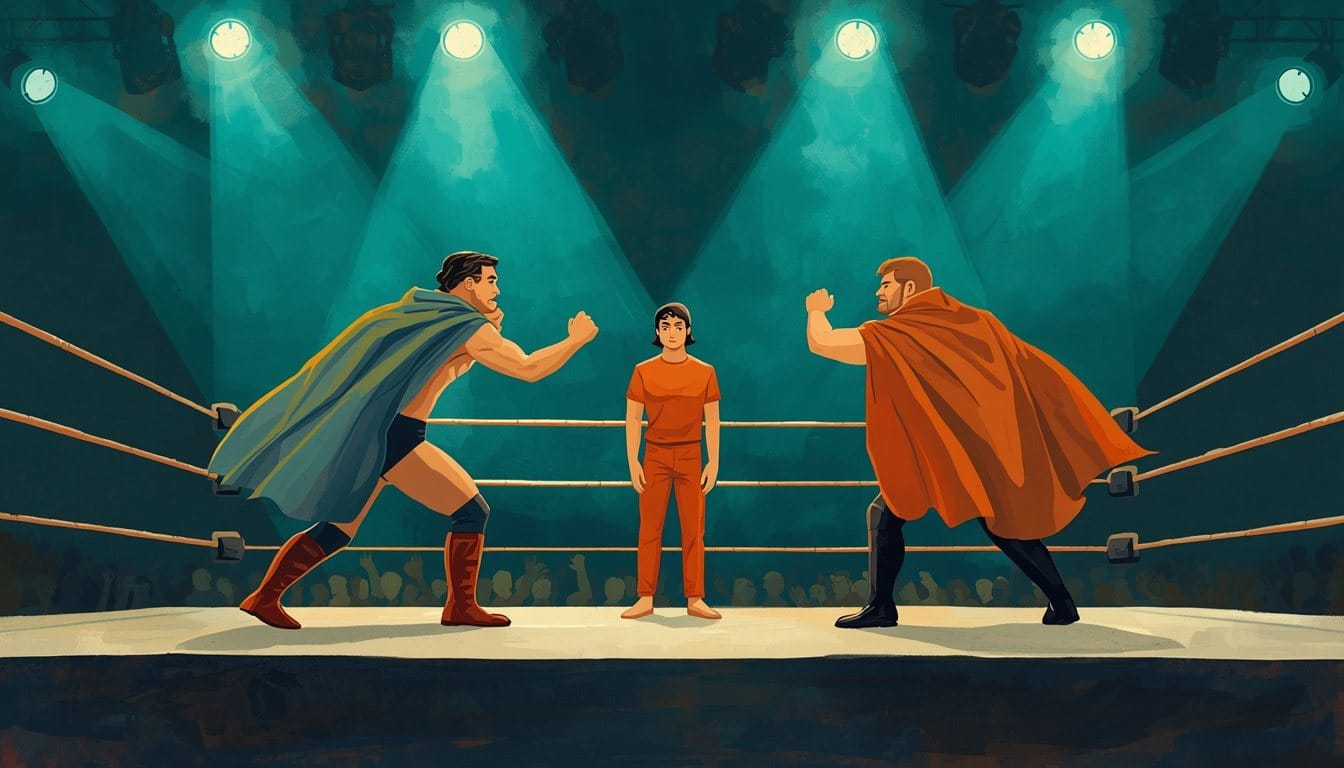
A kayfabe room has to react, and it tends to do one of three things. It humours you, and you become a useful fool, like the new hire who believed the orientation and the values on the wall, wheeled out as the sincere face of something nobody else believes. It shuts you down, and you get called difficult, or not a team player. Or, now and then, your sincerity is compelling enough that other people start questioning the game too, and something shifts. Think of Elle Woods in Legally Blonde, taken for a joke until she isn't, or Greta Thunberg, acting as though the world's climate promises were meant to be kept.
For people who meet the world with curiosity and care, this is a familiar ache. The way through is to keep your sincerity and go looking for where the real practice is happening, and who else is doing it, even when that's nowhere near the place that claims it.
Drawing the circle on purpose
Once you can see magic circles, you can start drawing them deliberately.
In one of my groups, we were taking turns to name the practices our lives are built around. When it came to one woman, she said she didn't really have one. “I don't really do anything,” she said. Then someone pointed out that she leaves comments on other people's work, specific ones that name what was beautiful in it. It turned out she only follows people she has time to respond to properly, because following someone and never responding felt like an insult. “I just leave comments” became a practice of appreciation: quietly subversive in an age of commodified attention, with standards she'd been serious about all along.
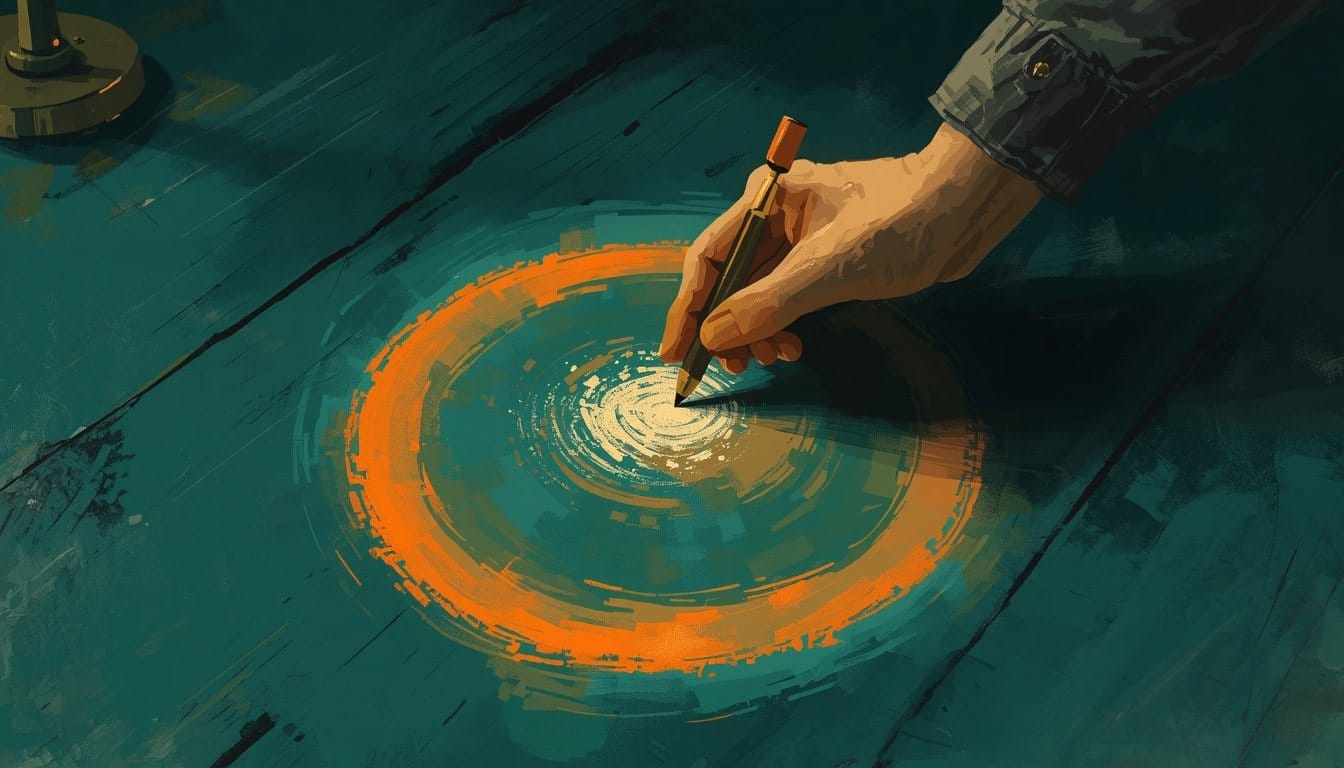
What she did stayed the same. The circle around it changed, and her ordinary act turned out to be a goal.
Your sincerest practice is probably already there, unnamed. You may have been scoring goals for years and calling it kicking a ball.
Try this
Recall a time you were fully alive inside a magic circle. You were scoring a goal. Time went strange, and what you were doing mattered more than it would have anywhere else. Write it down as a story, with as much detail as you can.
Then read it back as if it were someone else's, and spot the practice:
- What were you actually doing? Use verbs.
- What were the rules everyone inside the circle agreed to, spoken or unspoken?
- What counted as doing it well?
- Who else, anywhere in history, has done this kind of thing? What might their tradition be called?
Try a few names for the practice. Playful is fine: a practice of doubt, a practice of appreciation, following the glow. A name is a tool for seeing, and you can change it tomorrow.
If you like, finish this:
When I think about what I'm really committed to, even when no one's watching, I realise I'm a kind of ____. The tradition I belong to, or wish I did, is ____. My magic circle would include ____, and I'd show up sincerely in it by ____.
For a printable version of the magic circles map, the five steps for spotting your practice, the story template and some further reading, there's a sheet to keep: Spot the practice (PDF) ↗
Alongside this piece
Try it for yourself
Two small things to do with what you've just read. Open either one.
1 The real practice, or kayfabe?
Make the call on each scene before the answer appears.
2 Spot your practice
Start with one story and work outwards. It saves in this browser as you type, so you can come back. When you're ready, gather it into one page you can keep.
The story
Where were you, who was there, what were you doing, what did it feel like? Detail helps.
Spot the practice
Read your story back as if it were someone else's.
Try some names
Playful is fine: a practice of doubt, a practice of appreciation, following the glow. You can change it tomorrow.
If you like, finish this
Nothing you write here leaves your browser.
Unforgetting · becoming legible to yourself

In good company
Replies from signed-in readers. They open in their own space, so you can sit with the piece first.
In good company
What came up for you?