


If you ever find yourself hesitating to take the lead — or feeling frustrated and exhausted when others don’t come along as you wish them to — this is for you.
If you’ve been following this series, you’ve heard me say that leading begins with being the author and authority of your life (in Letter 2: Trust your own lead and Letter 4: The 9-Level Citadel).
We’ve also delved into discovering what moves you (in Letter 5: Seed of a Wish).
Those are foundational. It’s only once you’re grounded in yourself and connected with your inspiration that it’s relevant to talk about leading others.
Now, here you are — inspired, energised, ready to move. You know what you are about, and you know where you’re headed.
Then comes the next puzzle: how do you get others to move with you?
Every significant adventure involves other people. As the saying goes, “If you want to go fast, go alone; if you want to go far, go together.” Whatever kind of adventure you have in mind, there’ll come a time when you need others to follow your lead.
This is the place where many people stall.
If you aren’t sure you can get others to come along, is there any point in getting started?
It can feel like “Well, I’m all in, but the world is not minded to help. I don’t have the power to move others. They won’t come along.”
If it seems like you’re trying to get a mountain to budge, you might well worry that you’ll bust your gut from having to push so hard.
But if we take a deeper look, for many the hesitation is even more fundamental: I don’t want to go around pushing people.
...for many the hesitation is even more fundamental: I don’t want to go around pushing people.
That was me as a young teen. I’d seen people push each other around, and I knew I didn’t want to join the pushing brigade.
But what else was there?
My reluctance left me stranded, seemingly without options. It left me with no way to exercise authority in my own life — or so I thought.
But what if you knew how to lead without having to push?
I imagine you already know how to do that. When the setting feels safe and you’re feeling in good rapport with someone, I expect you already often do what I’m about to describe.
But it’s equally possible that you have no name for what you do when it comes naturally.
Chances are, you chalk those times up as “easy.” You probably don’t say “they followed my lead.” You may not quite know what made those times work.
That’s how it is for all of us, when we’re relying on spontaneous impulse. It carries us through, some of the time. But our power to lead is apt to falter when conditions are less than ideal.
I’d like to illustrate this point with an example on the dance-floor, but it applies equally elsewhere.
There is one crucial difference between a professional dancer and an accomplished amateur. The amateur might dance as beautifully as any professional — when everything helps, when conditions are conducive: a good floor, a great dance partner, a tune they like.
A professional, on the other hand, knows how to do a good-enough job at will, even when conditions are against them: when they haven’t slept well, and the dance floor is sticky, their partner is having an “off” night, the music is not their favourite, and so on.
What makes the difference is knowing what you’re doing, both at a felt level and in a way you could explain. If you have both, when you can’t go by feel, you have principles and practice to fall back on.
What if you knew how to lead people lightly and deftly, even when you’re not at your best?
To move others, is it best to push or pull?
When people arrive at their first-ever dance class, they’re almost guaranteed to feel out of their depth. This is a bit of a paradox, because everyone who comes to a taster session already has lots of experience leading others. Think about it: by the time someone reaches their late teens, they will have walked someone home, or guided someone through a crowd.
Let me repeat: everyone who came through the doors of my Tango dance studio had lots of experience leading others. Even so, the very first activity I used to ask people to do ended up showing me a gap.
It taught me that people often don’t have access to what they (implicitly) already know.
It taught me that people often don’t have access to what they (implicitly) already know.
After a while, I realised that this was the same kind of thing as seeing a teacher outside of school. A familiar face in a setting where you would not expect to see them. It can take several seconds to connect the dots. The formal name for this phenomenon is ‘context-specific learning’. You recognise the teacher instantly when you see them in a school hallway, but it takes your brain a few extra seconds to make sense of seeing them “out of place.”
That’s what was happening in my dance classes. In an unfamiliar setting, people couldn’t rely on the learnings they already had achieved elsewhere.
Picture the scene: pairs of strangers dotted around a dance studio. The wooden floor is gleaming. Everyone is looking nervous. The teacher (me) tells the pairs to face one another, and clasp each other’s right hand, as if in a handshake. I get each pairing to agree who is going to go first as the lead. I tell those playing the lead role to get their follower to move.
What do you imagine most people do?
First they stiffen their arm. Then they move it left and right, forward and back, to move the other person. It works, up to a point. I get the pairs to swap roles. Those who’ve just played the follower role are now the ones needing to get their partner to move.
Finally, I get the group together in a circle. How was it? Most people reply: awkward and not all that enjoyable.
Running this activity taught me that leading was something I needed to teach. I couldn’t just assume that people had it. I replaced the activity I’ve just described with a different one, called the Butterfly Lead.
Butterfly Lead
Picture the scene again: pairs of strangers in a dance studio. This time, I give a slightly different instruction. The leaders offer their hand, palm down. Their partner places their fingertips lightly on the back of that hand.
The touch is minimal — almost light as air. Like a butterfly perched on a verdant branch. I explain that protecting this ‘butterfly connection’ is a shared responsibility between leaders and followers.
I can see the look of doubt on some people’s faces. This gentle connection is so delicate — surely it’s not enough to move another person?
This lightness is actually part of the point. It makes it obvious that muscle power is not the driver in what happens next.
…lightness is actually part of the point. It makes it obvious that muscle power is not the driver in what happens next.
I ask the leaders to take a step. Not to move their partner. Just to move themselves.
There’s often a brief pause — a flicker of uncertainty. And then, as the leader steps… something curious happens. The follower moves too.
No pushing.
No pulling.
No effort to make anything happen.
The movement travels through the connection: each person moves their own body, and yet — they move together.
Within five minutes of standing up in a room together, these strangers are dancing with each other, beautifully and effortlessly.
As the room begins to move gracefully together, it never fails to bring me a huge thrill!
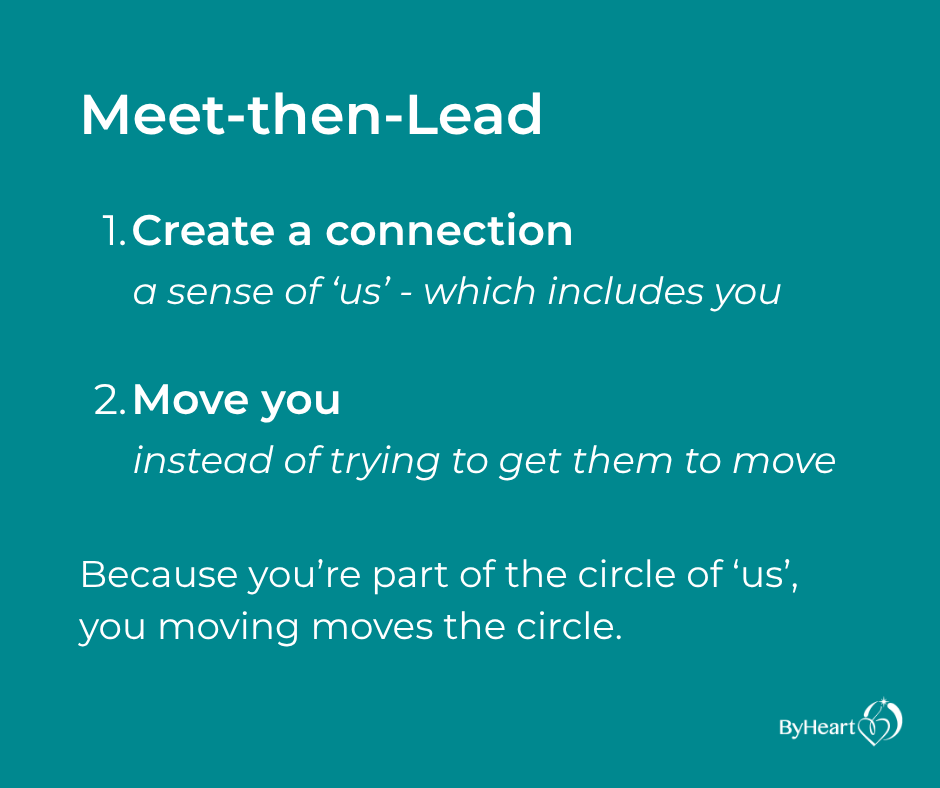
I’ve tested this format with groups of complete strangers arriving with no previous experience of partner dance. That’s how I know that these two actions are enough for anyone to lead:
- Create a connection.
- Move you.
Because of my training as a Leadership Coach, I began to wonder how well this transfers into other contexts, away from the dance-floor. This exploration resulted in my Dance of Leadership workshop, which begins with learning the Butterfly Lead.
When I run this workshop at conferences, instead of taking part, some people opt to sit and observe. Invariably, once the activity is finished, the observers come to me with questions.
“I couldn’t see which person in a pairing was leading and which one was following. I couldn’t spot the initiating move.”
I nod. I often can’t see it either, it’s that subtle. The communication travels that fast. Each pair becomes almost like a couple of swans swimming side-by-side, in wordless communion.
Part of the reason it’s hard to spot who’s leading is that, actually, both parties are actively co-creating the dance. Both are carrying the connection.
Here’s another way of putting it. If we’re connected and I move, our connection — the field uniting us — moves. As it moves, the most comfortable thing for you to do is to move with it.
The way they say this in Tango: “With a great lead, what the leader intends the follower to do feels like the most natural, the most obvious action to take.”
Leading through connection
We’ve looked at what it takes to lead physically, in the body: set up a connection, then move you.
Let’s call this principle Meet-then-Lead.
How does that translate into everyday life?
Think of a situation right now where someone isn’t moving with you, in the way you’d like them to.
The two checks I generally think of first reflect the two core actions of Meet-then-Lead:
- Is the connection strong and clear? Have I created an ‘us’, a sense of a larger unit, a micro-community which includes me and this other person?
- Am I moving me — or am I waiting / pushing for the other person to move first?
To illustrate, let me show you what it can look like when something in the Meet-then-Lead mix is off or incomplete.
I once received a DM from someone I’d never met. It led with: “I have answers to your questions.” The sender did not introduce themselves.
Predictably enough, my finger drifted towards the delete button. Who was this? Which questions were they talking about? What response was this person hoping for?
There was one tiny circumstance which kept me curious for a few extra seconds. I decided to give my mysterious correspondent one more chance: “Which questions are we talking about?”
Against all probability, it transpired that this was not a scam. The message was from a fellow student on an online course. She’d watched a recorded meeting of the study group where we were both members, and felt moved to reach out.
Here’s what I find interesting about this interaction. My fellow student took advantage of a shared context connecting us, and she made a move of her own. Does that mean that the principles of Meet-then-Lead were fully taken care of?
What she’d overlooked was the asymmetry of the situation. For her, the experience of contact with me was continuous: she saw me speaking on the recording, and she sent me a DM. It was not the same for me. In my world, the meeting I’d attended had taken place two days earlier. Any questions I might have voiced then were no longer fresh in my mind. What’s more, the Zoom recording afforded my peer the chance to see me — but she was still both unknown and invisible in my world. The result was that her sense of connection might have been strong, but mine was non-existent.
The result was that her sense of connection might have been strong, but mine was non-existent.
If we watched this interaction translated into an exchange of physical gestures, it might look like this:
- First there’s a bid for connection. My correspondent reaches for my hand — but doesn’t check if her grasp connects. The effect is, I’m not even sure why we’re talking.
- Then she doesn’t move. She tugs at my sleeve with seemingly no clear direction in mind so that I have no idea what response she’s hoping for.
This interaction is on track for a double-miss.
This might seem obvious when we’re watching others. And yet mis-communications of this kind are fairly common. In fact, they can happen with anyone — because when we’re stressed or preoccupied, our horizons narrow, and we have less mental bandwidth to consider the other person’s experience. (If you’d like to explore deeper into how this can happen, I recommend the fascinating book Scarcity: Why Having Too Little Means So Much by Sendhil Mullainathan and Eldar Shafir.)
The near-miss with my fellow student offers a reminder. The question isn’t just “Do I feel a strong connection with this person?” It needs to go both ways. Both sides need to feel included in that community of ‘us’.
Here are a few other questions that may prove fruitful to ask, when you’re thinking about a real-world situation:
- Is the connection between us alive?
- Am I including myself in what I’m asking to happen?
- What small adjustment might restore the flow between us?
Complaints as clues
There’s one more gift that the Meet-then-Lead principle brings to light. It suggests that, when others are complaining, they may be secretly waiting for you to make a move.
Perhaps their efforts to communicate are incomplete, like my mystery correspondent’s first DM.
What if, hidden in the complaint is an unspoken request — and an opportunity to lead?
In Letter 5: The seed of a wish, we talked about coaxing your own wishes to speak up. We’re now touching something similar in others. When others may be struggling to find words for what they wish, Meet-then-Lead may point a path to help them recognise and receive what they’re wishing for.
Because sometimes we receive unexpected gifts beyond our expectations. I imported the Butterfly Lead from martial arts practice into teaching Tango to help my students learn collaborative improvisation. I hadn't expected how much it would teach me about how we relate.
To this day, when I find a situation between people puzzling, I mentally sketch an illustration of what’s happening as a slow-motion dance. Often, this reveals a way to restore connection and open space for the next move.
Moving with others
However well you learn to meet and move with others,
there’s always a next horizon
which asks you to learn more.
The principles of Meet-then-Lead are valuable
not because they offer something radically new,
but because they can help you see
what was “hiding in plain sight.”
To lead someone, you need to start
truly by their side, by being with them.
If you’re hoping they will move,
the place to start is by moving you.


Member discussion