


Here's the opening chapter, free to read. Something is stirring in the poisoned soil. Come and see. (The full novel is out now in a newly revised and expanded edition.)
The ice crumbled faster than anyone predicted, faster than the most alarmist models had dared suggest. At first the frosts of the northern lands vanished like morning dew under a hot sun. Warmer air birthed greater storms with frightening frequency, each year bringing higher waters than the last.
Then came the biggest change. From 2057 the Atlantic crossed the final tipping point. Winters around the North Sea started getting noticeably colder. There was less annual rain to feed the crops, but when Spring storms did come, they were bigger, and more violent, flash-flooding the hardened ground. But it was the compound surge of 2069 that changed everything. That was when the North Sea truly began redrawing England's eastern edge, first with gentle brushstrokes, then with the violent hand of a frustrated artist. Three massive storms hit during spring tides; their timing as cruel as their strength. The first overwhelmed coastal defences, then, before recovery efforts were complete, two more arrived in quick succession. The third arrived as days of rain, and melting snow drained from the hills, swelling rivers with nowhere to flow but into the already flooded and hungry communities.
Now, after decades of displacement, and resilience, much has changed. Here grow the seeds of knowledge, taking root in transformed landscapes, sprouting unexpected truths about adaptation and resilience.
Signs and Signals
The North Sea gnawed at Yorkshire's crumbling cliffs. In the watch tower above Whitby, Rowan Cullen was doing what he did best: watching from a distance.
After five months of monitoring coastal nature, he knew it would be a lot easier for him if the numbers added up. But there it was: three satellite imaging passes had confirmed it. Increased chlorophyll signatures... Large plants thriving in soil that saltwater had been destroying with lashing storms since the last surge.
His Meridian hummed against his wrist, that particular caller's pulse pattern he'd learned to dread. With a reluctant gesture, he expanded the display, and Regina's face materialised before him, his supervisor at the Coastal Monitoring Consortium, looming like an unwelcome apparition.
“Your weekly metrics are late again, Rowan.” Her face filled the view, perfect as always, not a silver-rooted hair out of place, despite the early hour. Regina believed in procedure. It was how she’d risen from Field Researcher to Consortium Director in record time. “The board expects consistency in our reporting.”
“Consistency is the problem,” Rowan replied, running a hand through his perpetually uncombed hair. “The readings are strange. I'm seeing vegetation where nothing large is supposed to be growing. The baseline data you gave me must be wrong.”
“I didn’t ask you for satellite data, you’re supposed to be reporting your observations. This is mission creep Rowan.”
“But you need to...”
“Whatever you're thinking,” Regina cut in, “stop. Just file your observation report. Now, Rowan!” She hung up before he could protest.
Then she sat forward, rubbing the side of her neck below her left ear, where tension seemed to build up like sediment and caused her pain. The board’s breakfast meeting had been brutal. Thirty years of dedicated environmental science, reduced to quarterly metrics and impact assessments that barely scratched the surface of what was actually happening. Now there was a new requirement to align all research priorities with the government’s Strategic Green Infrastructure Review. She knew what that meant. It meant file nothing inconvenient. Nothing that didn’t serve a legible economic outcome.
She had just secured the funds to open the old monitoring stations again after five years of cuts had left them abandoned. Now she had to decide whether she could afford to follow up the new data coming from her new enthusiastic observers.
“Anomalous readings,” she muttered, staring at Rowan's preliminary report. Part of her, the scientist she'd been before climbing the administrative ladder, wanted to pursue this. But if she allocated resources to every enthusiastic observation from the field stations, they'd lose what little funding remained for the long-term programme.
She thought of the monitoring programmes that had been quietly archived over the past decades. Each one had value. But each one had seemed, at the time, like a compromise that would keep the important things alive, and each one had just been the beginning of another compromise.
She thought of the monitoring programmes that had been quietly archived over the past decades... each one had just been the beginning of another compromise.
She glanced at the corporate partnership proposal on her screen, that promised stable financing for five more years. The kind of security that kept researchers employed, that maintained the databases tracking fifty years of coastal change. The document was littered with sustainability buzzwords, perfectly calibrated to the current funding climate: innovation, investment, scalable solutions. But beneath the greenwashing there was enough genuine science to make a difference. Hardly the difference she’d dreamed of as a young researcher standing in a tidal marsh with nothing but a notebook and absolute conviction. But tangible, nonetheless.
“Sometimes all that matters is the lights staying on,” she told herself, the mantra of career administrators everywhere. She swiped to send the standard metrics request to Rowan again. Better he be disappointed, than have forty researchers lose their positions when the next funding review came around.
Through the windows of Rowan's station, the early sun caught the solar arrays, crowning the working port of Whitby. The coastline had transformed since the Antarctic collapse and subsequent sea rise. Great tidal surges had battered against their defences until the last great surge of 2069 drowned the lower town completely.
Where there had once been seaside arcades and fish and chip shops, pontoons now rose and fell with the tide between the partially flooded buildings, their foundations deteriorating.
The picturesque tourist town had evolved into a busy mooring for houseboats, and sustainable trade barges. Extending the bazaar of repair shops and quayside market stalls, selling all manner of goods. Everything you could never need or want; hats, boots, blankets, old spectacles, scavenged electrical components, and many goods made from the main local produce, Whitby seaweed fibre-cloth and bio-plastic. A trade that now employed most of the community.
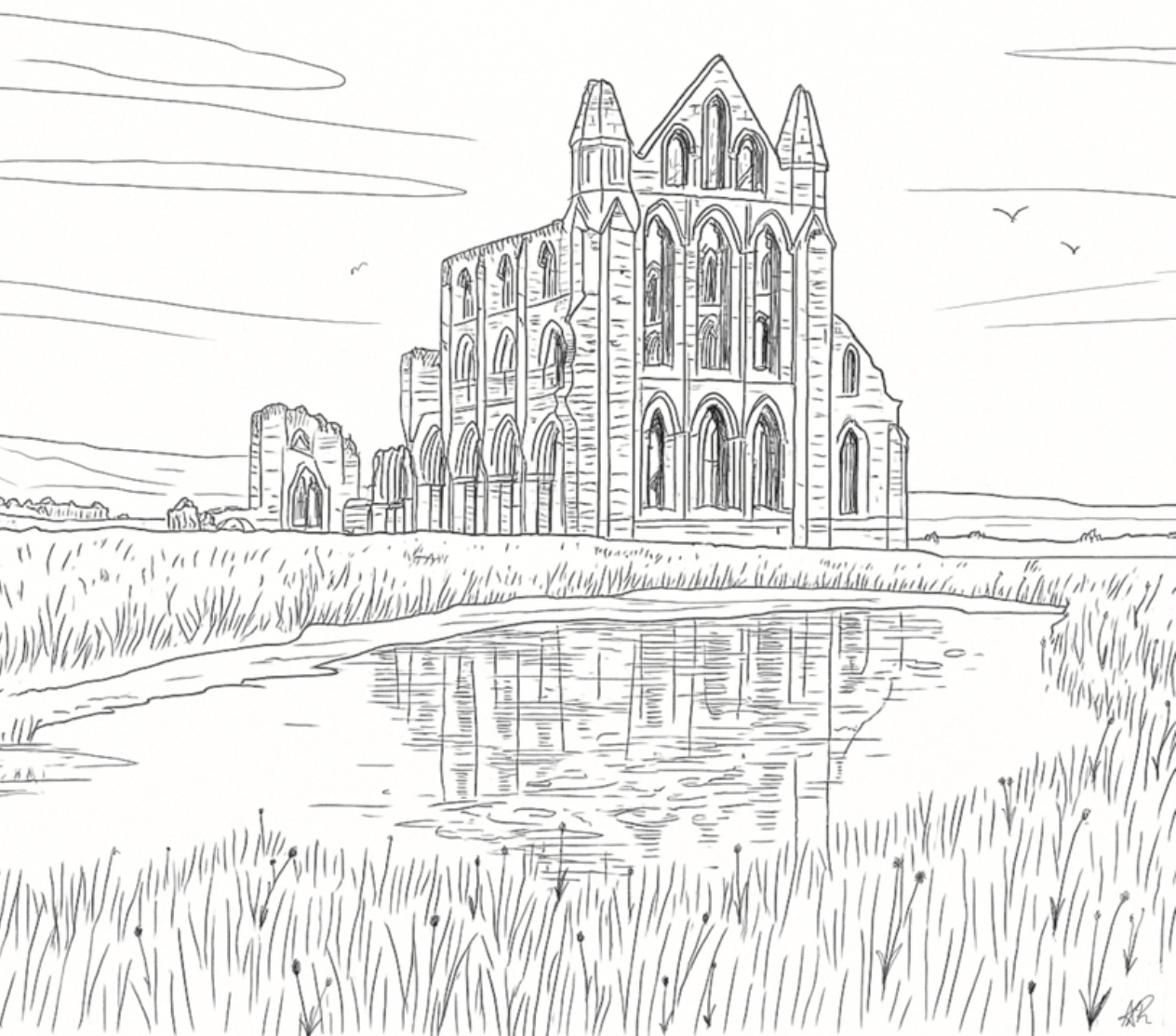
The old Abbey Steps rose from above the new high-water line to the small church and ancient Abbey ruins, which were silent witnesses to centuries of change, and now watching over yet another transformation, from the reinforced terraced cliffs.
On the flat ground around the community hall, brewery, and Abbey House, Earthship dwellings ran in long earth-built rows, housing settlers from Yorkshire’s flooded lowlands, now a valued part of the community. Seaweed-film growing-tunnels stretched alongside the dwellings, practical and DIY living, gradually added to over many years.
Beyond the residential zone lay Environmental Sector 7, where the sea-swept Saltwick Forest Park had been abandoned to the elements, after repeated storms and salinisation had made it “economically unfeasible” for regeneration, according to the consortium’s bland reports.
Movement caught Rowan’s eye and he grabbed his binoculars, focusing on the trees at the Sector's edge. He saw a flash of vibrant green, and the way the small branches swayed... it intrigued him. There was new movement in the morning breeze, leaves catching the light.
His Meridian pulsed again at his wrist: another automated request for standardised observation metrics from the Coastal Monitoring Consortium. Rowan swiped the notification away. With a fluid motion, he expanded the device's display, transforming it into a translucent screen that overlaid enhanced visuals onto the windows and landscape beyond. Earth Observation was not what he was employed to do here, but it was what he had trained for at university. The thermal bands showed definite biological activity. Even the reliable old radar backscatter was revealing patterns of new growth in the forest structure. He collapsed the Meridian back to wrist size, the living photosynthetic elements along its edge glowing softly as they charged in the morning sun.
The observations could wait. This was exactly what he'd been searching for since he'd started at the station, something that didn't fit the models, something alive that shouldn't be.
This was exactly what he'd been searching for since he'd started at the station, something that didn't fit the models, something alive that shouldn't be.
He was halfway down the station's staircase when he heard voices, unusual for this hour. Most of Whitby wouldn't stir for a while yet. What remained of the fishing fleet was out and the market traders were still setting up, far below. The voices were getting closer, one he recognised as Isaac the Harbour Master, the other unfamiliar, carrying a lilt that didn't belong to Yorkshire.
“I hope the observer is awake,” said a woman's voice, her accent distinctly Dutch, precise but musical.
“He’s usually an early riser,” Isaac replied in his deep salt-worn tone.
“I’ll only need a few min...”
Rowan burst out of the door, hoping to escape before they reached him, but he nearly collided with his visitor. She wore practical seafaring clothes: a weather-beaten jacket of some self-repairing material, sturdy deck-boots that had clearly seen real work, and she carried a distinctive sampling case, marked with the Seed Trust's emblem. The Trust was known for its work preserving coastal plant genetics, and rarely visited this little harbour.
“Dr Cullen?” she asked, steadying herself. Her eyes caught the light, sea-glass blue, a detail Rowan immediately noticed and felt foolish for doing so.
“Just Rowan,” he corrected, suddenly self-conscious of his rumpled appearance. “The doctorate's a bit... unfinished. I got this placement and they’ve kept me on.” His lip quivered as he got that sinking feeling, a self-loathing he always felt when he knew he had overshared again.
“I’ll leave you to get acquainted,” Isaac said with an amused smile, as he turned back towards the harbour.
Isaac was tall, with strongly sculpted features, his skin wind-etched and rain-polished, like sea-worn rock. He had dark, watchful eyes that had seen more than he would ever tell, after years of guarding the harbour. His kind expression was framed by a knitted hat pulled low, and a short, salt-white beard that looked smart, apart from a few stray lengths that stuck out like little antenna here and there.
“Go steady now,” he called as he left.
“You're here about Sector 7, aren't you?” Rowan asked, looking back at his visitor.
Her eyebrows rose slightly, clearly surprised by the directness emerging from his initial waffle.
“Yes, I'm Ash Van der Meer.” She extended her hand. Rowan looked at it and left her hanging for a moment, then shook it and felt the firmness of her grip. “We've been tracking unusual patterns in the coastal vegetation. Your monitoring station has the best records for this stretch of coast, so if you don’t mind...”
Her gaze travelled past him to the staircase leading up to his instruments. Then she stepped around him and went up. Rowan watched her move through his space with the focus of someone who had already decided what she needed to know.
“The chlorophyll readings shouldn't be possible,” Rowan said, turning to the wall map where he'd marked repeated anomalies. “Only marsh grass should handle that much salt logging and storm damage.”
The chlorophyll readings shouldn't be possible... Only marsh grass should handle that much salt logging and storm damage.
“Well, it’s actually entirely possible,” she said, studying his markings. “Just unexpected, I’d say.”
“I didn’t know you were doing Earth observation here, I thought these stations were for field work and recording what you see through these,” she said picking up his binoculars.
“Yes that’s the job, but I did EO at uni, it’s my thing.”
“Well, it’s a good thing,” she said, “But the important question is whether your satellite data matches what's happening on the ground.”
He held out his field kit that had been on his shoulder. “I was just heading out to check.”
“Mind if I join you?” A small smile appeared at the corner of her mouth, as if she already knew his answer.
The morning sun transformed the North Sea from grey to silver, its surface rippled with wind patterns, but no great waves.
“We'll take the path along the top then down the terraces,” Rowan said, slinging his pack over his shoulder. “But we'll need to move quickly, the weather's due to turn by mid-afternoon.”
The unfinished sea wall stood as a monument to failed engineering below them, its concrete face pitted and crumbling, metal rebar rods exposed like the bones of a beached whale. Wave-smoothed rubble made treacherous footing as they reached the lowest level. There wasn’t much there.
They looked around and sure enough, ahead of them a terrace up, life bloomed, and it was well before the old forest edge. Young elder and hawthorn, surrounded by healthy green nettles, where there had only been patches of scrub at that level.
They looked around and sure enough, ahead of them a terrace up, life bloomed, and it was well before the old forest edge.
“Look at this,” Ash said, crouching to examine the vegetation. She pulled a sampling tool from her case, a sleek device that looked more like an artist's stylus than scientific equipment. “The leaves are a little different from any I've seen in these species.”
Rowan knelt beside her, noticing the faint scent of something herbal in her hair. The plants did look different, the leaves were thicker, with patterns of fine hairs and waxy coating. Rowan pressed his soil testing kit into the ground and read the display.
“The substrate chemistry has always been a bit odd in this area; I’ve got the results from the last survey, conducted before the monitoring station was closed five years ago.” He frowned at the numbers. “There’s agricultural readings here.”
Ash glanced at the readings, then at the level above them where the remains of agricultural planting was still just visible, half-buried by coastal scrub. She was quiet for a moment. “What was grown up there, before the surges?” she asked.
“Oilseed, mostly, I think,” Rowan said. “I imagine the farmers tried all sorts on the terracing. Why?”
She pocketed the device. “Probably nothing.” She moved back to the plants, but the careful set of her expression told him she hadn't dismissed it at all.
Ash carefully bagged a sample. “I’m surprised they're growing this far down, let alone thriving. There was research before the surges, about coastal plant communities developing salt tolerance. But the conditions here shouldn’t really support it.”
The microscope lens on her device revealed complex fungal networks around the roots.
“The fungal layer...” Rowan murmured, leaning closer. He wasn’t really sure what he was looking at.
Ash's eyes met his over the microscope. She had the expression of someone who had come a long way to look at exactly this. “Yes,” she said quietly. “This is what I needed to see.”
📖 Continue the odyssey. Newly revised and expanded. Paperback and eBook out now.
🟣 Grokkist Members read it free — a complimentary eBook of every Grokkist Press book comes with your membership.


Member discussion