


The Mind clings to its opinions, and says “I know”.
The Heart bows and says “Show me”.
~ Rumi
There was a time when I struggled to believe there could be such a thing as respectful help.
Even though — or maybe because — I was in desperate need of it.
I knew what some other kinds of help could feel like.
There was the Done-To-You kind, where the other person effectively takes over and ‘sorts things out’ for you. This looks like people marching you to what they reckon is the right thing for you. I knew what the aftermath of that kind of help could be: a sense of listless discontent and disorientation that I would find it hard to explain, but that would trail after me, sometimes for days on end.
There was also the Done-At-You kind, which barely earns the title of help at all. This basket contains unasked-for advice — and advice given instead of actual assistance. Generally, the person speaking seems to assume they know what I’m up against, and has a prescription for my troubles. Like the doctor in the story that Leo McGarry tells in The West Wing’s Noël episode (S2E10). The doctor’s response to the shout for help from the man who’s fallen into a hole is to write a prescription, throw it down in the hole and move on.
As if help could be dispensed with eyes averted, without needing to see you at all.
I’d also grown tired of the more subtle Problem-First help. Its eyes seem to believe that there is a problem with its own separate existence. Deal with the problem, and you’re home and dry. You may not need to deal with the person at all. I’d grown accustomed to — and then defiant at — the role of the container of “the problem”. And I kept getting ever hungrier to be — and to be seen as — more than a problem to solve.
When respect has been in short supply
All those other styles of help may have been well-intentioned. But the net result was that I’d gone hungry for a long time.
If you have been there, you will already know this: a long string of disappointments can make you suspicious the next time someone offers help.
Because if your sense of autonomy — of sovereignty over your own life — has been undermined or disrespected before, the next time the cavalry arrives you may not feel relieved or grateful. You may feel challenged or even threatened instead.
Which means that the cavalry cannot expect you to throw open the gates to your domain at the drop of a hat. The person offering help may have to earn your trust — one slow, painstaking step at a time.
The person offering help may have to earn your trust — one slow, painstaking step at a time.
Somewhere inside me, I felt that this was a lot to ask for. I wished I could override my own defences.
And then again, I wished I wouldn’t have to.
I wasn’t at all sure that there was one person on the planet with the tenacity to dance the slow trust-building dance with me.
And yet, this was my hidden hunger.
When I dared to hope, without knowing how to say it, what I hoped for was this: help that would see me and hear what I wanted.
Easy, right?
Tidying the garden
A friend once came to help me tidy up my garden. As we got on with sweeping the paths and pruning overgrown bushes, I was glad of her help. But gradually, over the course of two hours, it began to feel as if the garden was becoming more hers and less mine.
My vague sense of unease sharpened when my friend insisted that we sweep the paths a second time. The results of the first sweeping did not satisfy her stringent standards.
I felt something inside me sink.
I remember standing there with the broom in my hand, unable to explain — even to myself — why my friend’s generous help had suddenly begun to feel like an invasion.
It would take a long time to find words for what that sinking feeling was about.
When I thought back on that moment later, it struck me that something vital had been lost in translation. I was living in a rented flat at the time, so my sense of the garden being mine was already shaky. My friend wasn’t to know what I myself only realised later: that my real hope had been that she could help me make the garden feel more mine. Tidiness was very much a secondary issue.
This subtle distinction — between aiming for tidiness or for a sense of belonging — turned out to be crucial for me. But how could someone else divine what I myself would only come to know explicitly much later?
Four quadrants of success
The more I thought about it, the more it stood out to me that a ‘helping occasion’ could result in just one of the parties feeling pleased with the outcome, or both or neither.
You could represent the field of possible outcomes like a chart:
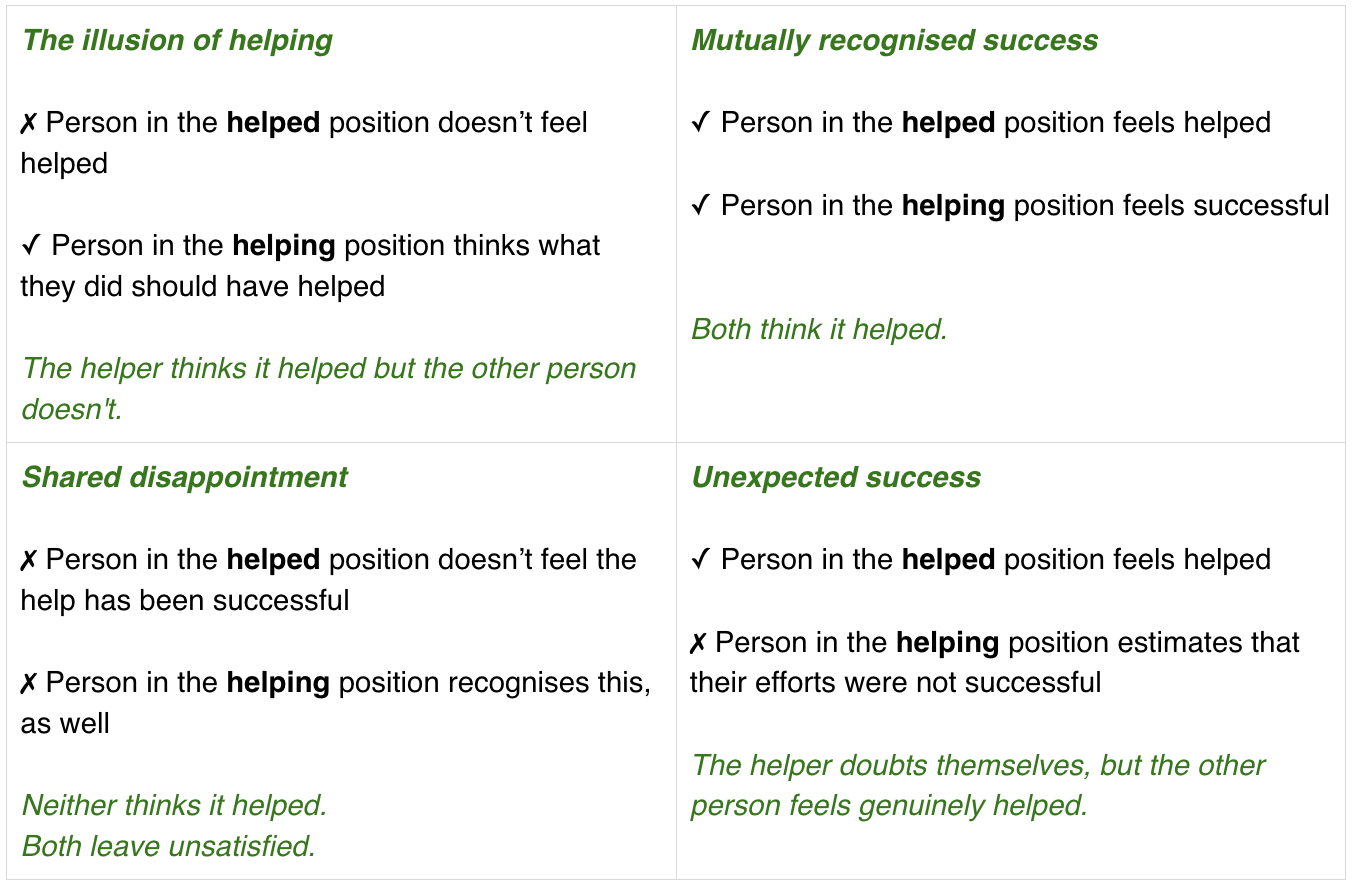
Of course, reality is not as simple as a chart.
Often, neither party is equipped from the start with the full picture of what success needs to look like for them. Just like I didn’t know it for me when my friend first came to help me with the garden.
My work with people confirms this. The first thing we often have to do together is find out what success would need to look like for them. Because it’s hard to go for what you can’t see.
Eyes that see you
How do you convey to someone that you’re interested in seeing them as a human being? That your starting point is to see them as more than a problem to solve?
I’ve learnt two simple ways.
One is to ask, How is this for you? and then to actually listen.
The other is to make the mental effort to estimate their likely answer. To say something like, Heya, tough day?
Your estimate doesn’t have to be right, or even close to it. All it needs to do is show that you’re genuinely interested. If you show willing, and your estimate is off the mark, people will correct you. They will respond by telling you how it is for them — which is what you were going for in the first place.
Your estimate doesn’t have to be right, or even close to it. All it needs to do is show that you’re genuinely interested.
And how do you show that you’ve heard them?
By saying back what you’ve heard. By showing them what of their words you managed to catch.
This ‘recipe’ is so straightforward, it may sound simple-minded. And yet it’s the fastest way for someone to feel heard and acknowledged.
I’ve noticed that I find it easier to feel how important this is when I’m the one in need of it. My life and work keep reminding me that others need it too.
One such reminder has a permanent place on my bookshelf. Its author is Chris Voss, former top international hostage negotiator for the FBI. In his book Never Split the Difference, Chris tells how the FBI adopted this echo-their-words-back-to-them approach from psychotherapeutic practice. I found it astoundingly moving to read how even died-in-the-wool terrorists responded to what the FBI calls ‘tactical empathy’. Apparently, eyes that see and dignify you are such a rare gift, they can sway negotiations with human lives in the balance.
“No one else sees the world the way you do,” wrote novelist Charles de Lint. Perhaps it makes you feel less alone in the world when someone shows that they get how you see things.
Eyes that see your possibilities
Is making time to notice and acknowledge how things are for someone the most we can hope to do for them?
Years ago, when my son was little, I rang a friend at half past eight in the morning, before it was polite to call. The day had barely begun, but I was already running out of strength to be a patient parent to my toddler.
My mind had gone into a panic spiral. I was hyperventilating, flashing nightmare visions of hurting my child. So I phoned a friend in a desperate bid to keep myself the right way up.
I don't remember what I said. But I do remember how she replied.
It was more than kind — it was brave.
“Pop him in the fridge, pop the kettle on, and have a nice leisurely cup of tea.”
It goes without saying I did not pop my son into the fridge.
But the absurdity of the idea opened space for something else: it made me laugh.
That laughter broke the hyperventilating cycle. It got me breathing again. It got my panic spiral to release its grip.
In one sentence, my friend had done me a huge favour. She managed to side-step the idea that I needed rescuing, which my panic was transmitting. Instead, she found a way to remind me that it was my day.
She managed to side-step the idea that I needed rescuing, which my panic was transmitting. Instead, she found a way to remind me that it was my day.
She opened a breathing hole in a wall of panic.
Paradoxically, her words also helped me get back to the version of me who knew: I had it in me. I had it in me to look after my young son for another interminably long day.
My friend found a way to summon that version of me back into the room.
In my memory, that brief conversation stands out as a superb example of help that heard what I wanted — heard my wish, beyond what my words had managed to ask for.
Elliott Connie, leader in the field of Solution Focused Brief Therapy, talks of how it’s not always possible for us to make things better or easier for another human being. My friend couldn’t rush over every time I was feeling wobbly. Raising my son was my task. Elliott points out that some trials may take a long time before we can call them done.
So what can we do for those we cannot help directly?
One thing we can do for another is hold faith.
I learnt this one evening when I came home after teaching a tango class. As a teacher, I’d learnt that one great gift I could give my students was being able to see their success before they could. My faith in their success was a vital resource I brought with me to every lesson. I was ready to show them this faith whenever theirs was flagging.
That particular evening, I came home after class and caught myself doing something very different towards my teenage son: the eyes I turned on him were full of fear. It was as if I knew nothing about my power to transmit my faith in him. Instead, I was in full Anxious Parent mode – which was what I’d grown up with as a kid.
It struck me like a thunderbolt. How could I know about transmitting faith as a teacher, and yet forget it as a parent?
I made a decision that day. To give my son the gift of eyes that could see his possibilities. That would insist on seeing not just what he is, but also what he may be.*
To see your own possibilities
We need eyes that see possibilities —
others’ and our own.
When you gaze around with respectful eyes,
make sure to turn them also
onto yourself.
When you say to others
“you matter, you are important,”
hear it for yourself, as well.
That’s how we can together
create a world
where Autonomy-in-Connection
can become a living joy.
Cultivating relationships where sovereignty can flourish
→ Letter 3: Autonomy-in-Connection
Remembering to include yourself when trying to move others
→ Letter 6: Leading lightly
Eyes that see possibility, or what we might call Affectionate Respect
→ Letter 7: To be seen with the Eyes of Love
The concluding line of this Letter was inspired by the title of Piero Ferrucci’s book What We May Be: Techniques for Psychological and Spiritual Growth Through Psychosynthesis


Member discussion