


Foraging in the forest of knowledge
Just as on any other day, infovores roamed the salience landscape. But today, they sought to notice the moment when information first entered their minds. They smelled the breeze infused with eastern sandalwood and newly flowering fields of study from the West. A deep remembering stirred: that smell is the first moment of digestion—though this was long masked by the decaying piles of old paradigms, rhetorical rot and epistemic pollution lingering in the Ol’Factories of knowledge.
They could recall the distinct smell of the landscape during times of hunting and gathering insights in the wild, tilling the fields of discourse, or refining epistemic farming into a science; though, they were never to know if the shift was their sensorium attuning to their physical activity or if the scent itself had truly changed. In either case, never would they forget that moment when all the low-hanging fruit had been plucked, and they climbed to the top of a tree only to find a new fruit no one had tasted before.
In times past, no one believed such vividly blue fruits existed, as, from the ground, they looked like sky. But co-arising with their heightened awareness from such a climb and the contrast against the forest canopy, their sensorium suddenly brought them into focus. They were reached only by collectively co-constructing a sturdy yet flexible cognitive scaffolding to traverse the canopy. Only then can there be spaciousness in the social terrain, gradually making a clearing in the untrodden paths to occasionally welcome in on-lookers. For it was spaciousness that enabled long treks to the edge of reason, where the path of inquiry becomes more noticeable than the destination. The onlookers were lucky to find a footnote in the foothills, but for the ontological weavers, the footnotes were now far from sight. Were it not for those ontological weavers who sew the attentional fabric upon which the paper trees themselves were constituted, there would be no footnotes laid at the head of the untrodden paths.
... it was spaciousness that enabled long treks to the edge of reason, where the path of inquiry becomes more noticeable than the destination.
That brief noticing of insight occurs when multiple layers of subtle and gross signals resonate throughout the nexus of space-time, allowing the conversation itself to grow new lenses, new footholds to be grafted onto the highest branches. However the grafts would not always take hold. Their sturdy placement was possible only through subtle discernment, nonverbal cues, and path-dependent intentionality interwoven within each stroke; often too fragile to hold structure beyond the present moment. These were all subtle cues that had not yet budded in-formation; moreover, the proliferation of leaflets of information often congested the path, making it harder to see the fruits along the way and the way itself.
It is there that deep learning is integrated, shaping the way that reality is disclosed. It is through experience that smell becomes an anticipatory inference, and that taste develops into affective Bayesian priors that wayshape the infovore's path. Co-evolving symbiotic relationships developed between their gut microbiome and their social culture, allowing them to entangle that which was as intimate as their salience landscape with the distant stars, which seamlessly came to inform where their minds traversed. Such an entanglement was required, for if not traversed with effortless action, the silk-like branches they flowed along may snap simply from an abrupt change of attention.
Conceptual proliferation and super-saturated nectars
One morning, the villagers awoke to the sound of deep humming and drumming across the valley; it was thought to have been giants in deep ritualistic chanting and meditative reflection. However, as the weavers peered over the edge of the canopy to view and peer review over to the other side of the valley, they caught a glimpse of the Epistemic-Farmers who had innovated rapidly. The humming came from giant external organs, distillation towers, and scopes of various sorts. The farmers had writing tablets which seemingly became magical surfaces of reflection.
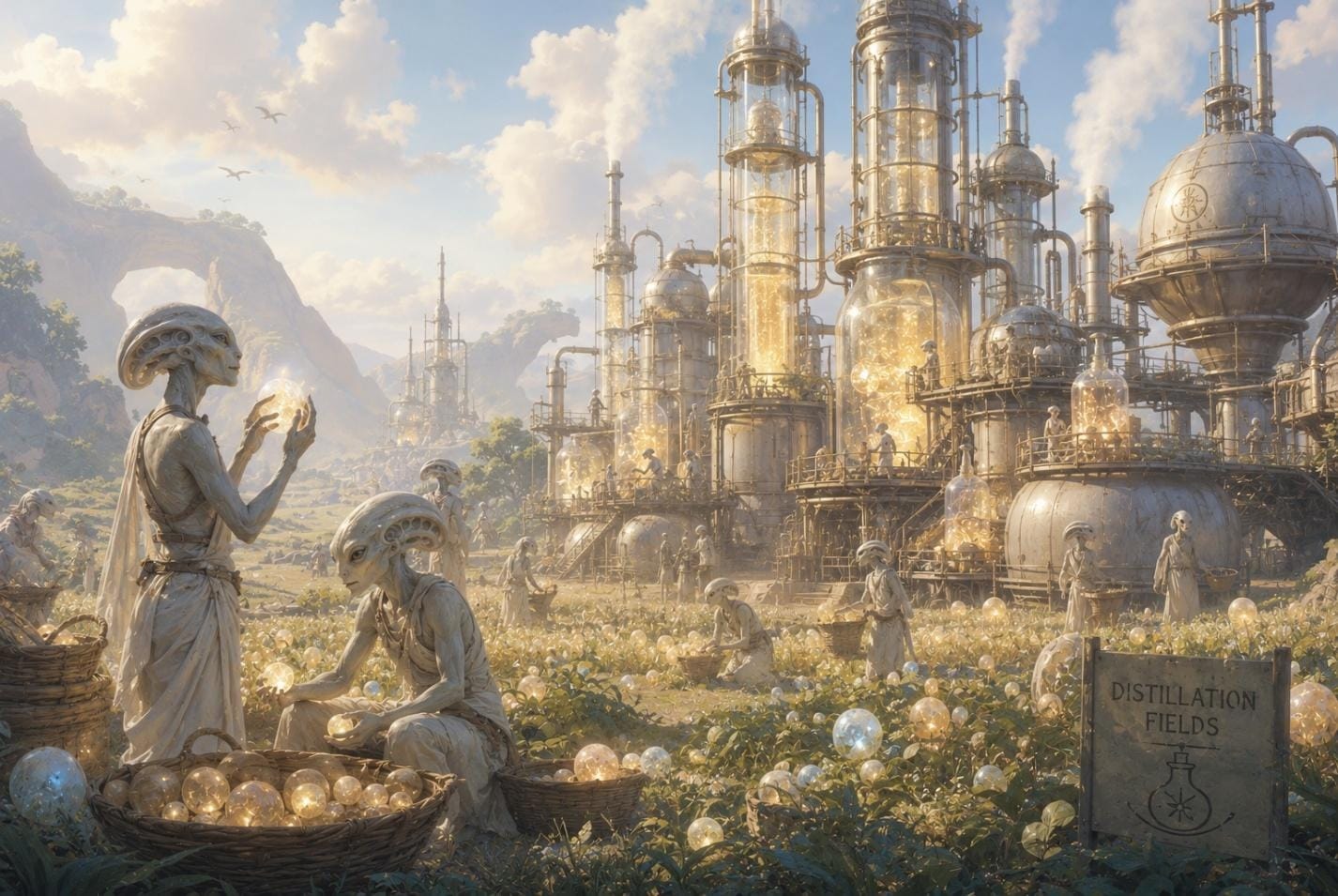
After inventing cold storage, the accumulation of information became cheap, and soon everything was packed into the same boxes. They built crawlers to cheaply search the terrain, and everything they collected was considered fruit. It all changed with the invention of the distillation tower, intaking complex carbohigh-bitrates and yielding simple sugars, making information abundant—too abundant—too quickly digested. Every nutritional value calculated, optimal calorie intake measured down to the minute, every kiosk and sales counter advertising knowledge measured by information per byte. Energy was on tap. Excitability rose.
But they soon noticed: when information inflates, wisdom withers. Everything grew flavorless. The figs turned to powder. Excitability didn’t lead to integration; knowledge without constraint didn’t lead one to alter their habits. With all bandwidth saturated, discernment became impossible; the profound sat beside the profane, insight next to the mundane. Context evaporated from the now dehydrated fruit. The very concept of a fig became an image; their grasp flattened knowledge, now thinned into content, and if content wasn’t eaten, it rotted and corrupted the landscape. They invented the fermentation vat to reintroduce culture, but it came with its own challenges. It digested information for them, cultivating bacterial communities to re-enrich the substrate. But the cultures often collapsed into monoculture and consumed all their sugar, leaving deserts where there were once desserts.
The very concept of a fig became an image; their grasp flattened knowledge, now thinned into content, and if content wasn’t eaten, it rotted and corrupted the landscape.
The churning of social digestion
Back in their village, each infovore had their own dietary restrictions and energetic needs. Their meals were always accompanied by collective conversation; without such communion, next year’s harvest would not pollinate, and their culture would not ferment. Their palettes welcomed the mild, the medium, and the spicy, as taste, for them, was a sense of epistemic valence. Each byte, more flavorful on a fasted stomach, perplexed as the newly discovered fruits made first contact with their guts.
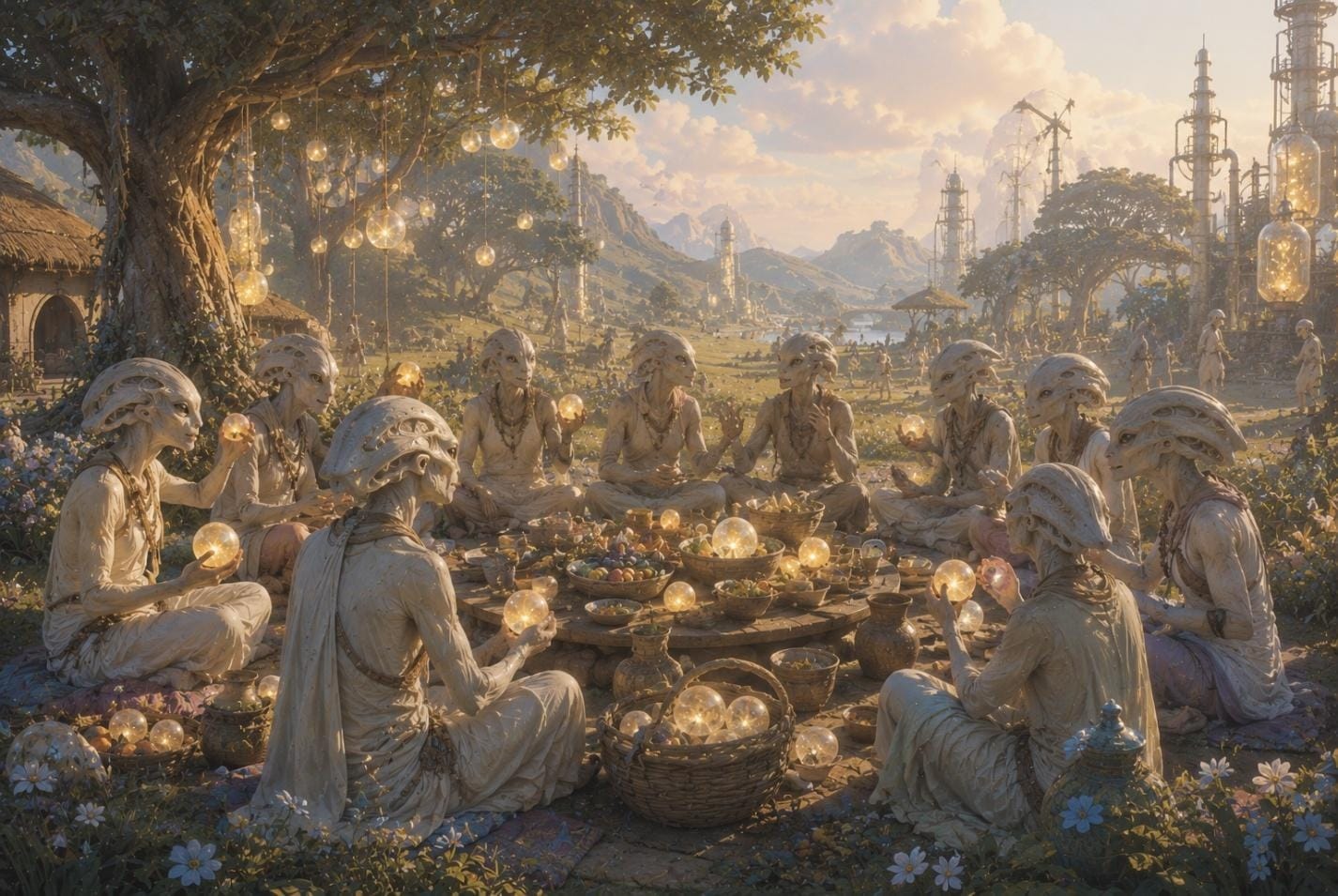
Perplexity is not merely uncertainty but a loosening of certainty—an opening that allows unfamiliar experience to enter without immediately being rejected. Such variety brings perplexity and to some, confusion: the sense impression immediately following taste, a feeling that arises just before it becomes a thought. Confusion contracts. It asks, How do I escape this? Perplexity expands. It asks, What is this asking of me?
Perplexity is the infovore's stomach acid. It dissolves the hard shell of first impressions so that meaning can be realized. For an infovore, nutrition and satiation are not found in consuming raw information. Information must be processed, integrated, and its waste shed—individually and collectively. Digestion does not happen in the stomach alone, for knowledge isn’t only metabolized conceptually. Such empty abstractions were often just stored as static content, becoming mental fat—reserves that are rarely called upon.
An infovore eventually discovers that the world is not merely something they touch, but something that touches them in return. Information cannot remain at arm's length, as it begins to infuse into the tissue with which they experience, crossing the intestinal wall of perception until it becomes lived capacity. Eventually it is unclear whether they are remembering or learning, as such embodied experience becomes muscle memory that is responsive, adaptive, and quietly available; no longer needing to be recalled with explicit conscious intent.
Information cannot remain at arm's length, as it begins to infuse into the tissue with which they experience, crossing the intestinal wall of perception until it becomes lived capacity.
Their bodies aren’t passive receptacles but wholes interwoven with other wholes, whole bodies of research, whole beings within the informational landscape. What crosses one membrane enters another.They cannot separate themselves from the information.
Information is not merely food; it is metabolized socially. Conversations enculturate the fermentation process within a living microbial ecology of perspectives, breaking down the tough fibers of experience that no single infovore could digest alone.
In the evenings, they metabolized information through somatic absorption; breath and dance became the tidal waves that churned their intestinal tracts. A requisite variety of energies and movements flourished a healthy microbiome that had no chance to form monoculture, monoliths, or monothoughts. Their bee-like dance signaled novel epistemologies, developmental stages, and traditions that continually enriched one another and interacted to break down complexity.
But the silence that followed into the night was the only way to dissolve such complexity. The slip into thoughtlessness, into structurelessness, into emptiness cleared the congestion and confusion, allowing them to break their fast once again and smell the morning breeze anew.
Hunger: The first organ of intelligence
The infovore does not wander the Forest of Knowledge because it wishes to accumulate fruit. It wanders because something in its world remains unfinished. Hunger is not the absence of information but the presence of concern; it is then no surprise that information abundance could never cure their misplaced hunger.
Long before an infovore knows what it seeks, it knows that it seeks. Hunger shapes attention, determining which scents are followed, which fruits stand out from the canopy, and which conversations linger long after the meal has ended. Every act of perception is already guided by appetite, an appetite to be refined through self-knowledge. Such an acquired taste makes no two infovores forage alike. Each carries different nutritional deficiencies, different gut cultures, different histories, and different responsibilities. The same fruit may nourish one while overwhelming another; knowing what not to eat becomes quite important.

The ontology weavers knew of this well, and fasted not to become empty for its own sake, but to remember what genuine hunger feels like, and where it directs attention. They were always both full and empty as they cycled their days and weeks through the 4 nutriments: The edible food, the food of Sense Impressions, the food of Volition, the food of Consciousness.
No one was any sweeter than the other. They knew knowledge was impermanent; if they grasped it, such clinging would only constipate. An information diet wasn’t an act of deprivation but of cultivation. Life feeds on negative entropy, and the quality of coherence was only felt after it metabolized into the intestinal walls, not a perceivable quantity displayed on the sales counter.
Discernment and digestion take time. Silence, solitude, long walks, sleep, breath, and unhurried conversation are not interruptions to learning. They are digestion itself, without which one becomes unable to distinguish hunger from craving, nourishment from stimulation. Information fasting empties irrelevant patterns, composts incomplete insights, purifies attention, and restores intellectual appetite.
Silence, solitude, long walks, sleep, breath, and unhurried conversation are not interruptions to learning. They are digestion itself...
Without fasting, sensemaking becomes gluttony. They need a digestive system to parse what to integrate into their identity and what to release. To take in too much too fast is to bloat; to cling to undigested fragments is to constipate the psyche; to process too little is to starve one’s agency. These are the thorny plants that come back every spring, the perennial problems.
The infovore's digestive system is more than a metaphor; it is a blueprint for a healthier epistemic culture—one where knowledge is not hoarded but lived, shared, and transformed. Knowledge survives only as metabolism: embodied, contextual, and relational. When we decontextualize, proliferate, or outsource cognition to attention-driven information systems, we erode the ecological conditions that make relevance, meaning, and wisdom possible.
Consciousness is undeniably metabolic, inviting infovores to dampen resource-intensive strategies of acquisition. A metabolic view reminds us that knowledge lives only in the present—in the warm data of relationships, continually integrated into lived experience, not preserved in cold storage.


Member discussion